Institut d'Investigació Biomèdica Sant Pau (IIB SANT PAU), 08041 Barcelona, Spain.
Departament de Bioquímica i Biologia Molecular, Universitat Autònoma De Barcelona, 08193 Barcelona, Spain.
Int J Mol Sci. 2022 Oct 18;23(20):12452. doi: 10.3390/ijms232012452.
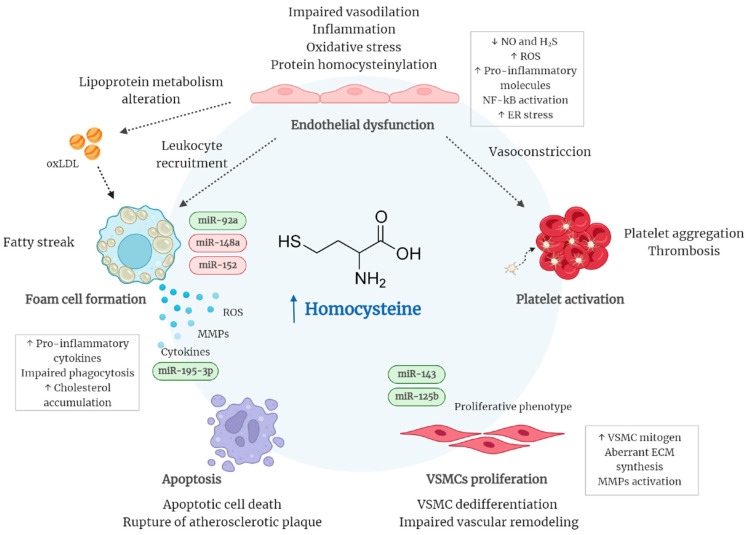
Increased serum levels of homocysteine (Hcy) is a risk factor for cardiovascular disease and is specifically linked to various diseases of the vasculature such as atherosclerosis. However, the precise mechanisms by which Hcy contributes to this condition remain elusive. During the development of atherosclerosis, epigenetic modifications influence gene expression. As such, epigenetic modifications are an adaptive response to endogenous and exogenous factors that lead to altered gene expression by methylation and acetylation reactions of different substrates and the action of noncoding RNA including microRNAs (miRNAs). Epigenetic remodeling modulates cell biology in both physiological and physiopathological conditions. DNA and histone modification have been identified to have a crucial role in the progression of atherosclerosis. However, the potential role of miRNAs in hyperHcy (HHcy)-related atherosclerosis disease remains poorly explored and might be essential as well. There is no review available yet summarizing the contribution of miRNAs to hyperhomocystein-mediated atherogenicity or their potential as therapeutic targets even though their important role has been described in numerous studies. Specifically, downregulation of miR-143 or miR-125b has been shown to regulate VSCMs proliferation in vitro. In preclinical studies, downregulation of miR-92 or miR195-3p has been shown to increase the accumulation of cholesterol in foam cells and increase macrophage inflammation and atherosclerotic plaque formation, respectively. Another preclinical study found that there is a reciprocal regulation between miR-148a/152 and DNMT1 in Hcy-accelerated atherosclerosis. Interestingly, a couple of studies have shown that miR-143 or miR-217 may be used as potential biomarkers in patients with HHcy that may develop atherosclerosis. Moreover, the current review will also update current knowledge on miRNA-based therapies, their challenges, and approaches to deal with Hcy-induced atherosclerosis.
同型半胱氨酸(Hcy)水平升高是心血管疾病的一个危险因素,与血管疾病如动脉粥样硬化等多种疾病密切相关。然而,Hcy 导致这种情况的确切机制仍不清楚。在动脉粥样硬化的发展过程中,表观遗传修饰会影响基因表达。因此,表观遗传修饰是一种对内外源性因素的适应性反应,导致不同底物的甲基化和乙酰化反应以及非编码 RNA(包括 microRNAs,miRNAs)的基因表达发生改变。表观遗传重塑调节生理和病理生理条件下的细胞生物学。已确定 DNA 和组蛋白修饰在动脉粥样硬化的进展中起关键作用。然而,miRNAs 在高同型半胱氨酸(HHcy)相关动脉粥样硬化疾病中的潜在作用仍未得到充分探索,其作用可能也很重要。目前还没有综述总结 miRNA 在高同型半胱氨酸介导的动脉粥样硬化发病机制中的作用,尽管在许多研究中已描述了它们的重要作用,但 miRNA 作为治疗靶点的潜在作用尚未得到研究。具体而言,miR-143 或 miR-125b 的下调已被证明可调节 VSCMs 的体外增殖。在临床前研究中,miR-92 或 miR195-3p 的下调已被证明可分别增加泡沫细胞中胆固醇的积累、增加巨噬细胞炎症和动脉粥样硬化斑块形成。另一项临床前研究发现,miR-148a/152 和 DNMT1 之间存在 Hcy 加速动脉粥样硬化的相互调节。有趣的是,有几项研究表明,miR-143 或 miR-217 可能作为可能发生动脉粥样硬化的 HHcy 患者的潜在生物标志物。此外,本综述还将更新基于 miRNA 的治疗方法、它们的挑战以及应对 Hcy 诱导的动脉粥样硬化的方法的最新知识。