
低气压低氧暴露引起的肺动脉高压和水肿中的炎症反应。
Inflammation in Pulmonary Hypertension and Edema Induced by Hypobaric Hypoxia Exposure.
机构信息
Institute of Health Studies, Arturo Prat University, Iquique 1100000, Chile.
Institute DECIPHER, German-Chilean Institute for Research on Pulmonary Hypoxia and Its Health Sequelae, Hamburg (Germany) and Iquique (Chile), Avenida Arturo Prat 2120, Iquique 1110939, Chile.
出版信息
Int J Mol Sci. 2022 Oct 21;23(20):12656. doi: 10.3390/ijms232012656.
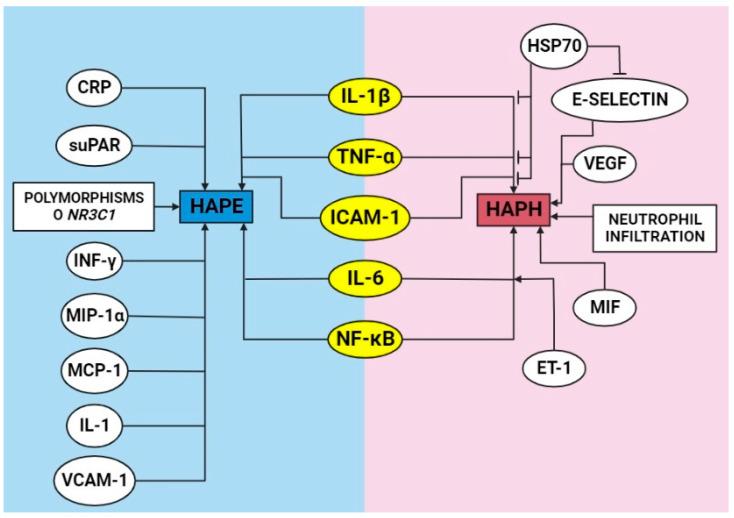
Exposure to high altitudes generates a decrease in the partial pressure of oxygen, triggering a hypobaric hypoxic condition. This condition produces pathophysiologic alterations in an organism. In the lung, one of the principal responses to hypoxia is the development of hypoxic pulmonary vasoconstriction (HPV), which improves gas exchange. However, when HPV is exacerbated, it induces high-altitude pulmonary hypertension (HAPH). Another important illness in hypobaric hypoxia is high-altitude pulmonary edema (HAPE), which occurs under acute exposure. Several studies have shown that inflammatory processes are activated in high-altitude illnesses, highlighting the importance of the crosstalk between hypoxia and inflammation. The aim of this review is to determine the inflammatory pathways involved in hypobaric hypoxia, to investigate the key role of inflammation in lung pathologies, such as HAPH and HAPE, and to summarize different anti-inflammatory treatment approaches for these high-altitude illnesses. In conclusion, both HAPE and HAPH show an increase in inflammatory cell infiltration (macrophages and neutrophils), cytokine levels (IL-6, TNF-α and IL-1β), chemokine levels (MCP-1), and cell adhesion molecule levels (ICAM-1 and VCAM-1), and anti-inflammatory treatments (decreasing all inflammatory components mentioned above) seem to be promising mitigation strategies for treating lung pathologies associated with high-altitude exposure.
暴露于高海拔地区会导致氧气分压降低,引发低氧环境。这种情况会导致机体发生病理生理改变。在肺部,对缺氧的主要反应之一是产生低氧性肺血管收缩(HPV),这可以改善气体交换。然而,当 HPV 加剧时,会导致高原性肺动脉高压(HAPH)。低氧环境下的另一种重要疾病是高原肺水肿(HAPE),它在急性暴露下发生。多项研究表明,炎症过程在高原疾病中被激活,突出了缺氧和炎症之间相互作用的重要性。本综述旨在确定低氧环境中涉及的炎症途径,研究炎症在 HAPH 和 HAPE 等肺部疾病中的关键作用,并总结针对这些高原病的不同抗炎治疗方法。总之,HAPE 和 HAPH 均显示炎症细胞浸润(巨噬细胞和中性粒细胞)、细胞因子水平(IL-6、TNF-α 和 IL-1β)、趋化因子水平(MCP-1)和细胞黏附分子水平(ICAM-1 和 VCAM-1)增加,抗炎治疗(降低上述所有炎症成分)似乎是治疗与高原暴露相关的肺部疾病的有前途的缓解策略。


 Zotero 插件