Bilim Vladimir, Kuroki Hiroo, Shirono Yuko, Murata Masaki, Hiruma Kaede, Tomita Yoshihiko
Department of Urology, Division of Molecular Oncology, Graduate School of Medical and Dental Sciences, Niigata University, 1-757 Asahimachi-dori, Chuo-ku, Niigata 951-8510, Japan.
Kameda Daiichi Hospital, Niigata 950-0165, Japan.
J Pers Med. 2022 Oct 20;12(10):1745. doi: 10.3390/jpm12101745.
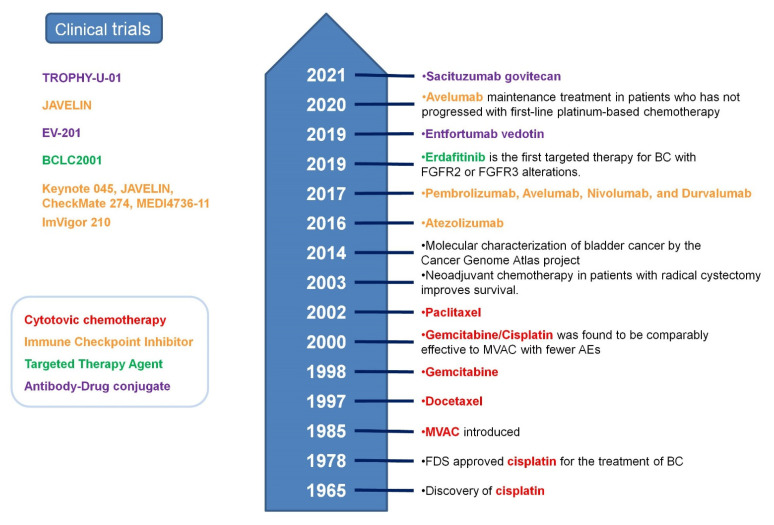
Bladder cancer is the 10th most common cancer type in the world. There were more than 573,000 new cases of bladder cancer in 2020. It is the 13th most common cause of cancer death with an estimated more than 212,000 deaths worldwide. Low-grade non-muscle-invasive bladder cancer (NMIBC) is usually successfully managed with transurethral resection (TUR) and overall survival for NMIBC reaches 90% according to some reports. However, long-term survival for muscle-invasive bladder cancer (MIBC) and metastatic bladder cancer remains low. Treatment options for bladder cancer have undergone a rapid change in recent years. Immune checkpoint inhibitors (ICI), targeted therapies, and antibody-drug conjugates are available now. As bladder cancer is genetically heterogeneous, the optimization of patient selection to identify those most likely to benefit from a specific therapy is an urgent issue in the treatment of patients with bladder cancer.
膀胱癌是全球第10大常见癌症类型。2020年,膀胱癌新增病例超过57.3万例。它是第13大常见癌症死亡原因,全球估计有超过21.2万人死亡。低级别非肌层浸润性膀胱癌(NMIBC)通常通过经尿道切除术(TUR)成功治疗,据一些报道,NMIBC的总生存率达到90%。然而,肌层浸润性膀胱癌(MIBC)和转移性膀胱癌的长期生存率仍然很低。近年来,膀胱癌的治疗选择发生了迅速变化。现在有免疫检查点抑制剂(ICI)、靶向治疗和抗体药物偶联物。由于膀胱癌在基因上具有异质性,优化患者选择以确定那些最有可能从特定治疗中获益的患者,是膀胱癌患者治疗中的一个紧迫问题。