
通过胶结磷石膏回填体渗流导致的污染物释放:与料浆制备规程的关联
The Release of Pollutants through the Bleeding of Cemented Phosphogypsum Backfill: Link to Protocols for Slurry Preparation.
作者信息
Min Chendi, Shi Ying, Zhou Yanan, Liu Zhixiang
机构信息
School of Resources and Safety Engineering, Central South University, Changsha 410083, China.
出版信息
Materials (Basel). 2022 Oct 13;15(20):7126. doi: 10.3390/ma15207126.
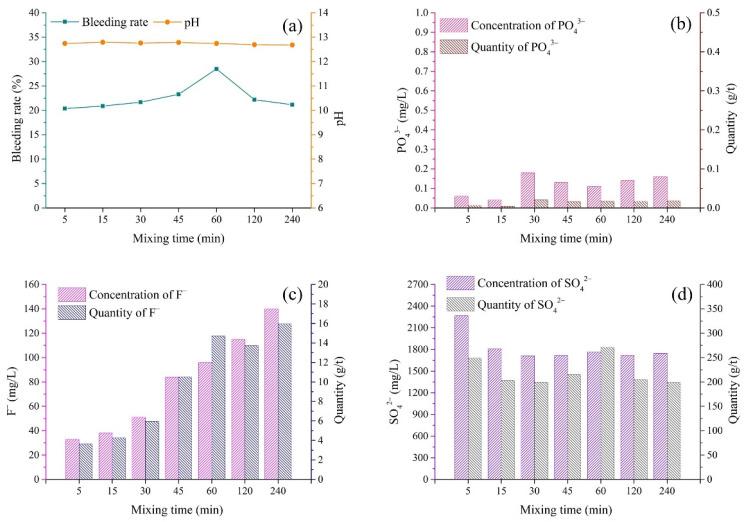
The present study investigated the effects of protocols for slurry preparation on the release of pollutants into bleeding water from cemented phosphogypsum (PG) backfill. Backfill slurry was prepared using four different protocols in which different parameters varied, including binder/PG ratio, solid concentration, binder type and mixing procedure. The concentrations of phosphate, fluoride and sulfate and the pH values of the obtained bleeding water were measured. The results demonstrated that the slurry preparation protocols affected the quantities of pollutants through the concentrations of pollutants in bleeding water and the bleeding rate. On the one hand, the binder/PG ratio was the key factor influencing the concentrations of all pollutants in bleeding water. Comparatively speaking, the binder type and mixing procedure had an obvious influence on the fluoride concentration but had little influence on the phosphate and sulfate concentrations in the bleeding water. On the other hand, the protocols for slurry preparation affected the bleeding rate by determining the water retention and water content of the backfill slurry. The most effective protocol for slurry preparation for cemented PG backfill could reduce the bleeding rate and enhance the immobilization of pollutants, minimizing the phosphate concentration in bleeding water to below 0.2 mg/L. However, it appeared that the fluoride concentration was still tens of milligrams per liter (over the limit of 10 ten milligrams per liter), to which attention should be paid.
本研究调查了胶结磷石膏(PG)回填材料制备料浆的方案对渗滤水中污染物释放的影响。使用四种不同方案制备回填料浆,其中不同参数发生变化,包括粘结剂/PG比例、固体浓度、粘结剂类型和混合程序。测量了所得渗滤水中磷酸盐、氟化物和硫酸盐的浓度以及pH值。结果表明,料浆制备方案通过渗滤水中污染物的浓度和渗滤速率影响污染物的量。一方面,粘结剂/PG比例是影响渗滤水中所有污染物浓度的关键因素。相对而言,粘结剂类型和混合程序对渗滤水中氟化物浓度有明显影响,但对磷酸盐和硫酸盐浓度影响较小。另一方面,料浆制备方案通过确定回填料浆的保水性和含水量来影响渗滤速率。用于胶结PG回填材料的最有效料浆制备方案可以降低渗滤速率并增强污染物的固定化,将渗滤水中的磷酸盐浓度降至0.2毫克/升以下。然而,氟化物浓度似乎仍为每升数十毫克(超过10毫克/升的限值),对此应予以关注。




 Zotero 插件