Yu Gengyuan, Zhang Tonghua, Xu Haoran, Bi Yuelin, Feng Xin, Wang Jiaqi, Li Tianyi, Zhang Chenning, Sun Yikun
School of Chinese Materia Medica, Beijing University of Chinese Medicine, Beijing, China.
Department of Pharmacy, Xiangyang No. 1 People's Hospital, Hubei University of Medicine, Xiangyang, China.
Evid Based Complement Alternat Med. 2022 Oct 17;2022:1487903. doi: 10.1155/2022/1487903. eCollection 2022.
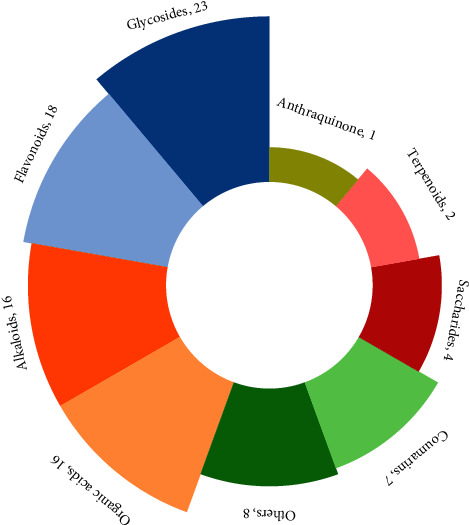
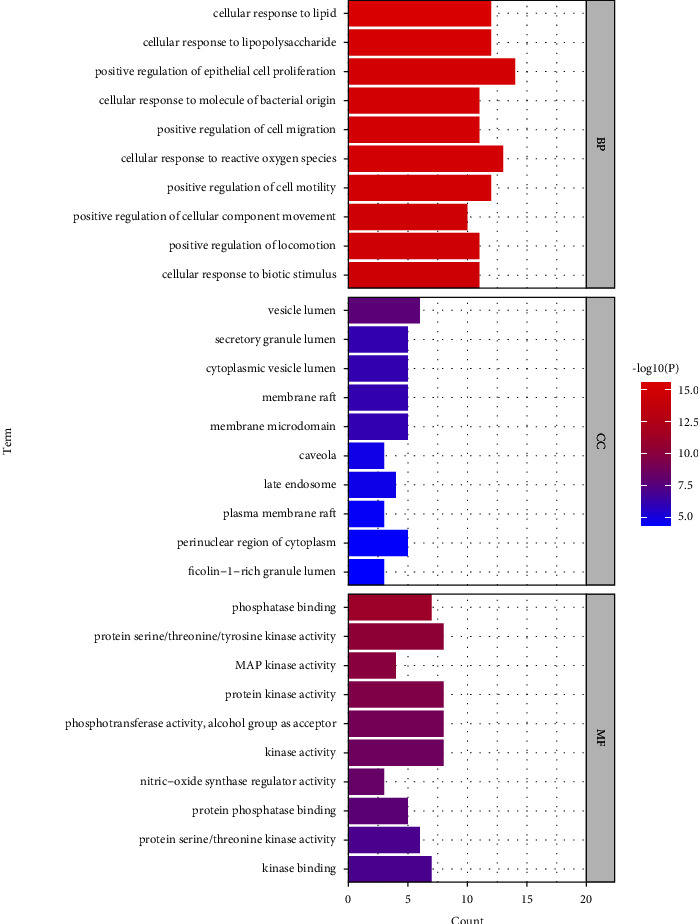
San-Jiu-Wei-Tai granules (SJWTG) are a significant Chinese patent medicine for the treatment of chronic gastritis (CG), having outstanding advantages in long-term treatment; however, the chemical composition and potential mechanism have not been investigated until now. In this study, a rapid separation and identification method based on UPLC-QE-Orbitrap-MS was established, and 95 chemical components from SJWTGs were identified, including 6 chemical components of an unknown source that are not derived from the 8 herbs included in SJWTGs. The identified chemical components were subsequently analysed by network pharmacology, suggesting that the core targets for the treatment of CG with SJWTGs were EGFR, SRC, AKT1, HSP90AA1, MAPK1, and MAPK3 and thus indicating that SJWTGs could reduce the inflammatory response of gastric epithelial cells and prevent persistent chronic inflammation that induces cancerization by regulating the MAPK signalling pathway and the C-type lectin receptor signalling pathway as well as their upstream and downstream pathways in the treatment of CG. The key bioactive components in SJWTGs were identified as 2,6-bis(4-ethylphenyl)perhydro-1,3,5,7-tetraoxanaphth-4-ylethane-1,2-diol, a chemical component of an unknown source, murrangatin, meranzin hydrate, paeoniflorin, and albiflorin. The results of molecular docking showed the strong binding interaction between the key bioactive components and the core targets, demonstrating that the key bioactive components deserve to be further studied and considered as Q-markers. By acting on multiple targets, SJWTG is less susceptible to drug resistance during the long-term treatment of CG, indicating the advantage of Chinese patent medicines. Furthermore, the preventive effect of SJWTGs on gastric cancer also demonstrates the superiority of preventive treatment of disease with traditional Chinese medicine.
三九胃泰颗粒(SJWTG)是治疗慢性胃炎(CG)的一种重要中成药,在长期治疗方面具有突出优势;然而,其化学成分和潜在作用机制至今尚未得到研究。本研究建立了一种基于超高效液相色谱-四极杆-轨道阱质谱联用(UPLC-QE-Orbitrap-MS)的快速分离鉴定方法,从三九胃泰颗粒中鉴定出95种化学成分,其中包括6种来源不明且并非源自三九胃泰颗粒所含8味药材的化学成分。随后通过网络药理学对鉴定出的化学成分进行分析,结果表明三九胃泰颗粒治疗慢性胃炎的核心靶点为表皮生长因子受体(EGFR)、原癌基因酪氨酸蛋白激酶(SRC)、蛋白激酶B(AKT1)、热休克蛋白90α家族成员1(HSP90AA1)、丝裂原活化蛋白激酶1(MAPK1)和丝裂原活化蛋白激酶3(MAPK3),这表明三九胃泰颗粒在治疗慢性胃炎时可通过调节丝裂原活化蛋白激酶信号通路和C型凝集素受体信号通路及其上下游通路,减轻胃上皮细胞的炎症反应,预防导致癌变的持续性慢性炎症。三九胃泰颗粒中的关键生物活性成分被鉴定为2,6-双(4-乙基苯基)全氢-1,3,5,7-四氧杂萘-4-基乙烷-1,2-二醇(一种来源不明的化学成分)、刺桐查耳酮、水合橙皮内酯、芍药苷和 albiflorin。分子对接结果显示关键生物活性成分与核心靶点之间具有强烈的结合相互作用,表明这些关键生物活性成分值得进一步研究并可考虑作为Q-标志物。通过作用于多个靶点,三九胃泰颗粒在慢性胃炎的长期治疗中不易产生耐药性,体现了中成药的优势。此外,三九胃泰颗粒对胃癌的预防作用也证明了中医对疾病进行预防性治疗的优越性。