Department of Neurology, Oregon Health & Science University, 3181 SW Sam Jackson Park Rd, OP-32, Portland, OR, 97239, USA.
APDM Wearable Technologies, Clario Company, 2828 S Corbett Ave, #135, Portland, OR, 97201, USA.
Geroscience. 2023 Apr;45(2):823-836. doi: 10.1007/s11357-022-00675-4. Epub 2022 Oct 27.
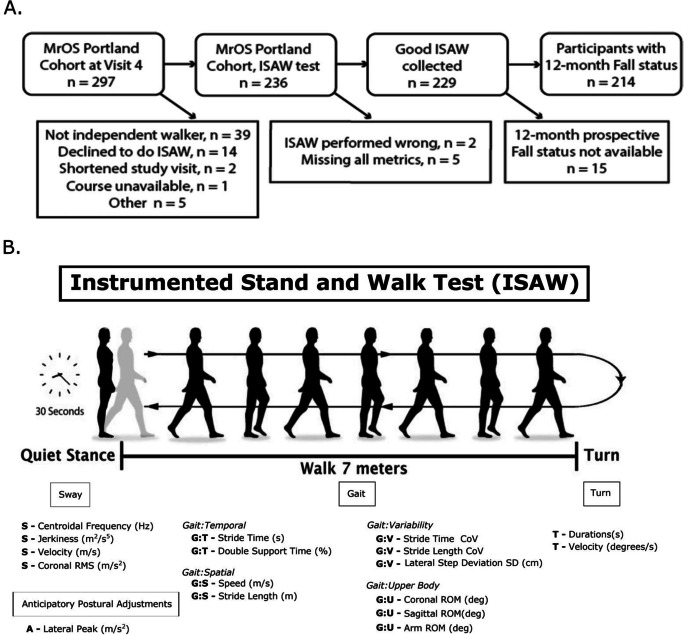
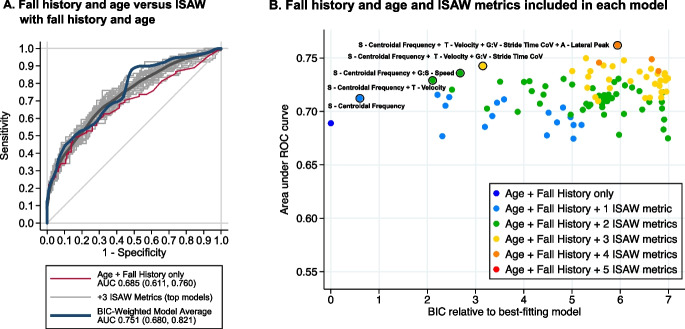
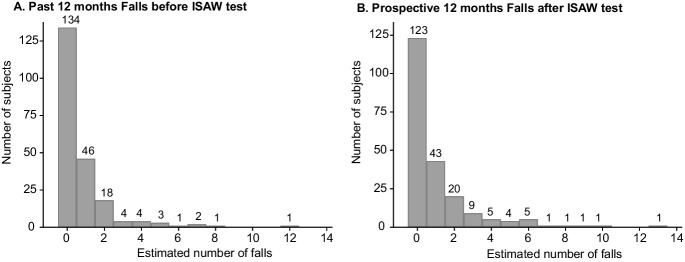
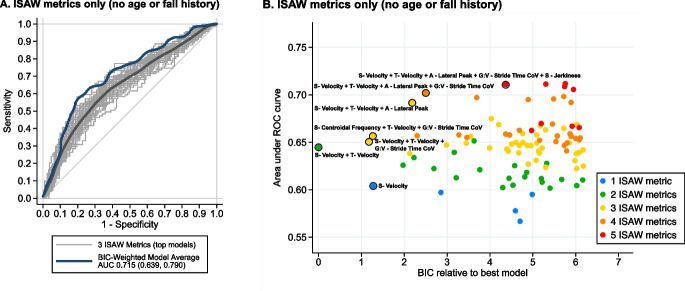
Objective measures of balance and gait have the potential to improve prediction of future fallers because balance and gait impairments are common precursors. We used the Instrumented Stand and Walk Test (ISAW) with wearable, inertial sensors to maximize the domains of balance and gait evaluated in a short test. We hypothesized that ISAW objective measures across a variety of gait and balance domains would improve fall prediction beyond history of falls and better than gait speed or dual-task cost on gait-speed. We recruited 214 high-functioning older men (mean 82 years), of whom 91 participants (42.5%) had one or more falls in the 12 months following the ISAW test. The ISAW test involved 30 s of stance followed by a 7-m walk, turn, and return. We examined regression models for falling using 17 ISAW metrics, with and without age and fall history, and characterize top-performing models by AUC and metrics included. The ISAW test improved distinguishing between future fallers and non-fallers compared to age and history of falls, alone (AUC improved from 0.69 to 0.75). Models with 1 ISAW metric usually included a postural sway measure, models with 2 ISAW measures included a turning measure, models with 3 ISAW measures included a gait variability measure, and models with 4 or 5 measures added a gait initiation measure. Gait speed and dual-task cost did not distinguish between fallers and non-fallers in this high-functioning cohort. The best fall-prediction models support the notion that older people may fall due to a variety of balance and gait impairments.
客观的平衡和步态测量方法有可能提高对未来跌倒者的预测能力,因为平衡和步态受损是常见的前兆。我们使用带有可穿戴惯性传感器的仪器站立和行走测试(ISAW),最大限度地评估了短时间测试中的平衡和步态领域。我们假设,在各种步态和平衡领域中,ISAW 的客观测量指标将改善跌倒预测,超过跌倒史,并优于步态速度或步态双重任务成本。我们招募了 214 名身体机能良好的老年男性(平均年龄 82 岁),其中 91 名参与者(42.5%)在 ISAW 测试后的 12 个月内发生了一次或多次跌倒。ISAW 测试包括 30 秒的站立,然后进行 7 米的行走、转弯和返回。我们检查了使用 17 项 ISAW 指标进行跌倒的回归模型,包括有无年龄和跌倒史,并通过 AUC 和包含的指标来描述表现最佳的模型。与单独使用年龄和跌倒史相比,ISAW 测试改善了对未来跌倒者和非跌倒者的区分能力(AUC 从 0.69 提高到 0.75)。具有 1 项 ISAW 指标的模型通常包括姿势摆动测量指标,具有 2 项 ISAW 指标的模型包括转弯测量指标,具有 3 项 ISAW 指标的模型包括步态变化测量指标,而具有 4 项或 5 项指标的模型则增加了步态起始测量指标。在这个身体机能良好的队列中,步态速度和双重任务成本无法区分跌倒者和非跌倒者。最佳跌倒预测模型支持老年人可能因各种平衡和步态损伤而跌倒的观点。