Institute of Immunology, Charité Universitätsmedizin, corporate member of Freie Universität Berlin and Humboldt-Universität zu Berlin, Berlin, Germany.
German Cancer Research Center, Heidelberg, Germany.
J Immunother Cancer. 2022 Oct;10(10). doi: 10.1136/jitc-2022-005535.
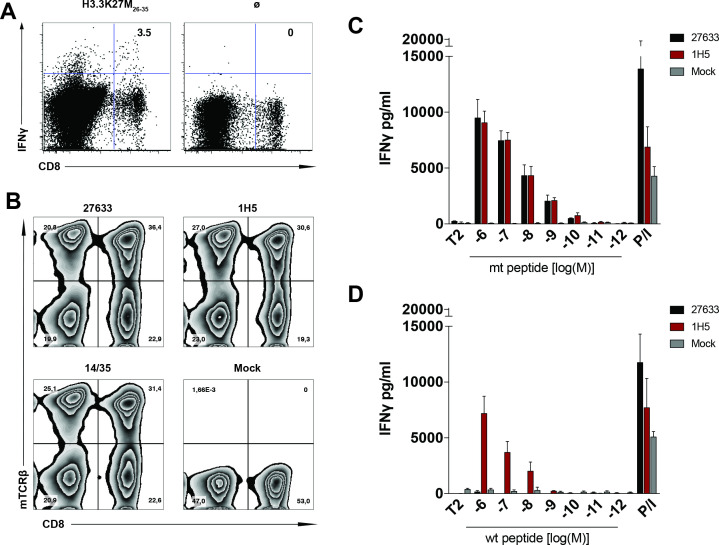
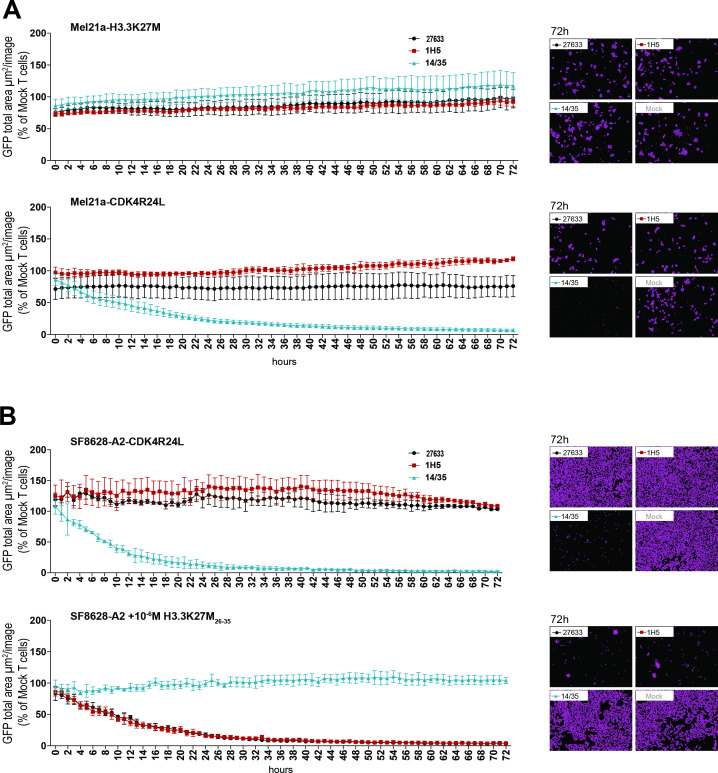
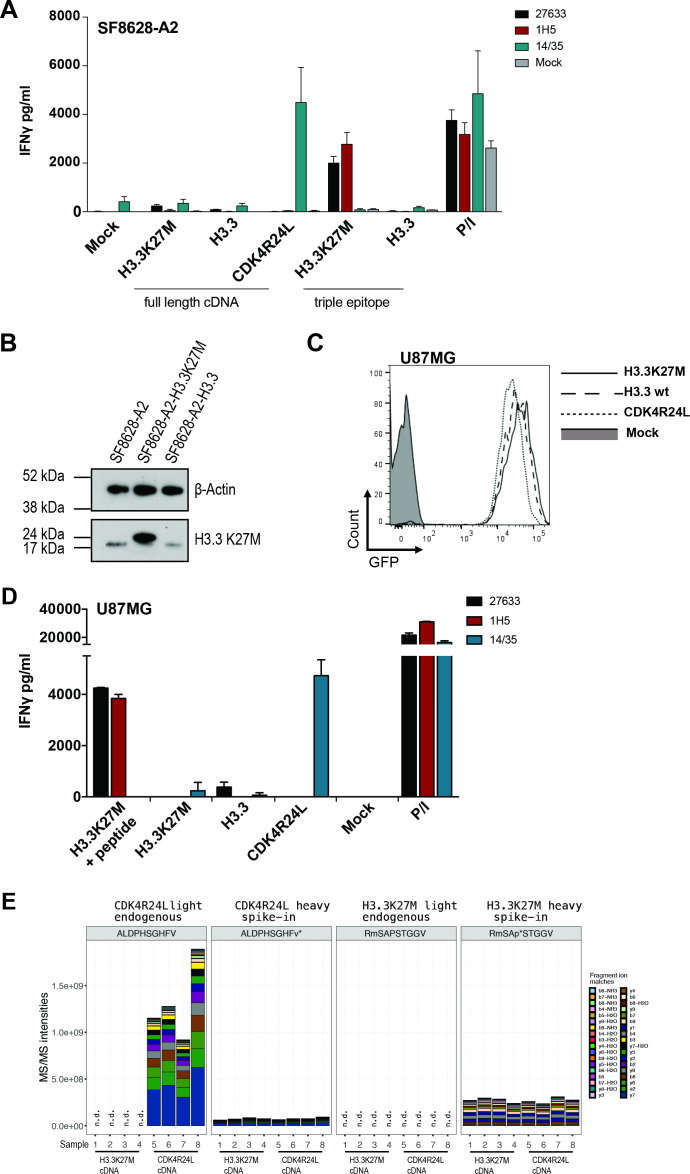
Diffuse midline glioma is the leading cause of solid cancer-related deaths in children with very limited treatment options. A majority of the tumors carry a point mutation in the histone 3 variant (H3.3) creating a potential HLA-A02:01 binding epitope (H3.3K27M). Here, we isolated an H3.3K27M-specific T cell receptor (TCR) from transgenic mice expressing a diverse human TCR repertoire. Despite a high functional avidity of H3.3K27M-specific T cells, we were not able to achieve recognition of cells naturally expressing the H3.3K27M mutation, even when overexpressed as a transgene. Similar results were obtained with T cells expressing the published TCR 1H5 against the same epitope. CRISPR/Cas9 editing was used to exclude interference by endogenous TCRs in donor T cells. Overall, our data provide strong evidence that the H3.3K27M mutation is not a suitable target for cancer immunotherapy, most likely due to insufficient epitope processing and/or amount to be recognized by HLA-A02:01 restricted CD8 T cells.
弥漫性中线胶质瘤是儿童实体瘤相关死亡的主要原因,其治疗选择非常有限。大多数肿瘤携带组蛋白 3 变体(H3.3)的点突变,从而产生潜在的 HLA-A02:01 结合表位(H3.3K27M)。在这里,我们从表达多样化人类 TCR 库的转基因小鼠中分离出了一种 H3.3K27M 特异性 T 细胞受体(TCR)。尽管 H3.3K27M 特异性 T 细胞具有很高的功能亲和力,但我们无法识别自然表达 H3.3K27M 突变的细胞,即使将其作为转基因过表达也是如此。用表达针对相同表位的已发表 TCR 1H5 的 T 细胞也得到了类似的结果。CRISPR/Cas9 编辑用于排除供体细胞 T 细胞中内源性 TCR 的干扰。总体而言,我们的数据提供了强有力的证据表明,H3.3K27M 突变不是癌症免疫治疗的合适靶点,这很可能是由于 HLA-A02:01 限制的 CD8 T 细胞识别的表位加工和/或数量不足。