Foundation Medicine Inc, Cambridge, Massachusetts, USA
Foundation Medicine Inc, Cambridge, Massachusetts, USA.
J Immunother Cancer. 2022 Oct;10(10). doi: 10.1136/jitc-2022-005573.
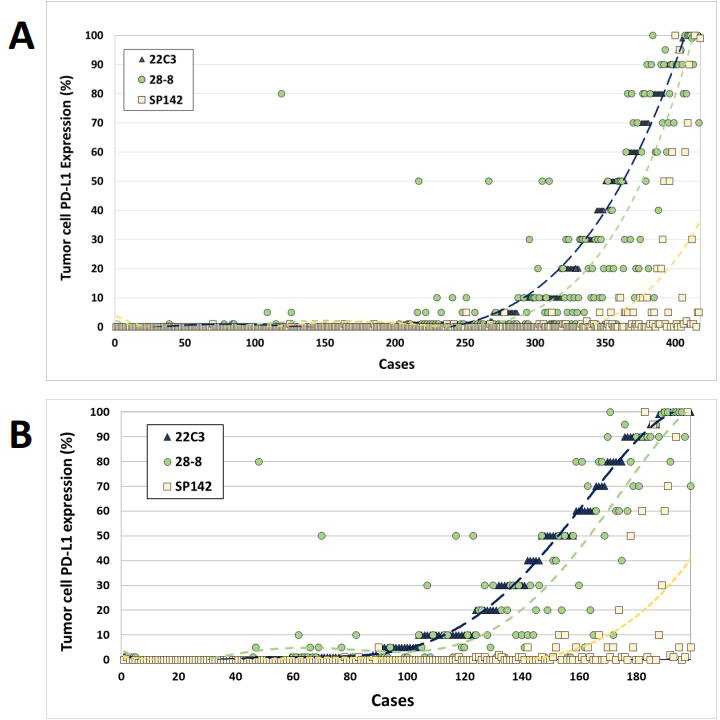
Multiple PD-L1 immunohistochemistry (IHC) assays, including DAKO 22C3, DAKO 28-8, and Ventana SP142 PD-L1 IHC assays, have been approved by the Food and Drug Administration as a companion diagnostic (CDx) for various antiprogrammed death-1 and antiprogrammed death ligand 1 (PD-L1) based cancer immunotherapies. Here we present 22C3, 28-8, and SP142 analysis of 418 tumor specimens encountered in routine clinical practice.
All specimens were tested with 22C3, 28-8, and SP142 assays following the manufacturer's established staining protocols.
The same PD-L1 status (defined as tumor cell expression (TC) scores with all three assays ≥1% or all <1%) was observed in 60.0% (251/418) tumor specimens (45.9% (192/418) were triple negative and 14.1% (59/418) were triple positive). A total of 54.1% (226/418) tumor cases were positive with at least one IHC assay (94.2% (213/226), 77.0% (174/226), and 28.8% (65/226) of these were positive for 22C3, 28-8 and SP142, respectively). Among the 40.0% (167/418) tumor cases that showed a different PD-L1 status, 62.3% (104/167) were 22C3+/28-8+/SP142-, and 28.7% (48/167) were 22C3+/28-8-/SP142-. The same PD-L1 status with all three antibody clones was observed in 48.7% (97/199) of NSCLC cases, and among these, 54.6% (53/97) were triple negative and 45.4% (44/97) triple positive. A total of 73.4% (146/199) NSCLC cases were positive with at least one IHC assay (95.2% (n=139/146), 82.2% (n=120/146), and 32.2% (n=47/146) were positive for 22C3, 28-8, and SP142, respectively). Among the 51.3% (102/199) NSCLC cases that showed a different status among the three IHC assays, 67.6% (69/102) were 22C3+/28-8+/SP142-, and 23.5% (24/102) were 22C3+/28-8-/SP142-. A total of 81.1% (43/53) lung squamous cell carcinoma, 72.1% (88/122) of lung adenocarcinoma, 69.6% (16/23) of non-small cell lung cancer (NSCLC) not otherwise specified (NOS), and 50.0% (4/8) of small cell lung carcinoma cases were positive with at least one IHC assay.
Our data suggest that 22C3 is the most sensitive PD-L1 IHC assay for tumor cell expression, followed by 28-8 and in turn by SP-142. These findings represent an additional factor for clinical teams to consider when deciding which PD-L1 IHC assay (and in turn which CDx-associated PD-L1 based immunotherapy) is most appropriate for each individual patient.
包括 DAKO 22C3、DAKO 28-8 和 Ventana SP142 PD-L1 IHC 检测在内的多种 PD-L1 免疫组化(IHC)检测已被美国食品和药物管理局(FDA)批准作为各种抗程序性死亡-1 和抗程序性死亡配体 1(PD-L1)基于癌症免疫疗法的伴随诊断(CDx)。在此,我们展示了在常规临床实践中遇到的 418 个肿瘤标本的 22C3、28-8 和 SP142 分析。
所有标本均按照制造商规定的染色方案,用 22C3、28-8 和 SP142 检测进行检测。
60.0%(251/418)的肿瘤标本(45.9%(192/418)为三阴性,14.1%(59/418)为三阳性)具有相同的 PD-L1 状态(定义为所有三种检测方法的肿瘤细胞表达(TC)评分均≥1%或均<1%)。共有 54.1%(226/418)的肿瘤病例至少有一种 IHC 检测呈阳性(94.2%(213/226)、77.0%(174/226)和 28.8%(65/226)分别为 22C3、28-8 和 SP142 阳性)。在 40.0%(167/418)表现出不同 PD-L1 状态的肿瘤病例中,62.3%(104/167)为 22C3+/28-8+/SP142-,28.7%(48/167)为 22C3+/28-8-/SP142-。在 48.7%(97/199)的非小细胞肺癌(NSCLC)病例中,三种抗体克隆均具有相同的 PD-L1 状态,其中 54.6%(53/97)为三阴性,45.4%(44/97)为三阳性。共有 73.4%(146/199)的 NSCLC 病例至少有一种 IHC 检测呈阳性(95.2%(n=139/146)、82.2%(n=120/146)和 32.2%(n=47/146)分别为 22C3、28-8 和 SP142 阳性)。在三种 IHC 检测显示不同状态的 51.3%(102/199)的 NSCLC 病例中,67.6%(69/102)为 22C3+/28-8+/SP142-,23.5%(24/102)为 22C3+/28-8-/SP142-。81.1%(43/53)的肺鳞状细胞癌、72.1%(88/122)的肺腺癌、69.6%(16/23)的非小细胞肺癌(NOS)和 50.0%(4/8)的小细胞肺癌病例至少有一种 IHC 检测呈阳性。
我们的数据表明,22C3 是最敏感的肿瘤细胞表达 PD-L1 IHC 检测方法,其次是 28-8,然后是 SP-142。这些发现代表了临床团队在决定哪种 PD-L1 IHC 检测(进而哪种与 CDx 相关的基于 PD-L1 的免疫疗法)最适合每个患者时需要考虑的另一个因素。