Xiao Min, Yang Song, Zhou An, Li Tongxin, Liu Jingjing, Chen Yang, Luo Ya, Qian Chunfang, Yang Fuping, Tang Bo, Li Chunhua, Su Na, Li Jing, Jiang Mingying, Yang Shiming, Lin Hui
Department of Gastroenterology, Xinqiao Hospital, Army Medical University, Chongqing, China.
Chongqing Public Health Medical Center, Southwest University, Chongqing, China.
Front Microbiol. 2022 Oct 11;13:1020542. doi: 10.3389/fmicb.2022.1020542. eCollection 2022.
MicroRNAs (miRNAs) play a vital role in tuberculosis (TB). Vitamin D receptor (VDR), an miRNA target gene, and its ligand, vitamin D (VitD), have been reported to exert protective effects against TB. However, whether miRNAs can affect the progression of TB by targeting VDR has not been reported.
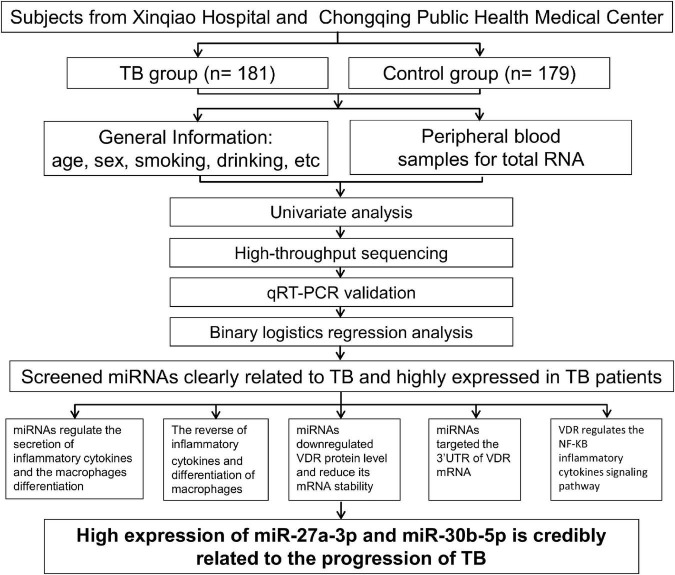
Research subjects were selected according to defined inclusion criteria. A clinical database of 360 samples was established, including the subjects' demographic information, miRNA expression profiles and cellular experimental results. Two candidate miRNAs, miR-27a-3p, and miR-30b-5p, were identified by a high-throughput sequencing screen and validated by qRT-PCR assays. Univariate and multivariate statistical analyses were performed. VDR and NF-kB p65 protein levels were detected by Western blot assays. Proinflammatory cytokine expression levels were detected by enzyme-linked immunosorbent assay (ELISA). Luciferase assays and fluorescence-activated cell sorting (FACS) were further applied to elucidate the detailed mechanisms.
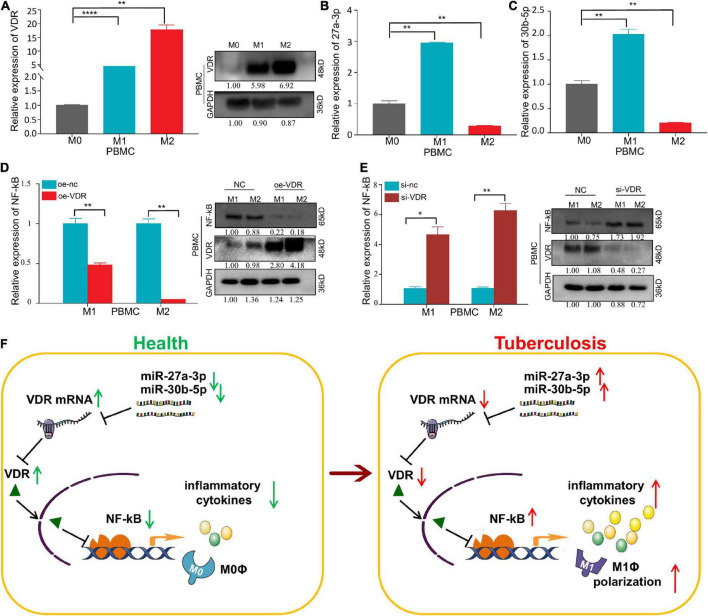
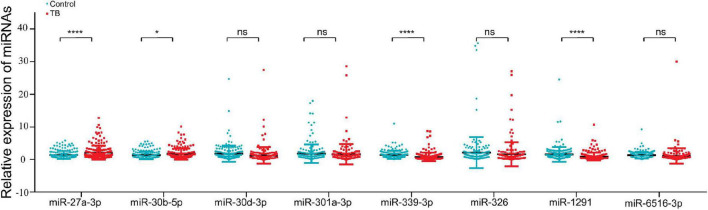
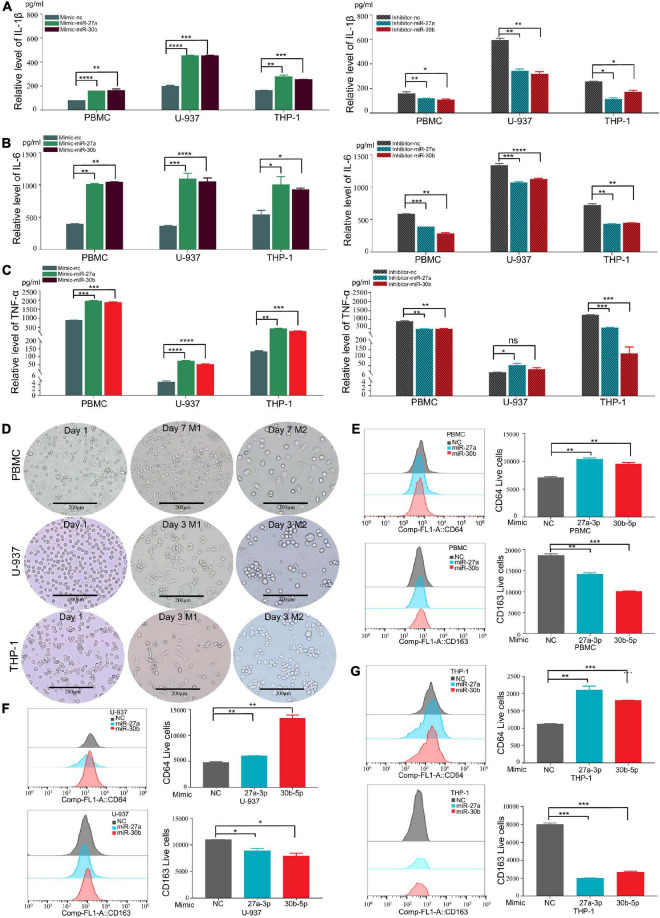
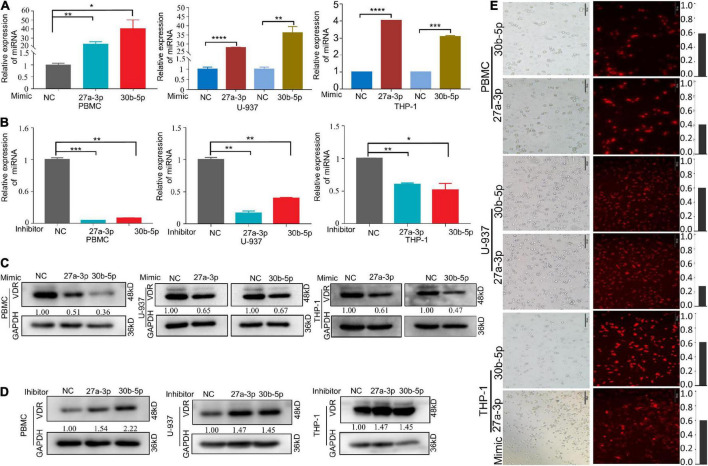
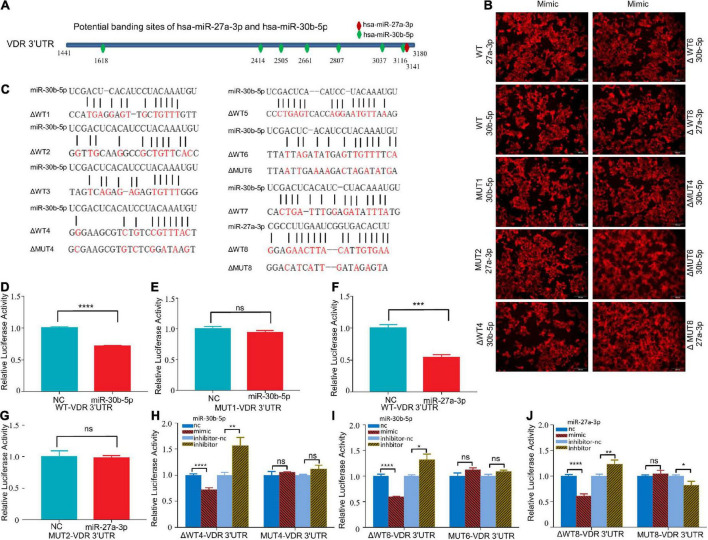
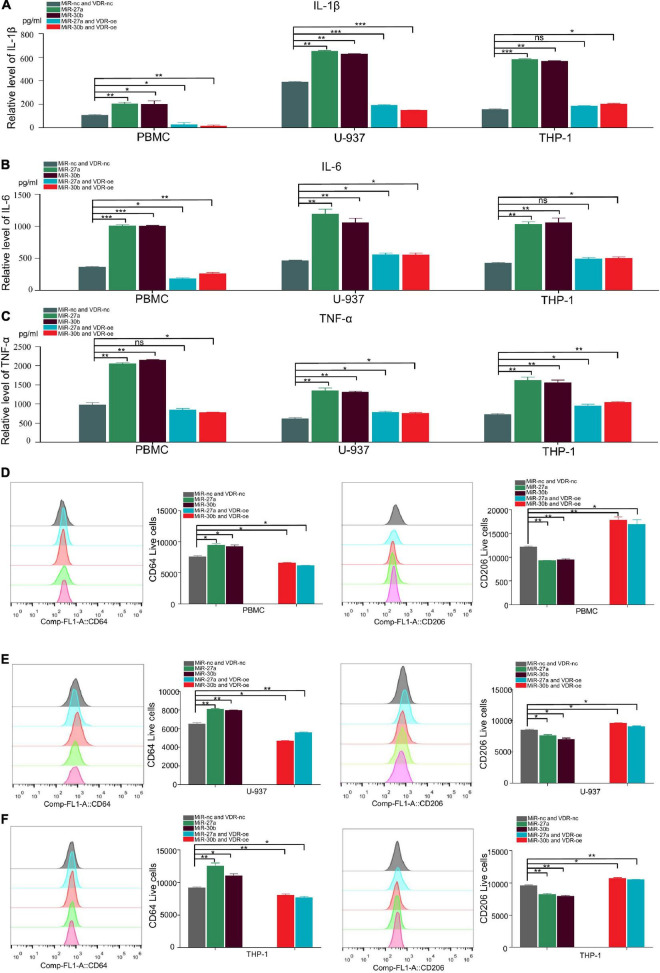
Differential miRNA expression profiles were obtained, and miR-27a-3p and miR-30b-5p were highly expressed in patients with TB. These results showed that the two miRNAs were able to induce M1 macrophage differentiation and inhibit M2 macrophage differentiation. Further experiments showed that the two miRNAs decreased the VDR protein level and increased proinflammatory cytokine secretion by macrophages. Mechanistically, the miRNAs targeted the 3' untranslated region (3'UTR) of the VDR mRNA and thereby downregulated VDR protein levels by post-transcriptional regulation. Then, due to the reduction in VDR protein levels, the NF-kB inflammatory cytokine signaling pathway was activated, thus promoting the progression of TB.
Our study not only identified differentially expressed miRNAs between the TB and control groups but also revealed that miR-27a-3p and miR-30b-5p regulate proinflammatory cytokine secretion and macrophage differentiation through VDR in macrophages. Thus, these two miRNAs influence the progression of TB.
微小RNA(miRNA)在结核病(TB)中起着至关重要的作用。维生素D受体(VDR)作为一种miRNA靶基因,及其配体维生素D(VitD),已被报道对结核病具有保护作用。然而,miRNA是否能通过靶向VDR影响结核病的进展尚未见报道。
根据既定的纳入标准选择研究对象。建立了一个包含360个样本的临床数据库,包括受试者的人口统计学信息、miRNA表达谱和细胞实验结果。通过高通量测序筛选鉴定出两个候选miRNA,即miR-27a-3p和miR-30b-5p,并通过qRT-PCR检测进行验证。进行单因素和多因素统计分析。通过蛋白质印迹法检测VDR和NF-κB p65蛋白水平。通过酶联免疫吸附测定(ELISA)检测促炎细胞因子表达水平。进一步应用荧光素酶测定和荧光激活细胞分选(FACS)来阐明详细机制。
获得了差异miRNA表达谱,miR-27a-3p和miR-30b-5p在结核病患者中高表达。这些结果表明,这两种miRNA能够诱导M1巨噬细胞分化并抑制M2巨噬细胞分化。进一步实验表明,这两种miRNA降低了VDR蛋白水平,并增加了巨噬细胞促炎细胞因子的分泌。机制上,这些miRNA靶向VDR mRNA的3'非翻译区(3'UTR),从而通过转录后调控下调VDR蛋白水平。然后,由于VDR蛋白水平降低,NF-κB炎性细胞因子信号通路被激活,从而促进结核病的进展。
我们的研究不仅鉴定了结核病组和对照组之间差异表达的miRNA,还揭示了miR-27a-3p和miR-30b-5p通过巨噬细胞中的VDR调节促炎细胞因子分泌和巨噬细胞分化。因此,这两种miRNA影响结核病的进展。