National Heart and Lung Institute, Imperial College London, Du Cane Road, London, W12 0HS, London, UK.
Section of Cardiovascular Medicine, Yale University, 330 Cedar Street, New Haven, CT 06520-8056, USA.
Europace. 2023 Feb 16;25(2):341-350. doi: 10.1093/europace/euac173.
The effect of atrial fibrillation catheter ablation on cardiovascular outcomes in heart failure is an important outstanding research question. We undertook a meta-analysis of randomized controlled trials comparing ablation to medical therapy in patients with AF and heart failure.
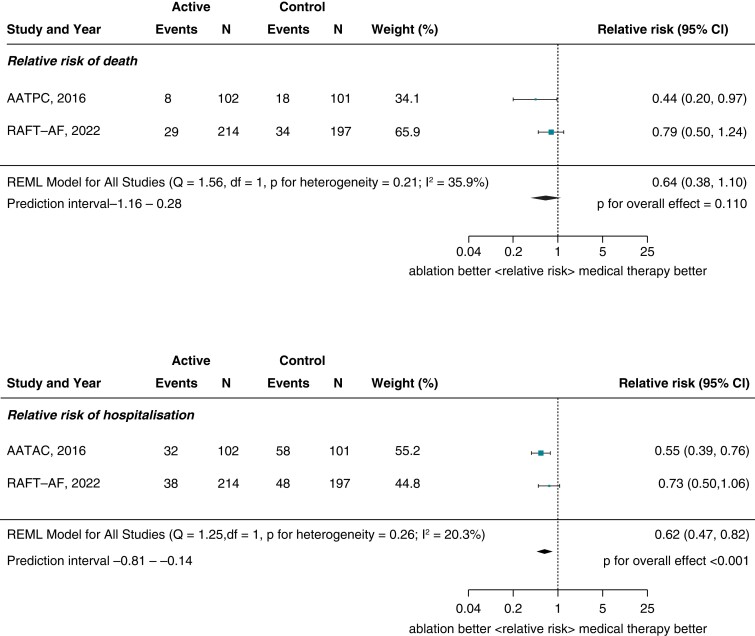
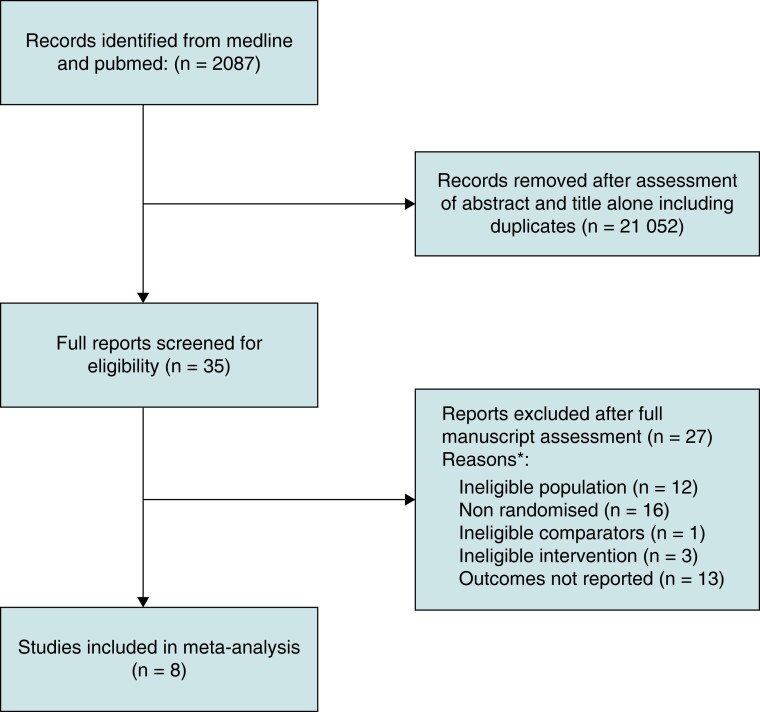
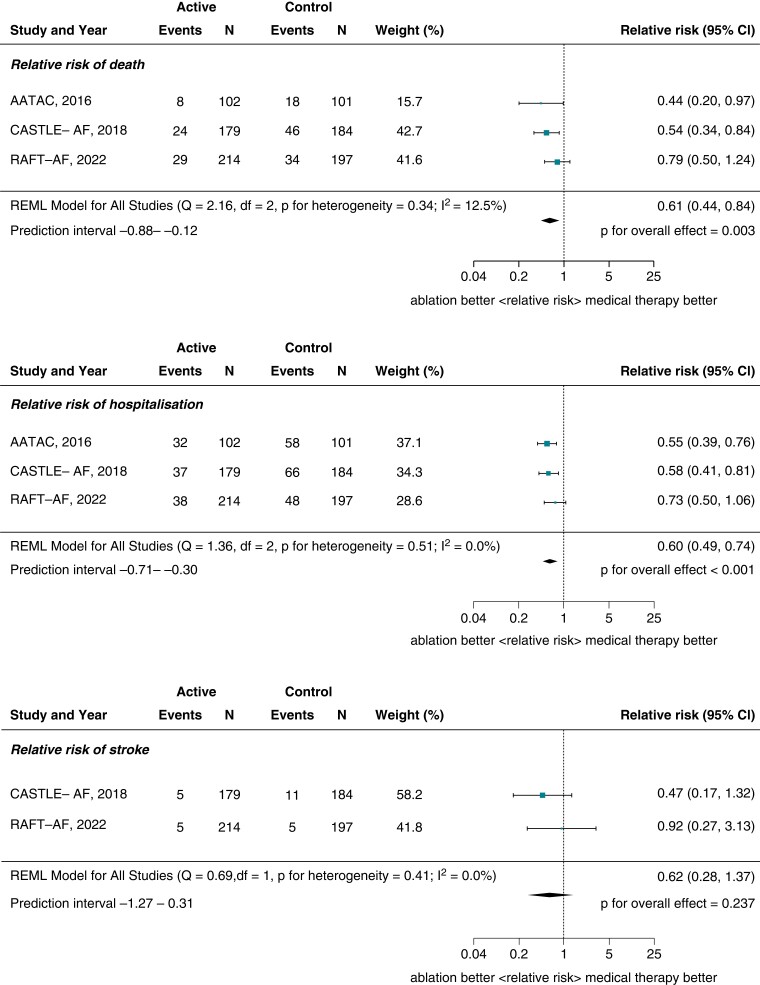
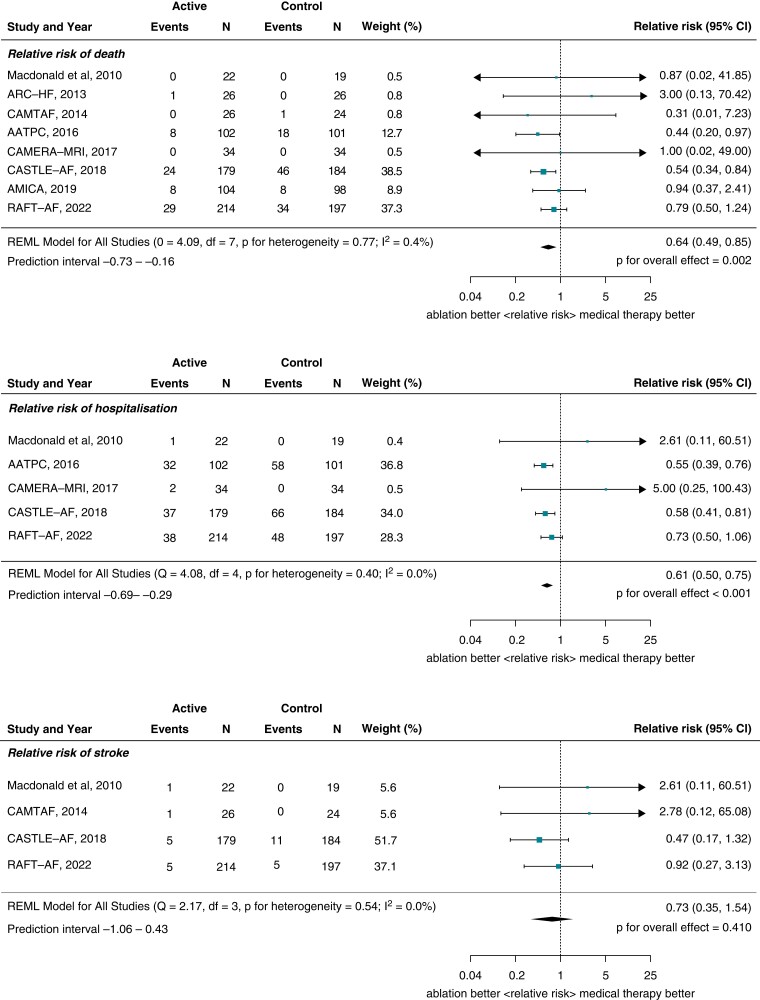
We systematically identified all trials comparing catheter ablation to medical therapy in patients with heart failure and atrial fibrillation. The pre-specified primary endpoint was all-cause mortality in trials with at least 2 years of follow-up. The secondary endpoint was heart failure hospitalization. Sensitivity analyses were performed for trials with any follow-up and trials deemed at low risk of bias. Eight trials (1390 patients) were included. Seven hundred and seven patients were randomized to catheter ablation and 683 to medical therapy. In the primary analysis (three trials, n = 977), catheter ablation reduced mortality compared with medical therapy [relative risk (RR): 0.61, 95% confidence interval (CI): 0.44 to 0.84, P = 0.003]. Catheter ablation also reduced heart failure hospitalizations compared with medical therapy (RR: 0.60, 95% CI: 0.49-0.74, P < 0.001). The effect on stroke was not statistically significant (RR: 0.62, 95% CI: 0.28-1.37, P = 0.237). There was low heterogeneity between studies. Sensitivity analyses were consistent with the primary analyses.
In patients with atrial fibrillation and heart failure, catheter ablation reduces mortality and the occurrence of heart failure hospitalizations.
心房颤动导管消融对心力衰竭患者心血管结局的影响是一个重要的未决研究问题。我们对比较消融与心力衰竭患者药物治疗的随机对照试验进行了荟萃分析。
我们系统地确定了所有比较导管消融与心力衰竭和心房颤动患者药物治疗的试验。主要终点是在至少 2 年随访的试验中全因死亡率。次要终点是心力衰竭住院。对任何随访试验和被认为低偏倚风险的试验进行了敏感性分析。纳入了 8 项试验(1390 例患者)。707 例患者被随机分配到导管消融组,683 例患者被分配到药物治疗组。在主要分析(三项试验,n = 977)中,导管消融与药物治疗相比降低了死亡率[相对风险(RR):0.61,95%置信区间(CI):0.44 至 0.84,P = 0.003]。与药物治疗相比,导管消融也减少了心力衰竭住院[RR:0.60,95%CI:0.49-0.74,P < 0.001]。对中风的影响无统计学意义[RR:0.62,95%CI:0.28-1.37,P = 0.237]。研究之间的异质性较低。敏感性分析与主要分析一致。
在心房颤动和心力衰竭患者中,导管消融可降低死亡率和心力衰竭住院发生率。