Department of Cardiology, Shanghai Tenth People's Hospital, Tongji University School of Medicine, 301 Yanchang Road, 200072, Shanghai, China.
Department of Cardiology, Shanghai Tenth People's Hospital, Chongming branch, Shanghai, China.
Cardiovasc Diabetol. 2022 Oct 29;21(1):222. doi: 10.1186/s12933-022-01653-y.
Coronary microvascular dysfunction (CMD) is common and is associated with unfavorable cardiovascular events in patients with diabetes mellitus (DM). Coronary angiography-derived index of microcirculatory resistance (caIMR) is a recently developed wire- and hyperemic agent-free method to assess CMD. We aimed to investigate the prognostic impact of CMD assessed by caIMR on clinical outcomes in patients with DM and chronic coronary syndrome (CCS).
CCS patients who underwent coronary angiography between June 2015 to May 2018 were included. Coronary microvascular function was measured by caIMR, and CMD was defined as caIMR ≥ 25U. The primary endpoint was major adverse cardiac events (MACE). Kaplan-Meier analysis and Cox proportional hazards models were used to assess the relationship between caIMR and the risk of MACE.
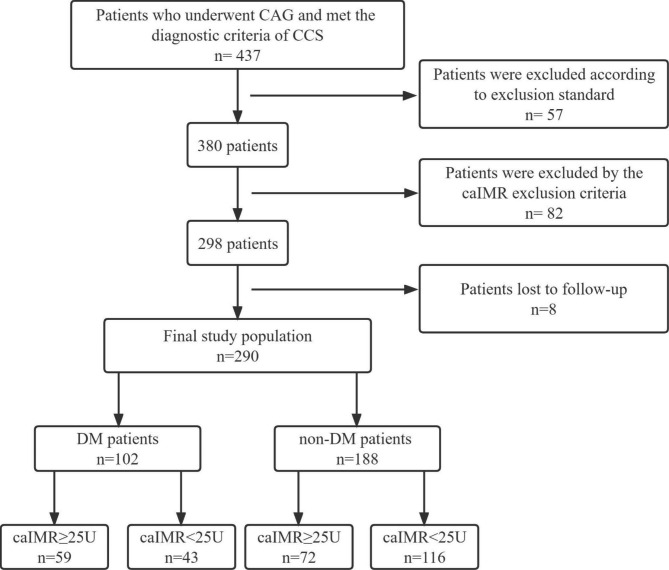
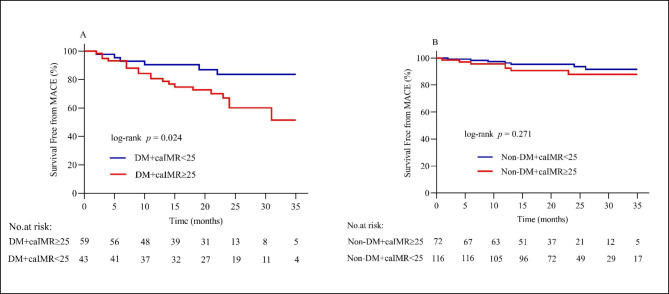
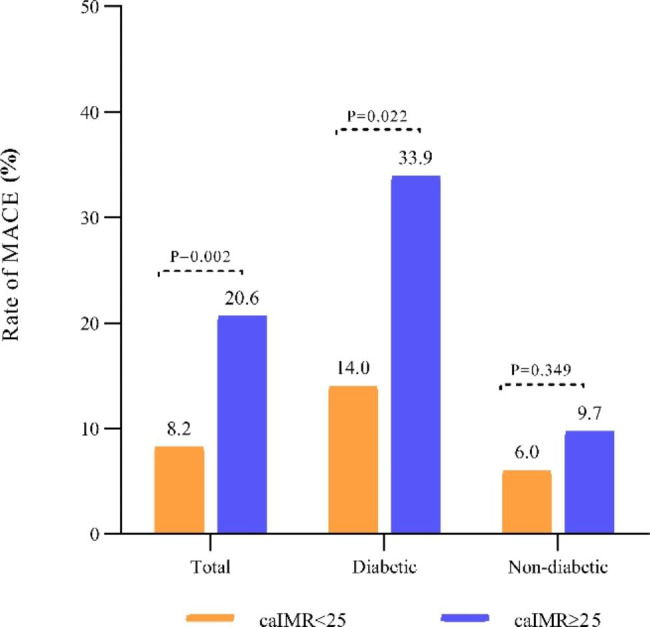
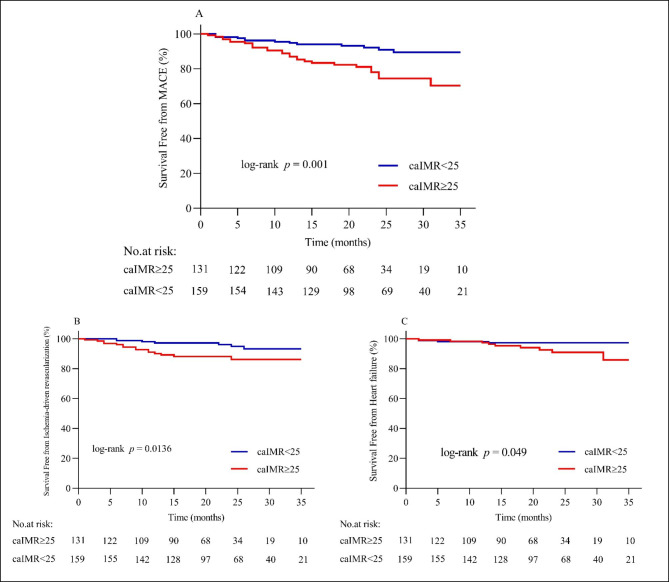
Of 290 CCS patients, 102 patients had DM. Compared with non-diabetic patients, CMD (caIMR ≥ 25U) was higher among DM patients (57.8% vs. 38.3%; p = 0.001). During a mean 35 months follow-up, 40 MACE had occurred. Patients with caIMR ≥ 25 had a higher rate of MACE than patients with caIMR < 25 (20.6% vs. 8.2%, p = 0.002). Of these, the MACE rate was higher among DM patients with caIMR ≥ 25 than those with caIMR < 25 (33.9% vs. 14.0%; p = 0.022). In multivariable Cox analysis, caIMR ≥ 25 was independently associated with MACE in the DM patients but not in non-DM patients (HR, 2.760; 95% CI, 1.066-7.146; P = 0.036).
CMD assessed by caIMR was common and is an independent predictor of MACE among diabetic patients with CCS. This finding potentially enables a triage of higher-risk patients to more intensive therapy.
冠状动脉微血管功能障碍(CMD)在糖尿病(DM)患者中很常见,并且与不良心血管事件相关。冠状动脉造影衍生的微血管阻力指数(caIMR)是一种最近开发的、无需导丝和血管扩张剂的评估 CMD 的方法。我们旨在研究 caIMR 评估的 CMD 对糖尿病合并慢性冠状动脉综合征(CCS)患者临床结局的预后影响。
纳入 2015 年 6 月至 2018 年 5 月间接受冠状动脉造影的 CCS 患者。通过 caIMR 测量冠状动脉微血管功能,CMD 定义为 caIMR≥25U。主要终点为主要不良心脏事件(MACE)。Kaplan-Meier 分析和 Cox 比例风险模型用于评估 caIMR 与 MACE 风险之间的关系。
在 290 名 CCS 患者中,有 102 名患有 DM。与非糖尿病患者相比,DM 患者的 CMD(caIMR≥25U)更高(57.8%比 38.3%;p=0.001)。在平均 35 个月的随访期间,发生了 40 例 MACE。caIMR≥25 的患者发生 MACE 的比率高于 caIMR<25 的患者(20.6%比 8.2%,p=0.002)。其中,caIMR≥25 的 DM 患者的 MACE 发生率高于 caIMR<25 的患者(33.9%比 14.0%;p=0.022)。多变量 Cox 分析显示,在 DM 患者中,caIMR≥25 与 MACE 独立相关,但在非 DM 患者中则不相关(HR,2.760;95%CI,1.066-7.146;P=0.036)。
caIMR 评估的 CMD 在 CCS 合并糖尿病患者中很常见,并且是 MACE 的独立预测因子。这一发现可能使高危患者分诊接受更强化的治疗。