Service of Endocrinology, Diabetes, Nutrition and Therapeutic Patient Education, Department of Internal Medicine, Geneva University Hospitals, Geneva, Switzerland.
Department of Cell Physiology and Metabolism, University of Geneva, Geneva, Switzerland.
Front Endocrinol (Lausanne). 2022 Oct 12;13:971745. doi: 10.3389/fendo.2022.971745. eCollection 2022.
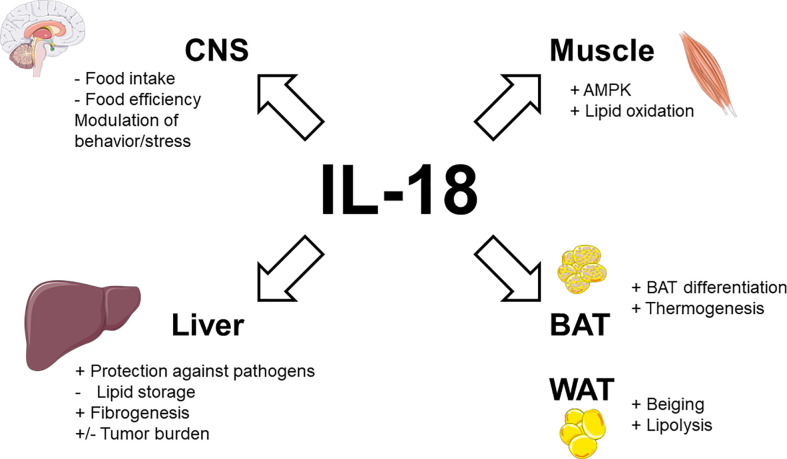
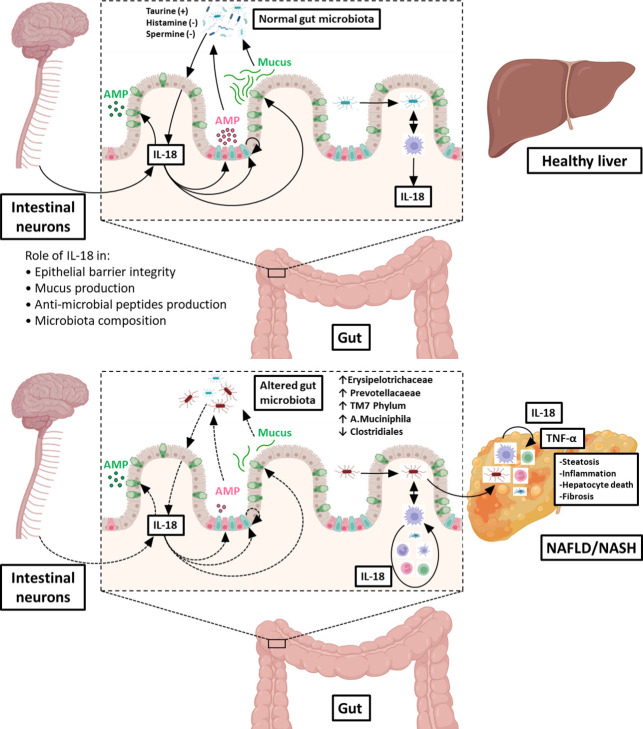
Interleukin-18 (IL-18) is a classical member of the IL-1 superfamily of cytokines. As IL-1β, IL-18 precursor is processed by inflammasome/caspase-1 into a mature and biologically active form. IL-18 binds to its specific receptor composed of two chains (IL-18Rα and IL-18Rβ) to trigger a similar intracellular signaling pathway as IL-1, ultimately leading to activation of NF-κB and inflammatory processes. Independently of this IL-1-like signaling, IL-18 also specifically induces IFN-γ production, driving the Th1 immune response. In circulation, IL-18 binds to the IL-18 binding protein (IL-18BP) with high affinity, letting only a small fraction of free IL-18 able to trigger receptor-mediated signaling. In contrast to other IL-1 family members, IL-18 is produced constitutively by different cell types, suggesting implications in normal physiology. If the roles of IL-18 in inflammatory processes and infectious diseases are well described, recent experimental studies in mice have highlighted the action of IL-18 signaling in the control of energy homeostasis, pancreatic islet immunity and liver integrity during nutritional stress. At the same time, clinical observations implicate IL-18 in various metabolic diseases including obesity, type 1 and 2 diabetes and nonalcoholic fatty liver disease (NAFLD)/nonalcoholic steatohepatitis (NASH). In the present review, we summarize and discuss both the physiological actions of IL-18 in metabolism and its potential roles in pathophysiological mechanisms leading to the most common human metabolic disorders, such as obesity, diabetes and NAFLD/NASH.
白细胞介素-18(IL-18)是细胞因子白细胞介素-1 超家族的经典成员。与白细胞介素-1β一样,IL-18 前体通过炎性体/半胱天冬酶-1 加工为成熟且具有生物活性的形式。IL-18 通过其特定受体(由两个链组成:IL-18Rα 和 IL-18Rβ)与配体结合,从而触发类似于 IL-1 的细胞内信号通路,最终导致 NF-κB 的激活和炎症过程。除了这种类似 IL-1 的信号外,IL-18 还特异性地诱导 IFN-γ 的产生,从而驱动 Th1 免疫反应。在循环中,IL-18 与白细胞介素-18 结合蛋白(IL-18BP)以高亲和力结合,仅让一小部分游离的 IL-18 能够触发受体介导的信号转导。与其他白细胞介素 1 家族成员不同,IL-18 由不同的细胞类型组成性地产生,这表明其在正常生理中具有重要作用。如果 IL-18 在炎症过程和传染病中的作用已经得到很好的描述,那么最近在小鼠中的实验研究则强调了 IL-18 信号在营养应激期间控制能量平衡、胰岛免疫和肝脏完整性中的作用。与此同时,临床观察表明 IL-18 参与了各种代谢疾病,包括肥胖、1 型和 2 型糖尿病以及非酒精性脂肪性肝病(NAFLD)/非酒精性脂肪性肝炎(NASH)。在本综述中,我们总结和讨论了 IL-18 在代谢中的生理作用及其在导致最常见人类代谢紊乱(如肥胖、糖尿病和 NAFLD/NASH)的病理生理机制中的潜在作用。