Szczawińska-Popłonyk Aleksandra, Popłonyk Natalia, Niedziela Marek, Sowińska-Seidler Anna, Sztromwasser Paweł, Jamsheer Aleksander, Obara-Moszyńska Monika
Department of Pediatric Pneumonology, Allergy and Clinical Immunology, Institute of Pediatrics, Poznań University of Medical Sciences, Poznań, Poland.
Student Scientific Society for Pediatric Endocrinology, Poznań University of Medical Sciences, Poznań, Poland.
Front Pediatr. 2022 Oct 14;10:990111. doi: 10.3389/fped.2022.990111. eCollection 2022.
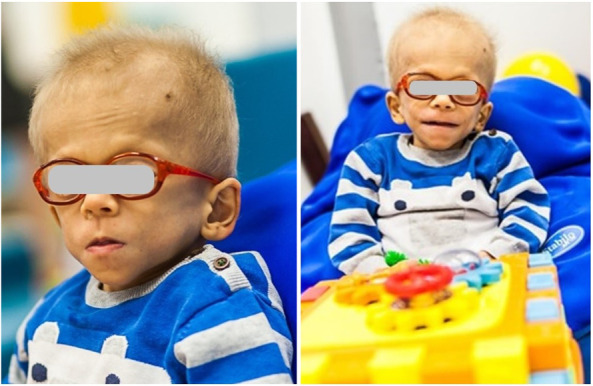
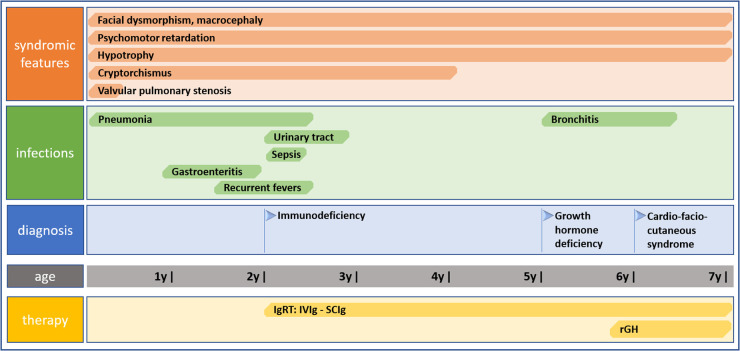
Cardio-facio-cutaneous syndrome (CFCS) belongs to the group of RASopathies, clinical disorders defined by disruptions in the RAS/MAPK signaling pathway. It is caused by heterozygous gain-of-function germline mutations in genes encoding protein kinases: , (), (), and in the GTPase-encoding gene . CFCS is characterized by craniofacial dysmorphic features, congenital heart defects, severe malnutrition, proportionate short stature, anomalies within the structure of skin and hair, and psychomotor disability. The pathophysiology of growth impairment is multifactorial with feeding difficulties, growth hormone deficiency, and insensitivity. Immunodeficiency has not been hitherto reported as an integral part of CFCS yet an increased activation of the RAS/MAPK signaling pathway may contribute to explaining the causal relationship between RASopathy and the dysfunctions within the B and T lymph cell compartments resulting in a deficiency in T cell costimulation and B cell maturation with impaired class switch recombination, somatic hypermutation, and high-affinity antibody production. We report on a boy born prematurely at 32 WGA, with the perinatal period complicated by pneumonia, respiratory distress syndrome, and valvular pulmonary stenosis. The boy suffered from recurrent pneumonia, obstructive bronchitis, sepsis, urinary tract infection, and recurrent fevers. He presented with severe hypotrophy, psychomotor disability, short stature, craniofacial dysmorphism, dental hypoplasia, sparse hair, and cryptorchidism. Whole genome sequencing showed a novel heterozygous pathogenic germline missense variant: c.364A > G; p.Asn122Asp in the gene, supporting the diagnosis of CFCS. The immunological workup revealed hypogammaglobulinemia, IgG subclass, and specific antibody deficiency accompanied by decreased numbers of T helper cells and naive and memory B cells. Replacement immunoglobulin therapy with timely antibiotic prophylaxis were instituted. At the age of six years, growth hormone deficiency was diagnosed and the rGH therapy was started. The ever-increasing progress in genetic studies contributes to establishing the definitive CFCS diagnosis and sheds the light on the interrelated genotype-phenotype heterogeneity of RASopathies. Herein, we add new phenotypic features of predominating humoral immunodeficiency to the symptomatology of CFCS with a novel mutation in While CFCS is a multifaceted disease, increased pediatricians' awareness is needed to prevent the delay in diagnostics and therapeutic interventions.
心脏-颜面-皮肤综合征(CFCS)属于RAS病组,是由RAS/丝裂原活化蛋白激酶(MAPK)信号通路中断所定义的临床疾病。它由编码蛋白激酶的基因(如BRAF、MEK1、ERK1)以及编码GTP酶的基因NRAS中的杂合功能获得性种系突变引起。CFCS的特征包括颅面畸形特征、先天性心脏缺陷、严重营养不良、身材比例矮小、皮肤和头发结构异常以及精神运动障碍。生长发育受损的病理生理学是多因素的,包括喂养困难、生长激素缺乏和不敏感。免疫缺陷迄今尚未被报道为CFCS的一个组成部分,但RAS/MAPK信号通路的激活增加可能有助于解释RAS病与B和T淋巴细胞亚群功能障碍之间的因果关系,导致T细胞共刺激和B细胞成熟缺陷,伴有类别转换重组、体细胞高频突变和高亲和力抗体产生受损。我们报告了一名32周龄早产男婴,围产期并发肺炎、呼吸窘迫综合征和瓣膜性肺动脉狭窄。该男婴患有复发性肺炎、阻塞性支气管炎、败血症、尿路感染和反复发热。他表现出严重消瘦、精神运动障碍、身材矮小、颅面畸形、牙釉质发育不全、头发稀疏和隐睾。全基因组测序显示在NRAS基因中有一个新的杂合致病性种系错义变异:c.364A>G;p.Asn122Asp,支持CFCS的诊断。免疫检查显示低丙种球蛋白血症、IgG亚类和特异性抗体缺乏,同时伴有辅助性T细胞以及初始B细胞和记忆B细胞数量减少。采用了替代免疫球蛋白疗法并及时进行抗生素预防。在6岁时,诊断出生长激素缺乏并开始使用重组人生长激素(rGH)治疗。遗传学研究的不断进展有助于确立CFCS的明确诊断,并揭示RAS病相关的基因型-表型异质性。在此,我们通过NRAS基因中的一个新突变,在CFCS的症状学中增加了以体液免疫缺陷为主的新表型特征。虽然CFCS是一种多方面的疾病,但需要提高儿科医生的认识,以防止诊断和治疗干预的延迟。