
吸入二氧化碳通过下调缺血性心跳骤停和复苏大鼠模型海马自噬和凋亡来改善神经功能结局。
Inhaled Carbon Dioxide Improves Neurological Outcomes by Downregulating Hippocampal Autophagy and Apoptosis in an Asphyxia-Induced Cardiac Arrest and Resuscitation Rat Model.
机构信息
Department of Emergency Medicine National Taiwan University Hospital Taipei Taiwan.
Department of Emergency Medicine, College of Medicine National Taiwan University Taipei Taiwan.
出版信息
J Am Heart Assoc. 2022 Nov;11(21):e027685. doi: 10.1161/JAHA.122.027685. Epub 2022 Oct 31.
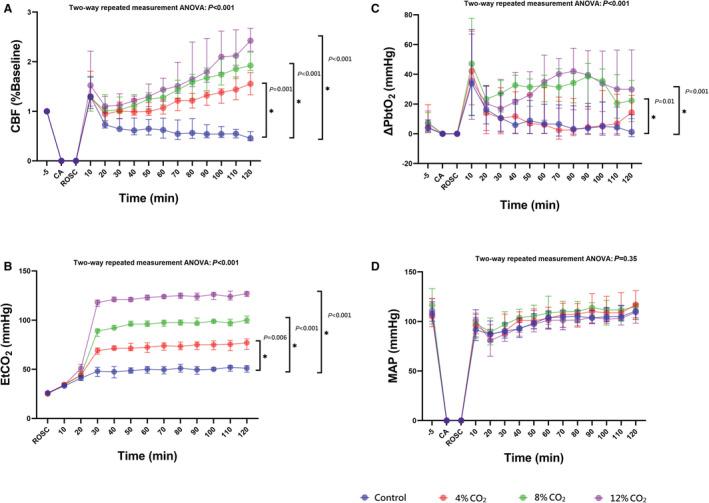
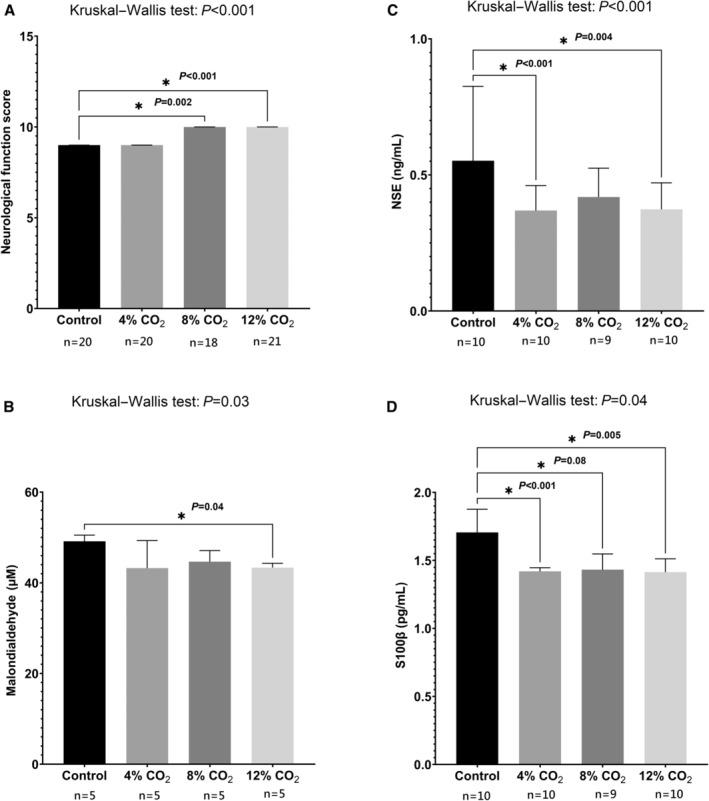
Background Protracted cerebral hypoperfusion following cardiac arrest (CA) may cause poor neurological recovery. We hypothesized that inhaled carbon dioxide (CO) could augment cerebral blood flow (CBF) and improve post-CA neurological outcomes. Methods and Results After 6-minute asphyxia-induced CA and resuscitation, Wistar rats were randomly allocated to 4 groups (n=25/group) and administered with different inhaled CO concentrations, including control (0% CO), 4% CO, 8% CO, and 12% CO. Invasive monitoring was maintained for 120 minutes, and neurological outcomes were evaluated with neurological function score at 24 hours post-CA. After the 120-minute experiment, CBF was 242.3% (median; interquartile range, 221.1%-267.4%) of baseline in the 12% CO group while CBF fell to 45.8% (interquartile range, 41.2%-58.1%) of baseline in the control group (<0.001). CBF increased along with increasing inhaled CO concentrations with significant linear trends (<0.001). At 24 hours post-CA, compared with the control group (neurological function score, 9 [interquartile range, 8-9]), neurological recovery was significantly better in the 12% CO group (neurological function score, 10 [interquartile range, 9.8-10]) (<0.001) while no survival difference was observed. Brain tissue malondialdehyde (=0.02) and serum neuron-specific enolase (=0.002) and S100β levels (=0.002) were significantly lower in the 12% CO group. TUNEL (terminal deoxynucleotidyl transferase-mediated biotin-deoxyuridine triphosphate nick-end labeling)-positive cell densities in hippocampal CA1 (<0.001) and CA3 (<0.001) regions were also significantly reduced in the 12% CO group. Western blotting showed that beclin-1 (=0.02), p62 (=0.02), and LAMP2 (lysosome-associated membrane protein 2) (=0.01) expression levels, and the LC3B-II:LC3B-I ratio (=0.02) were significantly lower in the 12% CO group. Conclusions Administering inhaled CO augmented post-CA CBF, mitigated oxidative brain injuries, ameliorated neuronal injury, and downregulated apoptosis and autophagy, thereby improving neurological outcomes.
背景 心脏骤停(CA)后长时间的脑低灌注可能导致神经功能恢复不良。我们假设吸入二氧化碳(CO)可以增加脑血流(CBF)并改善 CA 后的神经结局。
方法和结果 在 6 分钟窒息诱导的 CA 和复苏后,Wistar 大鼠被随机分为 4 组(每组 25 只),并给予不同浓度的吸入 CO,包括对照组(0% CO)、4% CO、8% CO 和 12% CO。持续监测 120 分钟,并在 CA 后 24 小时用神经功能评分评估神经功能结局。在 120 分钟的实验后,12% CO 组的 CBF 为基础值的 242.3%(中位数;四分位距,221.1%-267.4%),而对照组的 CBF 下降至基础值的 45.8%(四分位距,41.2%-58.1%)(<0.001)。随着吸入 CO 浓度的增加,CBF 增加,呈显著线性趋势(<0.001)。在 CA 后 24 小时,与对照组(神经功能评分 9[四分位距 8-9])相比,12% CO 组的神经恢复明显更好(神经功能评分 10[四分位距 9.8-10])(<0.001),而存活率无差异。12% CO 组的脑组织丙二醛(=0.02)、血清神经元特异性烯醇化酶(=0.002)和 S100β 水平(=0.002)显著降低。TUNEL(末端脱氧核苷酸转移酶介导的生物素-dUTP 缺口末端标记)阳性细胞密度在海马 CA1(<0.001)和 CA3(<0.001)区域也显著减少。Western 印迹显示,自噬相关蛋白 1(beclin-1)(=0.02)、p62(=0.02)和溶酶体相关膜蛋白 2(LAMP2)(=0.01)的表达水平以及 LC3B-II:LC3B-I 比值(=0.02)在 12% CO 组中显著降低。
结论 给予吸入 CO 可增加 CA 后的 CBF,减轻氧化脑损伤,改善神经元损伤,下调细胞凋亡和自噬,从而改善神经结局。




 Zotero 插件