• 文献检索
  • 文档翻译
  • 深度研究
  • 学术资讯
  • Suppr Zotero 插件Zotero 插件
  • 邀请有礼
  • 套餐&价格
  • 历史记录
应用&插件
Suppr Zotero 插件Zotero 插件浏览器插件Mac 客户端Windows 客户端微信小程序
定价
高级版会员购买积分包购买API积分包
服务
文献检索文档翻译深度研究API 文档MCP 服务
关于我们
关于 Suppr公司介绍联系我们用户协议隐私条款
关注我们

Suppr 超能文献

核心技术专利:CN118964589B侵权必究
粤ICP备2023148730 号-1Suppr @ 2026

文献检索

告别复杂PubMed语法,用中文像聊天一样搜索,搜遍4000万医学文献。AI智能推荐,让科研检索更轻松。

立即免费搜索

文件翻译

保留排版,准确专业,支持PDF/Word/PPT等文件格式,支持 12+语言互译。

免费翻译文档

深度研究

AI帮你快速写综述,25分钟生成高质量综述,智能提取关键信息,辅助科研写作。

立即免费体验

南亚婴幼儿获得性细菌感染的危险因素:一项纵向队列研究及嵌套病例对照分析。

Risk factors for community-acquired bacterial infection among young infants in South Asia: a longitudinal cohort study with nested case-control analysis.

机构信息

Department of Microbiology, Child Health Research Foundation, Dhaka, Bangladesh

Department of Clinical Research, London School of Hygiene & Tropical Medicine, London, UK.

出版信息

BMJ Glob Health. 2022 Nov;7(11). doi: 10.1136/bmjgh-2022-009706.

DOI:10.1136/bmjgh-2022-009706
PMID:36319031
原文链接:https://pmc.ncbi.nlm.nih.gov/articles/PMC9628539/
Abstract

OBJECTIVE

Risk factors predisposing infants to community-acquired bacterial infections during the first 2 months of life are poorly understood in South Asia. Identifying risk factors for infection could lead to improved preventive measures and antibiotic stewardship.

METHODS

Five sites in Bangladesh, India and Pakistan enrolled mother-child pairs via population-based pregnancy surveillance by community health workers. Medical, sociodemographic and epidemiological risk factor data were collected. Young infants aged 0-59 days with signs of possible serious bacterial infection (pSBI) and age-matched controls provided blood and respiratory specimens that were analysed by blood culture and real-time PCR. These tests were used to build a Bayesian partial latent class model (PLCM) capable of attributing the probable cause of each infant's infection in the ANISA study. The collected risk factors from all mother-child pairs were classified and analysed against the PLCM using bivariate and stepwise logistic multivariable regression modelling to determine risk factors of probable bacterial infection.

RESULTS

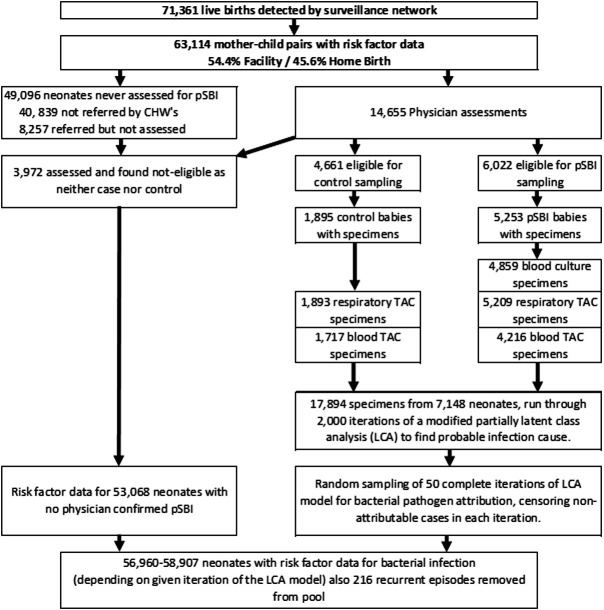
Among 63 114 infants born, 14 655 were assessed and 6022 had signs of pSBI; of these, 81% (4859) provided blood samples for culture, 71% (4216) provided blood samples for quantitative PCR (qPCR) and 86% (5209) provided respiratory qPCR samples. Risk factors associated with bacterial-attributed infections included: low (relative risk (RR) 1.73, 95% credible interval (CrI) 1.42 to 2.11) and very low birth weight (RR 5.77, 95% CrI 3.73 to 8.94), male sex (RR 1.27, 95% CrI 1.07 to 1.52), breathing problems at birth (RR 2.50, 95% CrI 1.96 to 3.18), premature rupture of membranes (PROMs) (RR 1.27, 95% CrI 1.03 to 1.58) and being in the lowest three socioeconomic status quintiles (first RR 1.52, 95% CrI 1.07 to 2.16; second RR 1.41, 95% CrI 1.00 to 1.97; third RR 1.42, 95% CrI 1.01 to 1.99).

CONCLUSION

Distinct risk factors: birth weight, male sex, breathing problems at birth and PROM were significantly associated with the development of bacterial sepsis across South Asian community settings, supporting refined clinical discernment and targeted use of antimicrobials.

摘要

目的

在南亚,导致婴儿在生命头 2 个月发生社区获得性细菌感染的危险因素了解甚少。确定感染的危险因素可以导致改进预防措施和抗生素管理。

方法

通过社区卫生工作者进行基于人群的妊娠监测,在孟加拉国、印度和巴基斯坦的 5 个地点招募母婴对。收集医学、社会人口统计学和流行病学危险因素数据。0-59 日龄有疑似严重细菌性感染(pSBI)体征的婴儿和年龄匹配的对照婴儿提供血液和呼吸道标本,由血培养和实时 PCR 进行分析。这些测试用于构建贝叶斯部分潜在类别模型(PLCM),该模型能够归因于 ANISA 研究中每个婴儿感染的可能原因。对所有母婴对收集的危险因素进行分类,并使用双变量和逐步逻辑多变量回归模型对 PLCM 进行分析,以确定可能的细菌性感染的危险因素。

结果

在出生的 63114 名婴儿中,评估了 14655 名婴儿,其中 6022 名有 pSBI 体征;其中,81%(4859 名)提供了血液样本进行培养,71%(4216 名)提供了血液样本进行定量 PCR(qPCR),86%(5209 名)提供了呼吸道 qPCR 样本。与细菌性感染相关的危险因素包括:低体重(相对风险(RR)1.73,95%置信区间(CrI)1.42-2.11)和极低出生体重(RR 5.77,95% CrI 3.73-8.94)、男性(RR 1.27,95% CrI 1.07-1.52)、出生时呼吸问题(RR 2.50,95% CrI 1.96-3.18)、胎膜早破(PROM)(RR 1.27,95% CrI 1.03-1.58)和处于最低三个社会经济地位五分位数(第一 RR 1.52,95% CrI 1.07-2.16;第二 RR 1.41,95% CrI 1.00-1.97;第三 RR 1.42,95% CrI 1.01-1.99)。

结论

在南亚社区环境中,出生体重、男性、出生时呼吸问题和 PROM 等明显不同的危险因素与细菌性败血症的发展显著相关,支持更精细的临床鉴别和针对性使用抗生素。
https://cdn.ncbi.nlm.nih.gov/pmc/blobs/1215/9628539/efe01fd13e66/bmjgh-2022-009706f01.jpg

相似文献

1
Risk factors for community-acquired bacterial infection among young infants in South Asia: a longitudinal cohort study with nested case-control analysis.南亚婴幼儿获得性细菌感染的危险因素:一项纵向队列研究及嵌套病例对照分析。
BMJ Glob Health. 2022 Nov;7(11). doi: 10.1136/bmjgh-2022-009706.
2
Causes and incidence of community-acquired serious infections among young children in south Asia (ANISA): an observational cohort study.南亚婴幼儿社区获得性严重感染的病因和发生率(ANISA):一项观察性队列研究。
Lancet. 2018 Jul 14;392(10142):145-159. doi: 10.1016/S0140-6736(18)31127-9. Epub 2018 Jul 6.
3
Infection Surveillance Protocol for a Multicountry Population-based Study in South Asia to Determine the Incidence, Etiology and Risk Factors for Infections Among Young Infants of 0 to 59 Days Old.南亚一项基于多国人群的研究的感染监测方案,以确定0至59日龄婴儿感染的发病率、病因和危险因素。
Pediatr Infect Dis J. 2016 May;35(5 Suppl 1):S9-15. doi: 10.1097/INF.0000000000001100.
4
Infectious aetiologies of neonatal illness in south Asia classified using WHO definitions: a primary analysis of the ANISA study.使用世卫组织定义对南亚新生儿疾病的传染性病因进行分类:ANISA 研究的初步分析。
Lancet Glob Health. 2022 Sep;10(9):e1289-e1297. doi: 10.1016/S2214-109X(22)00244-3.
5
Risk factors for possible serious bacterial infection in a rural cohort of young infants in central India.印度中部农村地区一组幼儿发生可能严重细菌感染的危险因素。
BMC Public Health. 2016 Oct 19;16(1):1097. doi: 10.1186/s12889-016-3688-3.
6
Prevalence of clinical signs of possible serious bacterial infection and mortality associated with them from population-based surveillance of young infants from birth to 2 months of age.基于人群的出生至 2 个月龄婴儿监测中,临床疑似严重细菌感染的体征流行情况及其与死亡的相关性。
PLoS One. 2021 Feb 24;16(2):e0247457. doi: 10.1371/journal.pone.0247457. eCollection 2021.
7
Severe bacterial neonatal infections in Madagascar, Senegal, and Cambodia: A multicentric community-based cohort study.马达加斯加、塞内加尔和柬埔寨的严重细菌性新生儿感染:一项多中心基于社区的队列研究。
PLoS Med. 2021 Sep 28;18(9):e1003681. doi: 10.1371/journal.pmed.1003681. eCollection 2021 Sep.
8
Determinants of low birth weight: a community based prospective cohort study.低出生体重的决定因素:一项基于社区的前瞻性队列研究。
Indian Pediatr. 1994 Oct;31(10):1221-5.
9
Folic acid supplementation and malaria susceptibility and severity among people taking antifolate antimalarial drugs in endemic areas.在流行地区,服用抗叶酸抗疟药物的人群中,叶酸补充剂与疟疾易感性和严重程度的关系。
Cochrane Database Syst Rev. 2022 Feb 1;2(2022):CD014217. doi: 10.1002/14651858.CD014217.
10
Community-based antibiotic delivery for possible serious bacterial infections in neonates in low- and middle-income countries.在低收入和中等收入国家,基于社区的抗生素给药用于治疗新生儿可能的严重细菌感染。
Cochrane Database Syst Rev. 2019 Apr 11;4(4):CD007646. doi: 10.1002/14651858.CD007646.pub3.

本文引用的文献

1
Partially latent class models for case-control studies of childhood pneumonia aetiology.用于儿童肺炎病因病例对照研究的部分潜在类别模型
J R Stat Soc Ser C Appl Stat. 2016 Jan;65(1):97-114. doi: 10.1111/rssc.12101. Epub 2015 Mar 26.
2
Risk factors of neonatal sepsis in India: A systematic review and meta-analysis.印度新生儿败血症的危险因素:系统评价和荟萃分析。
PLoS One. 2019 Apr 25;14(4):e0215683. doi: 10.1371/journal.pone.0215683. eCollection 2019.
3
Neonatal sepsis in South Asia: huge burden and spiralling antimicrobial resistance.
南亚的新生儿败血症:巨大的负担和不断上升的抗生素耐药性。
BMJ. 2019 Jan 22;364:k5314. doi: 10.1136/bmj.k5314.
4
Population-based rates, timing, and causes of maternal deaths, stillbirths, and neonatal deaths in south Asia and sub-Saharan Africa: a multi-country prospective cohort study.南亚和撒哈拉以南非洲地区基于人群的孕产妇死亡、死产和新生儿死亡的发生率、时间和原因:一项多国前瞻性队列研究。
Lancet Glob Health. 2018 Dec;6(12):e1297-e1308. doi: 10.1016/S2214-109X(18)30385-1. Epub 2018 Oct 22.
5
Causes and incidence of community-acquired serious infections among young children in south Asia (ANISA): an observational cohort study.南亚婴幼儿社区获得性严重感染的病因和发生率(ANISA):一项观察性队列研究。
Lancet. 2018 Jul 14;392(10142):145-159. doi: 10.1016/S0140-6736(18)31127-9. Epub 2018 Jul 6.
6
Implementation of the Neonatal Sepsis Calculator in an Australian Tertiary Perinatal Centre.新生儿败血症计算器在澳大利亚一家三级围产期中心的应用
Neonatology. 2018;113(4):379-382. doi: 10.1159/000487298. Epub 2018 Mar 7.
7
The global burden of paediatric and neonatal sepsis: a systematic review.全球儿童和新生儿脓毒症负担:系统评价。
Lancet Respir Med. 2018 Mar;6(3):223-230. doi: 10.1016/S2213-2600(18)30063-8.
8
Global, regional, and national age-sex specific mortality for 264 causes of death, 1980-2016: a systematic analysis for the Global Burden of Disease Study 2016.全球、地区和国家按年龄、性别划分的 264 种死因的死亡率:2016 年全球疾病负担研究的系统分析。
Lancet. 2017 Sep 16;390(10100):1151-1210. doi: 10.1016/S0140-6736(17)32152-9.
9
Precisely Tracking Childhood Death.精确追踪儿童死亡情况。
Am J Trop Med Hyg. 2017 Jul;97(1):3-5. doi: 10.4269/ajtmh.16-0302.
10
Recognizing Sepsis as a Global Health Priority - A WHO Resolution.将脓毒症确认为全球卫生重点——一项世界卫生组织决议
N Engl J Med. 2017 Aug 3;377(5):414-417. doi: 10.1056/NEJMp1707170. Epub 2017 Jun 28.