Forman Leah S, Lodi Sara, Fatch Robin, Emenyonu Nneka I, Adong Julian, Ngabirano Christine, Jacobson Karen R, Gerona Roy, Reckers Andrew R, Gandhi Monica, Muyindike Winnie R, Hahn Judith A
Biostatistics and Epidemiology Data Analytics Center, Boston University School of Public Health, Boston, Massachusetts, USA.
Department of Biostatistics, Boston University School of Public Health, Boston, Massachusetts, USA.
Open Forum Infect Dis. 2022 Oct 1;9(10):ofac516. doi: 10.1093/ofid/ofac516. eCollection 2022 Oct.
Isoniazid (INH) preventative therapy is recommended for people with HIV (PWH) in resource-constrained settings. Valid measures are needed to assess adherence. We aimed to examine agreement between measures overall and by level of social desirability.
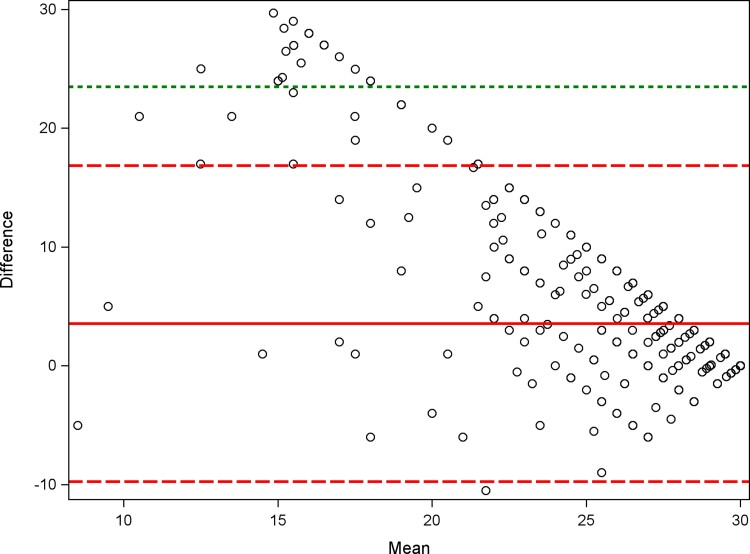
PWH with latent tuberculosis (TB) were recruited in Mbarara, Uganda. Past 30-day adherence was measured by the number of days with pill bottle openings using a medication event monitoring system (MEMS) and self-reported number of days pills taken. INH concentration (INH plus acetyl INH and their ratio) in hair samples was measured. We used Bland-Altman plots to examine agreement between adherence measures and calculated the area under the receiver operating characteristics curve (AUROC) to determine if INH hair concentration predicted optimal MEMS-measured adherence (≥90%).
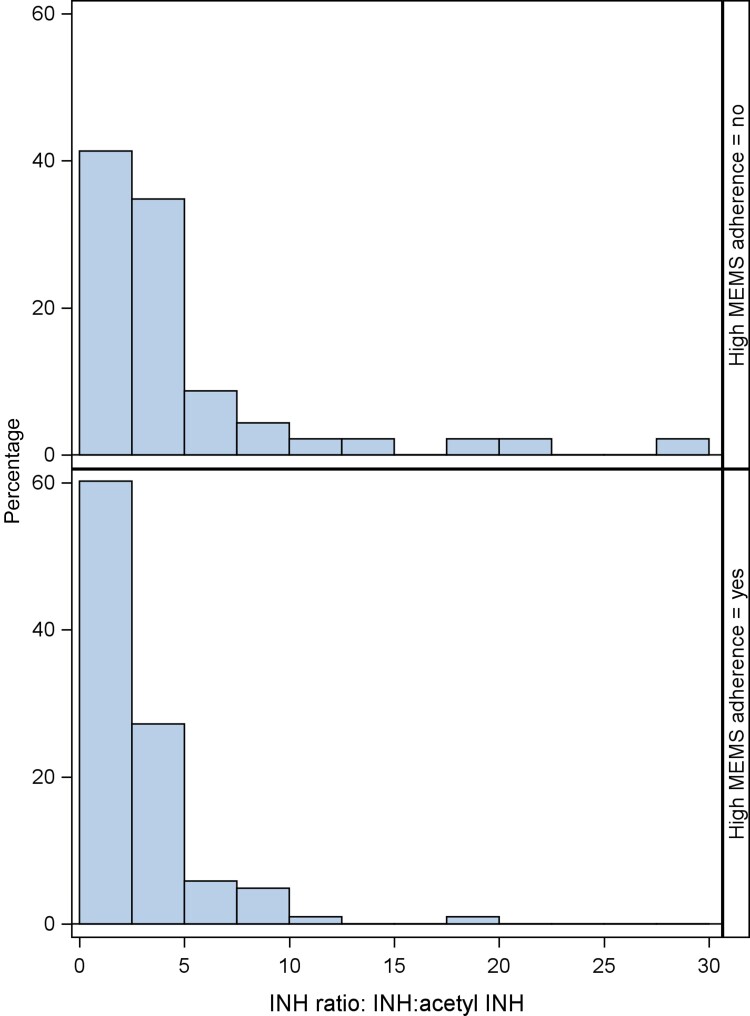
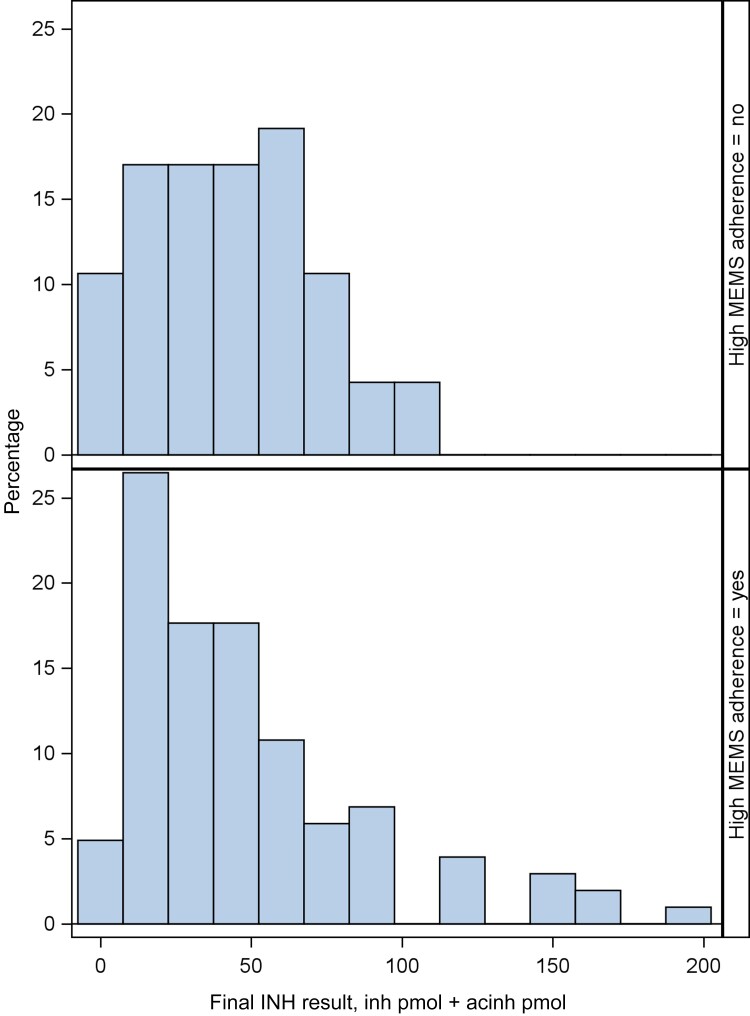
A total of 301 participants enrolled; 92% were virologically suppressed, and adherence was high. The median (interquartile range [IQR]) number of pill bottle openings in 30 days was 28 (24-30) compared with 30 (28-30) via self-report. The median INH concentration (IQR) was 36.2 (17.2-62.4), and the INH:acetyl ratio was 2.43 (0.99-3.92). Agreement between self-reported and MEMS adherence was greater at more optimal adherence levels. INH:acetyl INH ratio was not predictive of optimal adherence according to MEMS (AUROC, 0.62; 95% CI, 0.52-0.72) in a subset (n = 161).
Lower MEMS adherence levels compared with self-report suggest the need for objective adherence measures. Biologic measures have potential, although in this study INH concentration was not predictive of MEMS measured adherence. More data are needed to assess the accuracy of biologic measures.
在资源有限的环境中,推荐对艾滋病毒感染者(PWH)进行异烟肼(INH)预防性治疗。需要有效的措施来评估依从性。我们旨在总体上以及按社会期望水平来检查各项措施之间的一致性。
在乌干达姆巴拉拉招募了患有潜伏性结核病(TB)的艾滋病毒感染者。使用药物事件监测系统(MEMS)通过药瓶开启天数来测量过去30天的依从性,并通过自我报告的服药天数来测量。测量头发样本中的异烟肼浓度(异烟肼加乙酰异烟肼及其比值)。我们使用布兰德-奥特曼图来检查依从性测量之间的一致性,并计算受试者工作特征曲线下面积(AUROC),以确定异烟肼头发浓度是否能预测MEMS测量的最佳依从性(≥90%)。
共招募了301名参与者;92%的参与者病毒得到抑制,依从性较高。30天内药瓶开启的中位数(四分位间距[IQR])为28(24 - 30)天,而自我报告的天数为30(28 - 30)天。异烟肼浓度的中位数(IQR)为36.2(17.2 - 62.4),异烟肼与乙酰异烟肼的比值为2.43(0.99 - 3.92)。在依从性更佳的水平上,自我报告和MEMS依从性之间的一致性更高。在一个亚组(n = 161)中,根据MEMS,异烟肼与乙酰异烟肼的比值不能预测最佳依从性(AUROC,0.62;95% CI,0.52 - 0.72)。
与自我报告相比,MEMS测量的依从性水平较低,这表明需要客观的依从性测量方法。生物学测量方法具有潜力,尽管在本研究中异烟肼浓度不能预测MEMS测量的依从性。需要更多数据来评估生物学测量方法的准确性。