Udoumoh Anietie Francis, Nwaogu Innocent Chima, Igwebuike Udensi Maduabuchi, Obidike Ikechukwu Reginald
Department of Veterinary Anatomy, Faculty of Veterinary Medicine, University of Nigeria, Nsukka, Nigeria.
Department of Veterinary Physiology and Pharmacology, Faculty of Veterinary Medicine, University of Nigeria, Nsukka, Nigeria.
Vet Res Forum. 2022 Sep;13(3):301-308. doi: 10.30466/vrf.2020.127741.2953. Epub 2022 Sep 15.
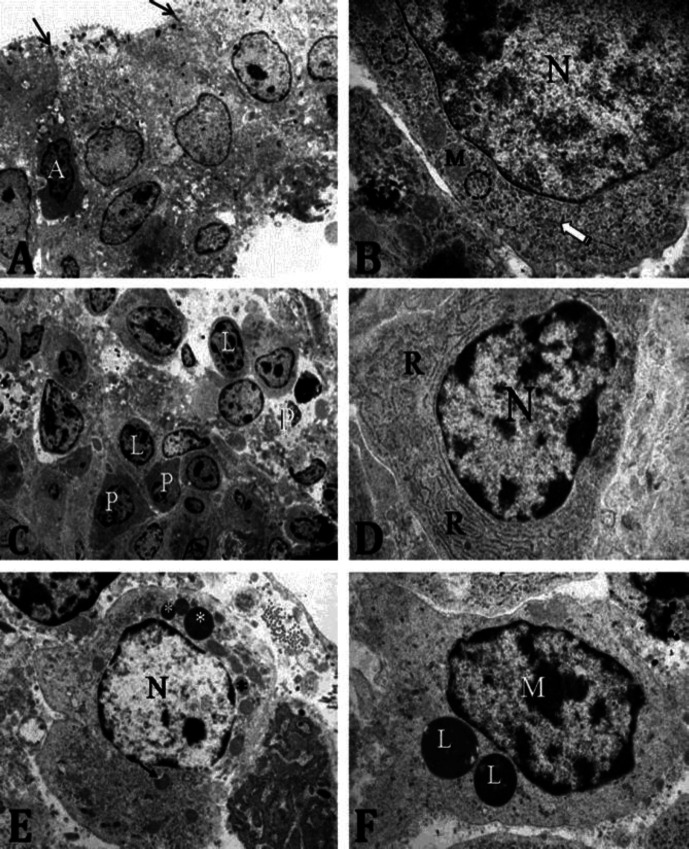
The developmental morphology of the bursa of Fabricius (BF) of broiler chicken was evaluated in this study using gross anatomical, histological, reticulin histo-chemical, and transmission electron microscopic techniques. The result showed that the short plica of the BF at embryonic day (ED) 14 was a mesenchymal tissue that contained cells, including mesenchymal cells and lymphoblasts. The organo-somatic index (OSI) of the BF peaked at ED 17, while the BF of ED 19 showed well delineated follicle-associated and inter-follicular epithelial (IFE) cells. Whereas, the IFE contained apical vacuoles which increased in size with age, the BF contained lymphoid follicles which were first observed at ED 17, and increased steadily in mean diameter from ED 19 to post-hatch day (PD) 28. The framework of the inter-follicular areas and the follicular capsules were composed of collagen type III fibres. Moreover, the cortico-medullary basement membranes were well established with peripheral and cortico-medullary basement capillaries becoming very consistent between PDs 5 and 7. The lymphoid follicle contained lymphocytes with mitotic figures, and plasma cells which showed extensive network of rough endoplasmic reticulum at PD 21, while macrophages contained increasing evidence of phagocytosis from PDs 35 to 56. In conclusion, the morphological features of the BF of broiler chicken in this study reveals that the key function of B-cell maturation within the BF may occur between the first 3 to 4 weeks after hatching, and thereafter, may primarily produce immunoglobulins until involution occurs.
本研究采用大体解剖、组织学、网状纤维组织化学和透射电子显微镜技术,对肉鸡法氏囊(BF)的发育形态进行了评估。结果表明,胚胎第14天(ED14)时BF的短皱襞是一种间充质组织,包含间充质细胞和成淋巴细胞等细胞。BF的器官-体指数(OSI)在ED17时达到峰值,而ED19时的BF显示出界限清晰的滤泡相关上皮细胞和滤泡间上皮(IFE)细胞。IFE含有顶端空泡,其大小随年龄增长而增加,BF含有淋巴滤泡,最早在ED17时观察到,平均直径从ED19到出壳后第28天(PD28)稳步增加。滤泡间区域和滤泡囊的框架由III型胶原纤维组成。此外,皮质-髓质基底膜在PD5至PD7之间发育良好,外周和皮质-髓质基底毛细血管变得非常一致。淋巴滤泡在PD21时含有有丝分裂象的淋巴细胞和显示广泛粗面内质网网络的浆细胞,而巨噬细胞在PD35至PD56时吞噬作用的证据增加。总之,本研究中肉鸡BF的形态学特征表明,BF内B细胞成熟的关键功能可能发生在孵化后的前3至4周,此后,可能主要产生免疫球蛋白直至退化发生。