Zhang Nan, Liu Xiaoyan, Wu Jinxian, Li Xinqi, Wang Qian, Chen Guopeng, Ma Linlu, Wu Sanyun, Zhou Fuling
Department of Hematology, Zhongnan Hospital of Wuhan University, Wuhan, China.
Department of Hematology, Zhongnan Hospital of Wuhan University, No.169 Donghu Road, Wuhan 430072, China.
Ther Adv Hematol. 2022 Oct 28;13:20406207221132346. doi: 10.1177/20406207221132346. eCollection 2022.
The clinical risk classification of acute myelocytic leukemia (AML) is largely based on cytogenetic and molecular genetic detection. However, the optimal treatment for intermediate-risk AML patients remains uncertain. Further refinement and improvement of prognostic stratification are therefore necessary.
The aim of this study was to identify serum protein biomarkers to refine risk stratification in AML patients.
This study is a retrospective study.
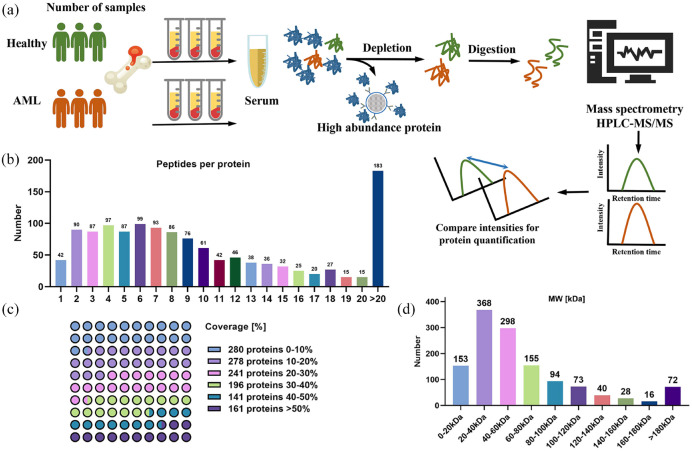
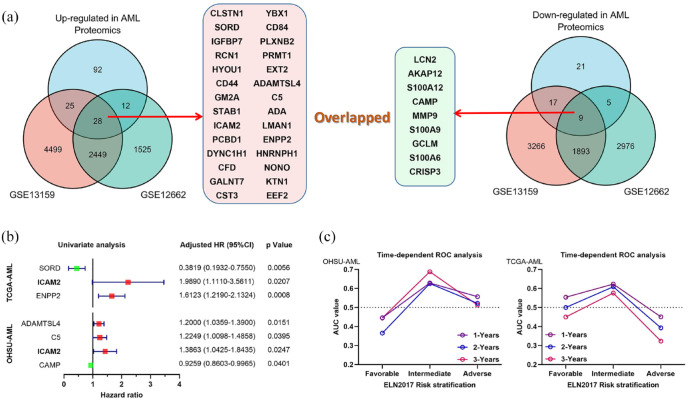
Label-free proteomics was used to identify the differential abundance of serum proteins in AML patients. Transcriptomic data were combined to identify key altered markers that could indicate the risk rank of AML patients. The survival status was assessed by Kaplan-Meier and multivariate Cox regression analyses.
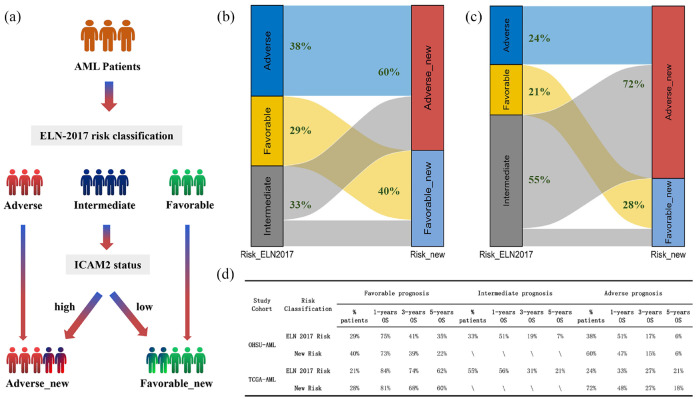
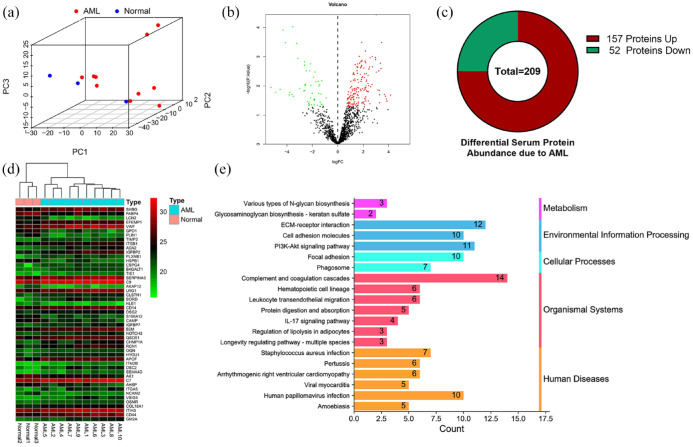
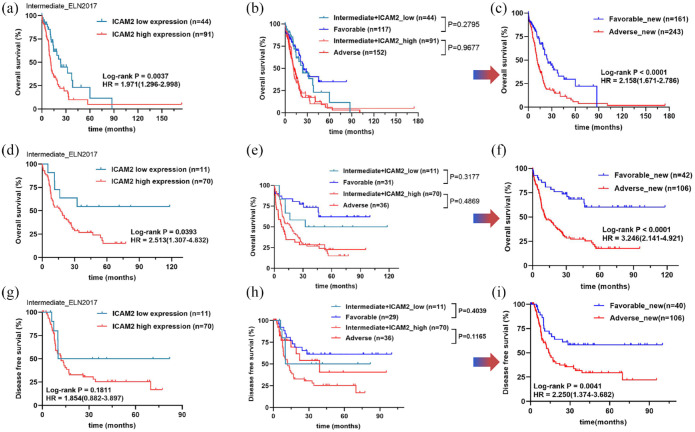
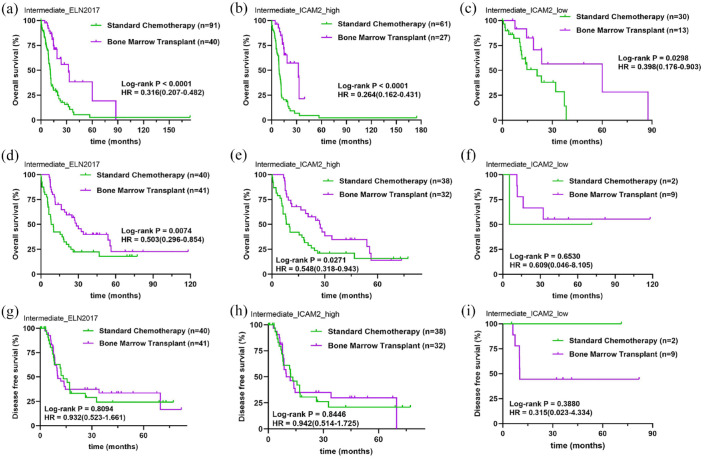
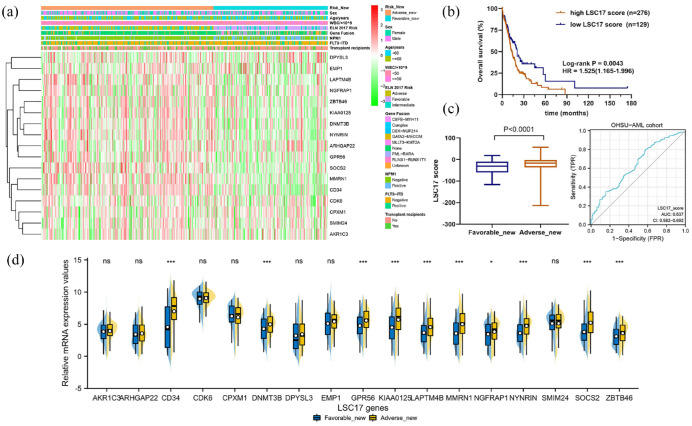
We delineated serum protein expression in a population of AML patients. Many biological processes were influenced by the identified differentially expressed proteins. Association analysis of transcriptome data showed that intercellular adhesion molecule-2 (ICAM2) had a higher survival prediction value in the intermediate-risk AML group. ICAM2 was detrimental for intermediate-risk AML, regardless of whether patients received bone marrow transplantation. ICAM2 well distinguishes the intermediate group of patients, whose probability of survival is comparable to that of patients with the ELN-2017 according to the reference classification. In addition, newly established stratified clinical features were associated with leukemia stem cell scores.
The inclusion of ICAM2 expression into the AML risk classification according to ELN-2017 was a good way to transfer patients from three to two groups. Thus, providing more information for clinical decision-making to improve intermediate-risk stratification in AML patients.
急性髓系白血病(AML)的临床风险分类很大程度上基于细胞遗传学和分子遗传学检测。然而,中危AML患者的最佳治疗方案仍不明确。因此,有必要进一步细化和改进预后分层。
本研究旨在识别血清蛋白生物标志物,以细化AML患者的风险分层。
本研究为回顾性研究。
采用无标记蛋白质组学技术识别AML患者血清蛋白的差异丰度。结合转录组数据,识别可指示AML患者风险等级的关键改变标志物。通过Kaplan-Meier和多变量Cox回归分析评估生存状态。
我们描绘了AML患者群体中的血清蛋白表达情况。许多生物学过程受到所识别的差异表达蛋白的影响。转录组数据的关联分析表明,细胞间黏附分子2(ICAM2)在中危AML组中具有较高的生存预测价值。无论患者是否接受骨髓移植,ICAM2对中危AML都是有害因素。ICAM2能很好地区分中危患者组,根据参考分类,该组患者的生存概率与ELN-2017标准下的患者相当。此外,新建立的分层临床特征与白血病干细胞评分相关。
将ICAM2表达纳入基于ELN-2017标准下的AML风险分类,是将患者从三组分类转变为两组分类的良好方式。从而为临床决策提供更多信息,以改善AML患者的中危分层。