Division of Cardiology, Department of Medicine, Johns Hopkins University School of Medicine, Carnegie 528, 600 N. Wolfe St, Baltimore, MD, 21287, USA.
Division of Cardiology, Department of Medicine, Creighton University, Omaha, NE, USA.
Int J Cardiovasc Imaging. 2023 Feb;39(2):411-421. doi: 10.1007/s10554-022-02734-5. Epub 2022 Nov 4.
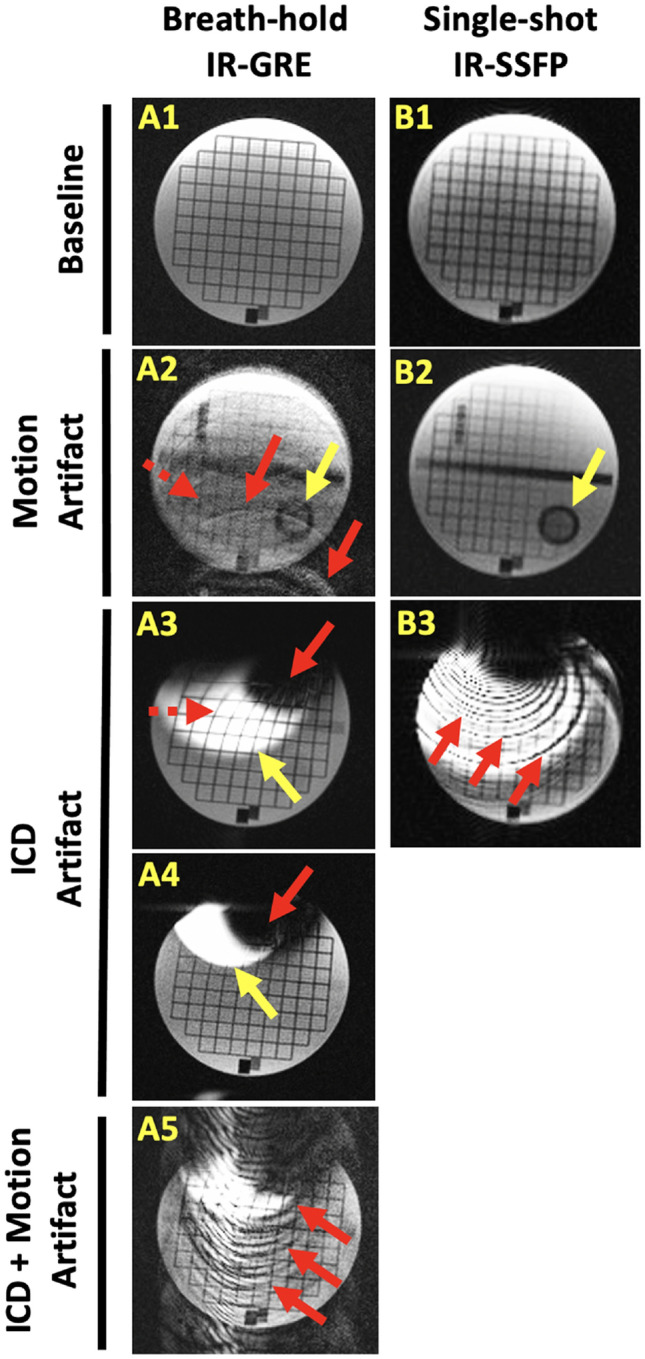
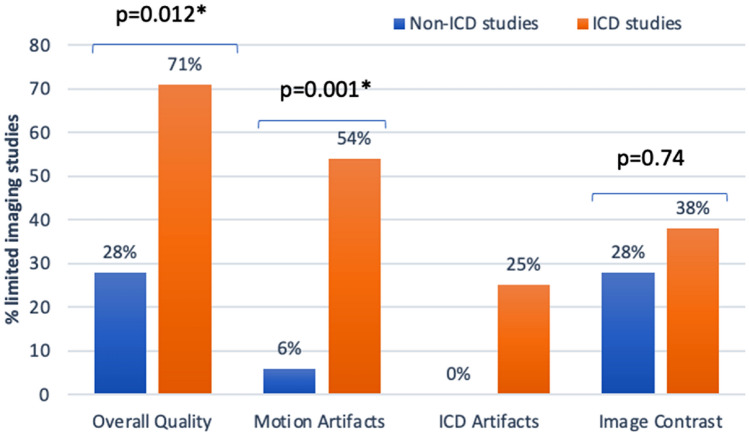
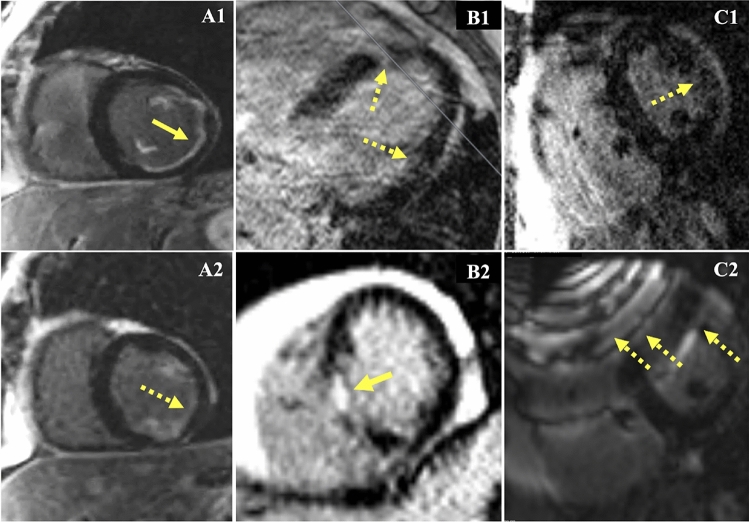
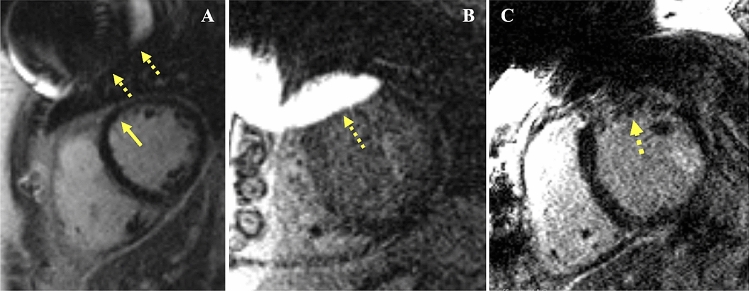
High-resolution scar characterization using late gadolinium enhancement cardiac magnetic resonance imaging (LGE-CMR) is useful for guiding ventricular arrhythmia (VA) treatment. However, imaging study quality may be degraded by breath-holding difficulties, arrhythmias, and implantable cardioverter-defibrillators (ICDs). We evaluated the effect of image quality on left ventricle (LV) base to apex scar interpretation in pre-VA ablation LGE-CMR. 43 consecutive patients referred for VA ablation underwent gradient-recalled-echo LGE-CMR. In ICD patients (n = 24), wide-bandwidth inversion-recovery suppressed ICD artifacts. In non-ICD patients, single-shot steady-state free-precession LGE-CMR could also be performed to reduce respiratory motion/arrhythmia artifacts. Study quality was assessed for adequate/limited scar interpretation due to cardiac/respiratory motion artifacts, ICD-related artifacts, and image contrast. 28% of non-ICD patients had studies where image quality limited scar interpretation in at least one image compared to 71% of ICD patient studies (p = 0.012). A median of five image slices had limited quality per ICD patient study, compared to 0 images per non-ICD patient study. Poorer quality in ICD patients was largely due to motion-related artifacts (54% ICD vs 6% non-ICD studies, p = 0.001) as well as ICD-related image artifacts (25% of studies). In VA ablation patients with ICDs, conventional CMR protocols frequently have image slices with limited scar interpretation, which can limit whole-heart scar assessment. Motion artifacts contribute to suboptimal image quality, particularly in ICD patients. Improved methods for motion and ICD artifact suppression may better delineate high-resolution LGE scar features of interest for guiding VA ablation.
使用钆延迟增强心脏磁共振成像(LGE-CMR)进行高分辨率瘢痕特征分析有助于指导室性心律失常(VA)的治疗。然而,呼吸暂停困难、心律失常和植入式心脏复律除颤器(ICD)可能会降低成像研究的质量。我们评估了图像质量对VA 消融前 LGE-CMR 中左心室(LV)基底至心尖瘢痕解读的影响。43 例因 VA 消融而接受梯度回波 LGE-CMR 的连续患者。在 ICD 患者(n = 24)中,使用宽带反转恢复抑制 ICD 伪影。在非 ICD 患者中,还可以进行单次激发稳态自由进动 LGE-CMR,以减少呼吸运动/心律失常伪影。由于心脏/呼吸运动伪影、ICD 相关伪影和图像对比度,评估了研究质量是否足以/有限地解释瘢痕。与 71%的 ICD 患者研究相比,28%的非 ICD 患者研究中至少有一个图像的图像质量限制了瘢痕的解释(p = 0.012)。每例 ICD 患者研究中有 5 个图像切片的质量有限,而非 ICD 患者研究中每例患者有 0 个图像切片的质量有限。ICD 患者图像质量较差主要是由于运动相关伪影(54%的 ICD 与 6%的非 ICD 研究,p = 0.001)和 ICD 相关图像伪影(25%的研究)。在患有 ICD 的 VA 消融患者中,常规 CMR 方案经常有图像切片瘢痕解释有限,这可能会限制全心瘢痕评估。运动伪影导致图像质量不佳,尤其是在 ICD 患者中。用于运动和 ICD 伪影抑制的改进方法可能会更好地描绘用于指导 VA 消融的高分辨率 LGE 瘢痕特征。