Michigan State University, United States; University of California, San Francisco, United States.
Michigan State University, United States.
Psychoneuroendocrinology. 2023 Jan;147:105958. doi: 10.1016/j.psyneuen.2022.105958. Epub 2022 Oct 21.
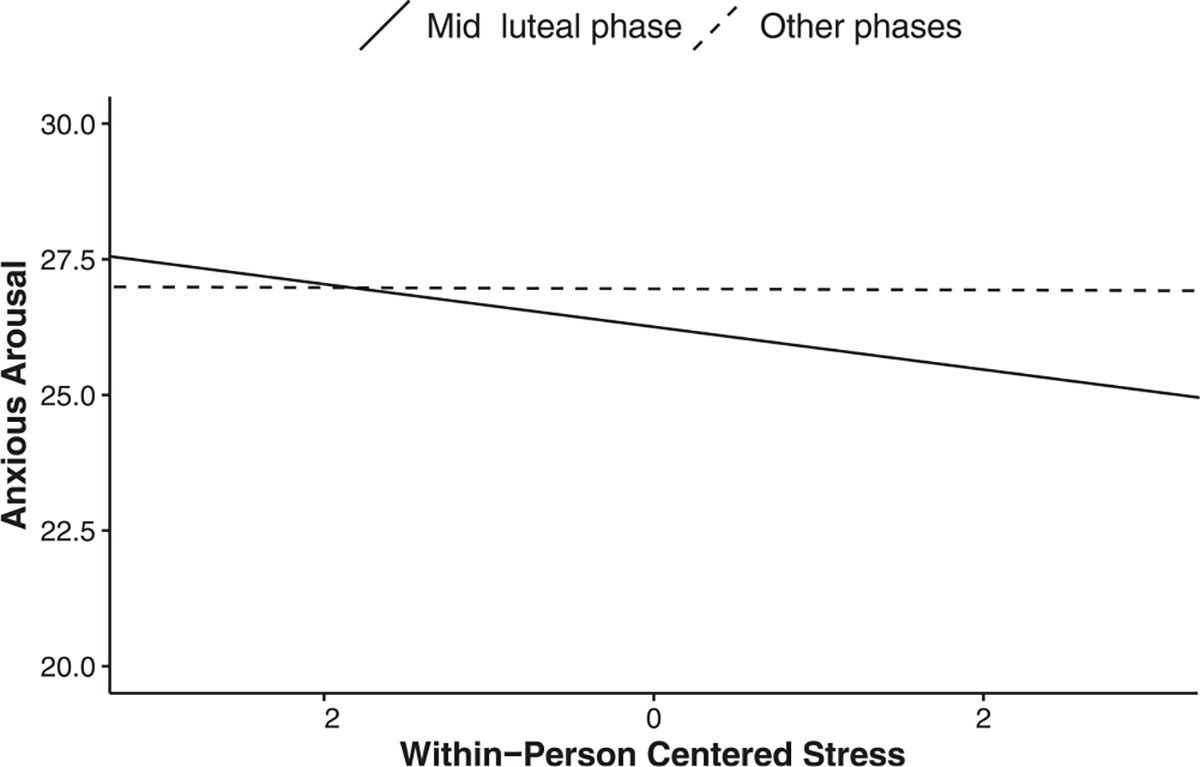
Particular phases of the menstrual cycle may exacerbate affective symptoms for females with a diagnosed mental health disorder. However, there are mixed findings regarding whether affective symptoms change across the menstrual cycle in females without a clinical diagnosis. The window of vulnerability model proposes that natural increases in ovarian hormones in the mid-luteal phase of the menstrual cycle lead to systematic changes in brain networks associated with affective processing. Consequently, the model posits that females may experience stress more intensely and remember negative events more readily in the mid-luteal phase, increasing their risk for higher affective symptoms. Using a 35-day longitudinal study design, we tested the window of vulnerability model in a non-clinical sample. We tracked naturally cycling females' daily stress and three types of affective symptoms: anxious apprehension, anxious arousal, and anhedonic depression. Using multilevel modeling, we simultaneously modeled within- and between-person associations among stress and menstrual phase for each affective symptom. We found increased anhedonic depression in the mid-luteal phase but not anxious apprehension or anxious arousal. Moreover, we detected a positive association between within- and between-person stress and anxious apprehension and anhedonic depression, but not anxious arousal. These associations were not stronger in the mid-luteal phase. Overall, we provide weak evidence for a window of vulnerability for affective symptoms in the mid-luteal phase of the menstrual cycle. Our findings suggest that stress is a better predictor of fluctuations in affective symptoms than the menstrual cycle. Moreover, our findings highlight the importance of measuring multiple negative affective symptoms because they may be differentially related to stress and the menstrual cycle.
特定的月经周期阶段可能会使患有精神健康障碍的女性的情感症状恶化。然而,对于没有临床诊断的女性,情感症状是否会在月经周期中发生变化,目前的研究结果存在差异。脆弱期窗口模型提出,卵巢激素在月经周期的黄体中期自然增加会导致与情感处理相关的大脑网络的系统变化。因此,该模型假设女性在黄体中期可能会更强烈地体验到压力,更容易记住负面事件,从而增加她们出现更高情感症状的风险。本研究采用 35 天的纵向研究设计,在非临床样本中检验了脆弱期窗口模型。我们追踪了自然周期女性的日常压力和三种类型的情感症状:焦虑性恐惧、焦虑性唤醒和快感缺失性抑郁。我们使用多层次模型,同时对每个情感症状的压力和月经周期的个体内和个体间关联进行建模。我们发现快感缺失性抑郁在黄体中期增加,但焦虑性恐惧和焦虑性唤醒没有增加。此外,我们检测到个体内和个体间压力与焦虑性恐惧和快感缺失性抑郁之间存在正相关,但与焦虑性唤醒没有相关。这些关联在黄体中期并不更强。总的来说,我们为月经周期黄体中期情感症状的脆弱期窗口提供了较弱的证据。我们的研究结果表明,压力是情感症状波动的更好预测因素,而不是月经周期。此外,我们的研究结果强调了测量多种负性情感症状的重要性,因为它们可能与压力和月经周期有不同的关系。