Department of Medicine, University of Ottawa and the Ottawa Hospital Research Institute, Ontario, Canada.
Division of Nephrology, Department of Medicine, University of British Columbia, British Columbia, Canada.
J Am Soc Nephrol. 2022 Dec;33(12):2247-2257. doi: 10.1681/ASN.2022030258. Epub 2022 Nov 4.
Although case reports have described relapses of glomerular disease after COVID-19 vaccination, evidence of a true association is lacking. In this population-level analysis, we sought to determine relative and absolute risks of glomerular disease relapse after COVID-19 vaccination.
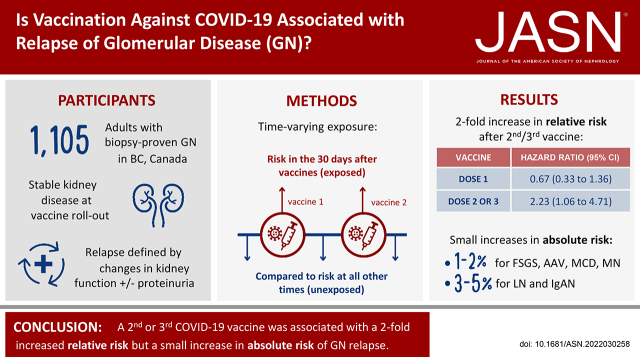
In this retrospective population-level cohort study, we used a centralized clinical and pathology registry (2000-2020) to identify 1105 adult patients in British Columbia, Canada, with biopsy-proven glomerular disease that was stable on December 14, 2020 (when COVID-19 vaccines first became available). The primary outcome was disease relapse, on the basis of changes in kidney function, proteinuria, or both. Vaccination was modeled as a 30-day time-varying exposure in extended Cox regression models, stratified on disease type.
During 281 days of follow-up, 134 (12.1%) patients experienced a relapse. Although a first vaccine dose was not associated with relapse risk (hazard ratio [HR]=0.67; 95% confidence interval [95% CI], 0.33 to 1.36), exposure to a second or third dose was associated with a two-fold risk of relapse (HR=2.23; 95% CI, 1.06 to 4.71). The pattern of relative risk was similar across glomerular diseases. The absolute increase in 30-day relapse risk associated with a second or third vaccine dose varied from 1%-2% in ANCA-related glomerulonephritis, minimal change disease, membranous nephropathy, or FSGS to 3%-5% in IgA nephropathy or lupus nephritis. Among 24 patients experiencing a vaccine-associated relapse, 4 (17%) had a change in immunosuppression, and none required a biopsy.
In a population-level cohort of patients with glomerular disease, a second or third dose of COVID-19 vaccine was associated with higher relative risk but low absolute increased risk of relapse.
尽管已有病例报告描述了 COVID-19 疫苗接种后肾小球疾病的复发,但缺乏真正关联的证据。在这项人群水平分析中,我们旨在确定 COVID-19 疫苗接种后肾小球疾病复发的相对和绝对风险。
在这项回顾性人群水平队列研究中,我们使用集中的临床和病理登记处(2000-2020 年),确定了 1105 名在不列颠哥伦比亚省的成年患者,这些患者的肾小球疾病活检证实稳定,且于 2020 年 12 月 14 日(COVID-19 疫苗首次可用时)无变化。主要结局是基于肾功能、蛋白尿或两者的变化来确定疾病复发。在扩展的 Cox 回归模型中,将疫苗接种建模为 30 天的时变暴露,按疾病类型分层。
在 281 天的随访期间,有 134 名(12.1%)患者出现疾病复发。尽管首次接种疫苗与复发风险无关(风险比 [HR]=0.67;95%置信区间 [95%CI],0.33 至 1.36),但接种第二剂或第三剂疫苗与复发风险增加两倍相关(HR=2.23;95%CI,1.06 至 4.71)。相对风险的模式在各种肾小球疾病中相似。与接种第二剂或第三剂疫苗相关的 30 天复发风险的绝对增加在 ANCA 相关肾小球肾炎、微小病变性肾病、膜性肾病或 FSGS 中为 1%-2%,在 IgA 肾病或狼疮性肾炎中为 3%-5%。在 24 名经历疫苗相关复发的患者中,有 4 名(17%)改变了免疫抑制治疗,且无一例需要进行活检。
在肾小球疾病患者的人群水平队列中,COVID-19 疫苗的第二剂或第三剂与更高的相对风险相关,但绝对复发风险增加幅度较低。