Department of Respiratory Medicine, Juntendo University Graduate School of Medicine, Tokyo, Japan.
Department of Respiratory Medicine and Infectious Diseases, Niigata University Graduate School of Medical and Dental Sciences, 1-757 Asahimachidori, Chuouku, Niigata, 951-8510, Japan.
BMC Cancer. 2022 Nov 4;22(1):1135. doi: 10.1186/s12885-022-10222-1.
Small-cell lung cancer (SCLC) accounts for 12-15% of lung cancers and has a limited prognosis, with approximately one-third of SCLC patients having a poor performance status (PS). Patients with extensive-stage (ES) SCLC and a poor PS have a poor prognosis. For this population, overall survival from carboplatin and etoposide treatment is 7-8 months, and treatment development is an unmet medical need. Recently, the combination of an anti-PD-L1 (a ligand for programmed cell death 1) antibody and platinum-based chemotherapy has become the standard of care for ES-SCLC patients with a good PS (PS 0-1). We hypothesized that the combination of the anti-PD-L1 antibody durvalumab with carboplatin and etoposide would be feasible and effective for such patients.
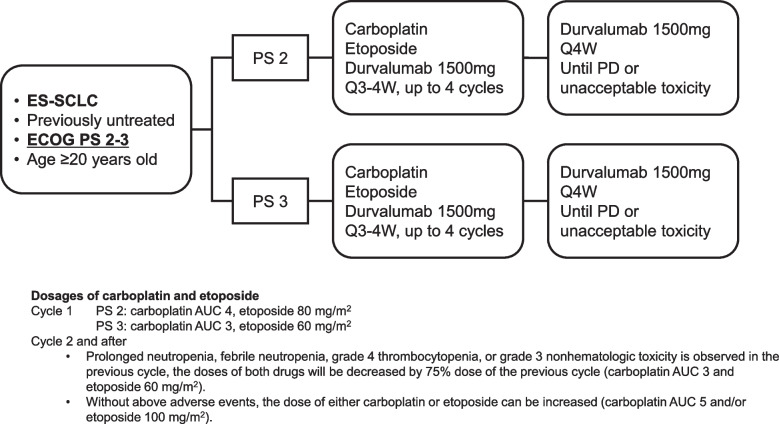
We initiated a multicenter phase II study of durvalumab combined with carboplatin and etoposide in previously untreated ES-SCLC patients with a poor PS (PS 2-3). Eligible patients will receive durvalumab plus carboplatin and etoposide every 3 to 4 weeks for up to 4 cycles, followed by durvalumab every 4 weeks until progression or unacceptable toxicity. The dosages of carboplatin and etoposide for the second and subsequent cycles will be adaptively determined based on the adverse events of the first cycle. A total of 56 patients (43 patients with a PS of 2 and 13 patients with a PS of 3) will be enrolled in this study, with a 24-month enrollment period and a 12-month follow-up. The primary endpoint is the tolerability of carboplatin and etoposide plus durvalumab in previously untreated ES-SCLC patients with a poor PS. The secondary endpoints are the 1-year survival rate, objective response rate, progression-free survival, overall survival, ratio of PS improvement, and safety.
The results of this study are intended to establish the safety and efficacy of carboplatin and etoposide plus durvalumab in patients with ES-SCLC and a poor PS.
Japan Registry of Clinical Trials (jRCT), jRCTs031200319. Registered 21 January 2021, https://jrct.niph.go.jp/en-latest-detail/jRCTs031200319.
小细胞肺癌(SCLC)约占肺癌的 12%-15%,预后有限,约有三分之一的 SCLC 患者体能状况(PS)较差。广泛期(ES)SCLC 且 PS 差的患者预后较差。对于这部分人群,接受卡铂和依托泊苷治疗的总生存期为 7-8 个月,因此治疗进展是未满足的医疗需求。最近,抗 PD-L1(程序性死亡受体 1 的配体)抗体联合铂类化疗已成为 PS 良好(PS 0-1)的 ES-SCLC 患者的标准治疗。我们假设抗 PD-L1 抗体 durvalumab 联合卡铂和依托泊苷对 PS 差(PS 2-3)的此类患者是可行且有效的。
我们启动了一项多中心 II 期研究,评估 durvalumab 联合卡铂和依托泊苷在未经治疗的 ES-SCLC 且 PS 差(PS 2-3)的患者中的疗效和安全性。符合条件的患者将接受 durvalumab 联合卡铂和依托泊苷每 3-4 周治疗 4 个周期,随后 durvalumab 每 4 周给药直至疾病进展或出现不可耐受的毒性。第二周期及后续周期的卡铂和依托泊苷剂量将根据第一周期的不良反应进行适应性调整。该研究共入组 56 例患者(PS 2 患者 43 例,PS 3 患者 13 例),入组时间为 24 个月,随访时间为 12 个月。主要终点是评估 durvalumab 联合卡铂和依托泊苷在未经治疗的 ES-SCLC 且 PS 差的患者中的耐受性。次要终点包括 1 年生存率、客观缓解率、无进展生存期、总生存期、PS 改善比例和安全性。
该研究旨在确定卡铂和依托泊苷联合 durvalumab 在 ES-SCLC 且 PS 差的患者中的安全性和有效性。
日本临床试验注册(jRCT),jRCTs031200319。于 2021 年 1 月 21 日注册,https://jrct.niph.go.jp/en-latest-detail/jRCTs031200319。