Department of Interdisciplinary Life Sciences, Institute of Wildlife Ecology, University of Veterinary Medicine, Vienna, Savoyenstr. 1, 1160, Vienna, Austria.
Institute of Wildlife Biology and Game Management, University of Natural Resources and Life Sciences, Vienna, Gregor Mendel-Str. 33, 1180, Vienna, Austria.
J Comp Physiol B. 2023 Jan;193(1):135-143. doi: 10.1007/s00360-022-01466-1. Epub 2022 Nov 6.
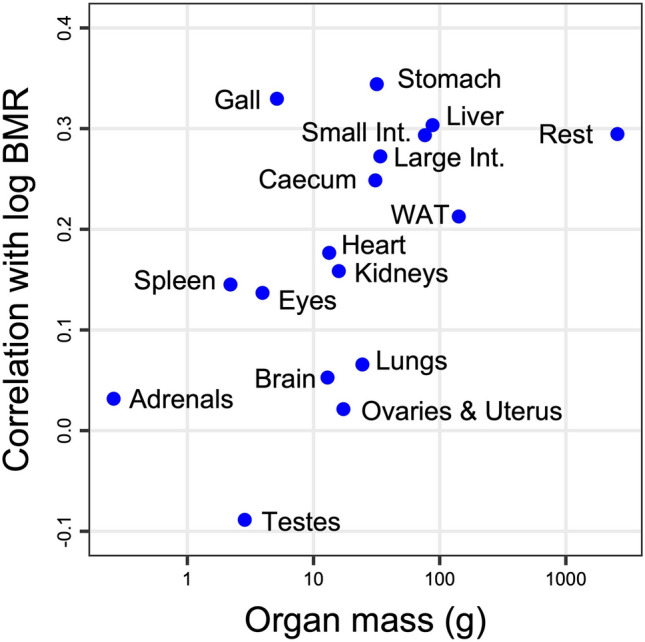
Visceral organs and tissues of 89 free-living alpine marmots (Marmota marmota) shot during a population control program in Switzerland, were collected. Between emergence from hibernation in April to July, the gastrointestinal tract (stomach to colon) gained 51% of mass and the liver mass increased by 24%. At the same time, the basal metabolic rate (BMR), determined with a portable oxygen analyzer, increased by 18%. The organ masses of the digestive system (stomach, small intestine, caecum, large intestine) were all significantly correlated with BMR. Interestingly, the mass of abdominal white adipose tissue (WAT) and of the remaining carcass (mainly skin and bones) were also significantly correlated with BMR. These results indicate that the gastrointestinal tract and organs involved in digestive function are metabolically expensive. They also show that it is costly to maintain even tissues with low metabolic rate such as WAT, especially if they are large. Heart and kidneys and especially brain and lungs did not explain a large proportion of the variance in BMR. Marmots increased the uptake of fat prior to hibernation, both by selective feeding and enhanced gastrointestinal capacity. Large fat reserves enable marmots to hibernate without food intake and to reproduce in spring, but at the cost of an elevated BMR. We predict that climate changes that disturb energy accumulation in summer, increase energy expenditure in winter, or delay the emergence from hibernation in spring, such as the occurrence of storms with increasing frequency, will increase mortality in alpine marmots.
从瑞士的一项种群控制计划中射杀了 89 只自由生活的高山土拨鼠(Marmota marmota),收集了它们的内脏器官和组织。在 4 月至 7 月从冬眠中苏醒期间,胃肠道(胃到结肠)增加了 51%的质量,肝脏质量增加了 24%。与此同时,使用便携式氧气分析仪测定的基础代谢率(BMR)增加了 18%。消化系统(胃、小肠、盲肠、大肠)的器官质量与 BMR 呈显著相关。有趣的是,腹部白色脂肪组织(WAT)和剩余胴体(主要是皮肤和骨骼)的质量也与 BMR 呈显著相关。这些结果表明,胃肠道和参与消化功能的器官在代谢上是昂贵的。它们还表明,即使是代谢率较低的组织,如 WAT,也需要维持成本,尤其是如果它们很大的话。心脏、肾脏,尤其是大脑和肺部,不能解释 BMR 变化的很大一部分。土拨鼠在冬眠前通过选择性进食和增强胃肠道能力来增加脂肪的吸收。大量的脂肪储备使土拨鼠能够在没有食物摄入的情况下冬眠,并在春天繁殖,但代价是基础代谢率升高。我们预测,扰乱夏季能量积累、增加冬季能量支出或延迟春季冬眠苏醒的气候变化,如暴风雨频率增加,将增加高山土拨鼠的死亡率。