Discipline of Orthodontics, University of Otago, PO Box 56, Dunedin, New Zealand.
Discipline of Orthodontics, University of Queensland, Brisbane, Australia.
Prog Orthod. 2022 Nov 7;23(1):37. doi: 10.1186/s40510-022-00433-4.
Uprighting incisors is particularly important with clear aligner therapy as incisor tip determines the mesio-distal space needed in the arch, and consequently the fit of the aligner. The objective of this study was to investigate the accuracy of ClinCheck software to predict lower incisor tip by comparing digitally prescribed movements with actual clinical outcomes and to determine whether the presence of a vertically orientated rectangular composite attachment influences the efficacy of incisor tip.
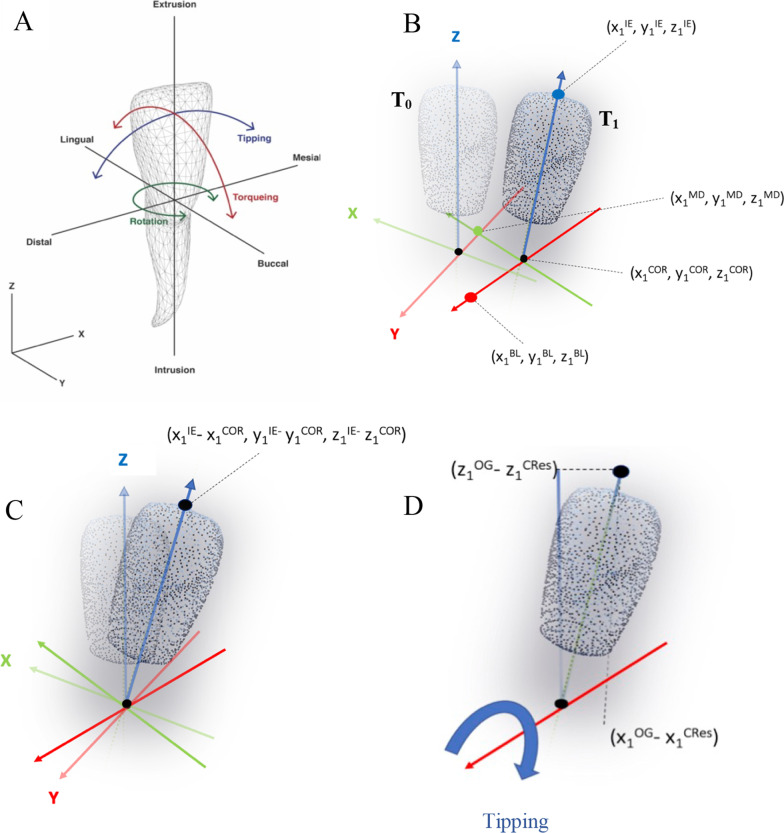
This retrospective study included 66 lower incisors from 42 non-extraction adult patients treated using the Invisalign appliance. Twenty-one incisors had vertical attachments, while 45 incisors did not have any attachments. Lower incisor tip was measured at T0 (pre-treatment), T1 (predicted post-treatment) and T2 (achieved post-treatment) on digital models using metrology software. The change in position from T0 to T1 and T0 to T2 was measured from the estimated centre of resistance (C) of each tooth. The estimated centre of rotation was plotted relative to the C to describe the type of orthodontic tooth movement (OTM) predicted and achieved.
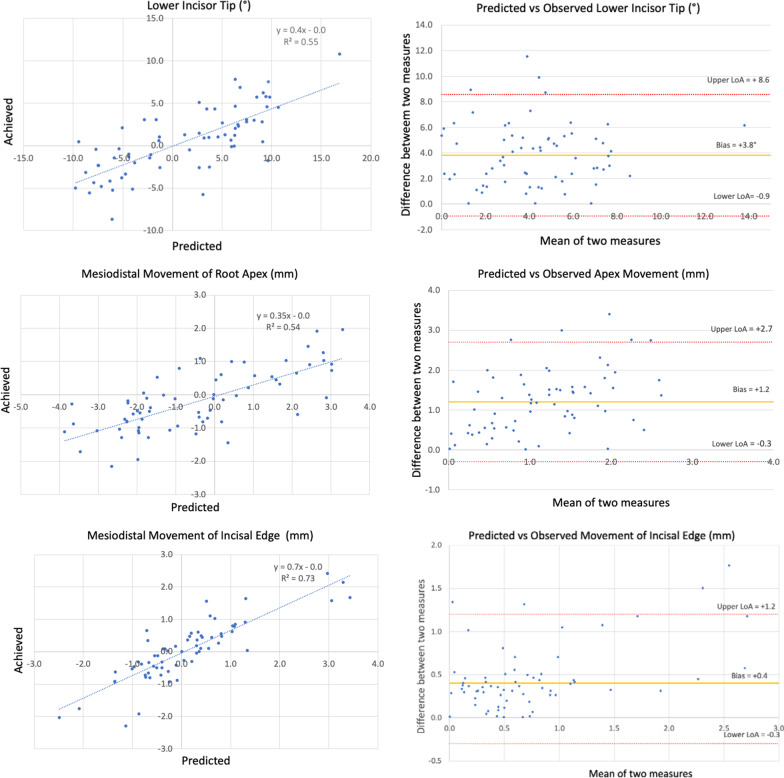
Predicted incisor tip and achieved incisor tip were positively correlated (R = 0.55; p < 0.001). For every degree of tip planned 0.4 degrees of tip was achieved. The presence of an attachment resulted in 1.2 degrees greater tip (F = 3.7; p = 0.062) and 0.5 mm greater movement of the predicted apex of the tooth (F = 4.3; p = 0.042) compared with the no attachment group. The type of OTM achieved differed from the type predicted. Sixty-seven percent of incisors investigated were predicted to move by root movement, while 46% achieved this type of movement.
The amount of lower incisor tip achieved was on average substantially less than the ClinCheck displayed. Vertically orientated rectangular attachments are recommended where large root movement is planned, and their presence slightly improves apex movement.
在使用 Clear Aligner 治疗时,直立切牙尤为重要,因为切牙尖端决定了弓内所需的近远中间隙,进而影响矫治器的适配性。本研究旨在通过比较数字预设移动与实际临床结果,来评估 ClinCheck 软件预测下切牙尖端的准确性,并确定垂直定向矩形复合附件是否会影响切牙尖端的效果。
本回顾性研究纳入 42 名非拔牙成年患者的 66 颗下切牙,均使用 Invisalign 矫治器治疗。21 颗下切牙带有垂直附件,45 颗下切牙不带任何附件。使用计量软件在下颌模型的 T0(治疗前)、T1(预测治疗后)和 T2(实际治疗后)测量下切牙尖端位置。从每个牙齿的估计阻力中心(C)测量从 T0 到 T1 和 T0 到 T2 的位置变化。相对 C 绘制估计旋转中心,以描述预测和实现的正畸牙齿移动(OTM)类型。
预测切牙尖端和实际切牙尖端呈正相关(R=0.55;p<0.001)。每计划 1 度切牙尖端,实际可实现 0.4 度切牙尖端。与无附件组相比,附件的存在导致切牙尖端增加 1.2 度(F=3.7;p=0.062)和预测牙尖移动增加 0.5 毫米(F=4.3;p=0.042)。实际实现的 OTM 类型与预测的类型不同。67%的研究切牙预计通过根移动移动,而 46%实现了这种类型的移动。
实际下切牙尖端移动量平均明显小于 ClinCheck 显示的量。建议在计划进行大量根移动时使用垂直定向矩形附件,并且其存在可略微改善牙尖移动。