Van Os Jennifer M C, Nemeth Geoffrey S S, Weary Daniel M, von Keyserlingk Marina A G
Animal Welfare Program, Faculty of Land and Food Systems, University of British Columbia, Canada V6T 1Z4.
Department of Animal and Dairy Sciences, University of Wisconsin-Madison, 1675 Observatory Dr., Madison 53706.
JDS Commun. 2021 Oct 9;2(6):403-408. doi: 10.3168/jds.2021-0118. eCollection 2021 Nov.
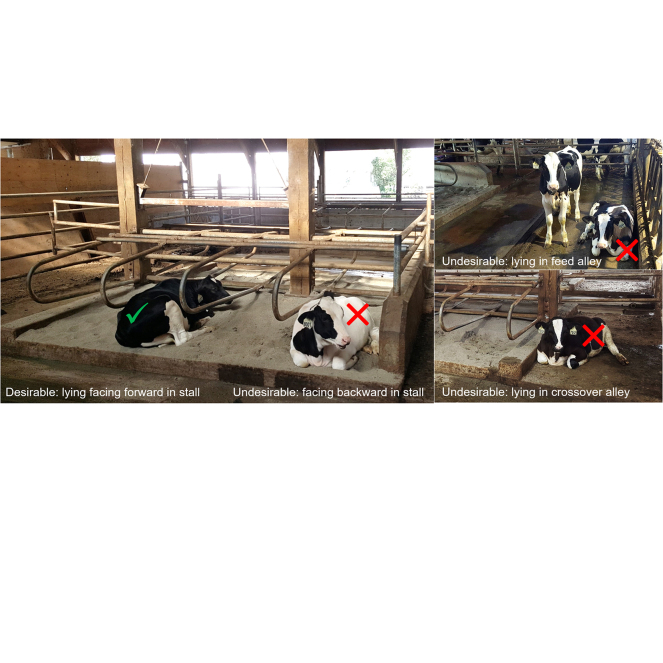
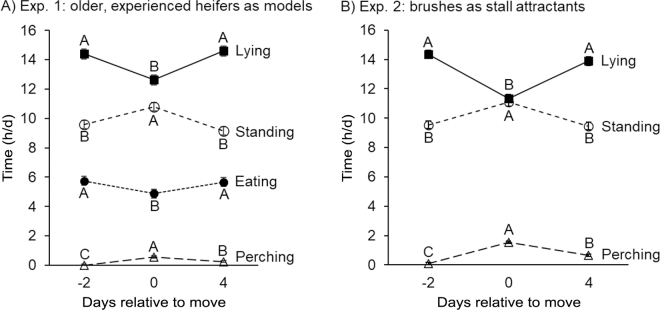
Dairy cattle can experience problems adjusting to freestalls when first introduced, resulting in a marked reduction in lying time and increased abnormal behaviors such as lying in the alley or lying backward in a stall. Our objective was to evaluate 2 strategies to ease the transition of heifers to freestalls: using an older, experienced heifer as a social model [experiment (Exp.) 1] or using brushes mounted in the stalls as an attractant (Exp. 2). In Exp. 1, 44 naïve heifers (129 ± 37 d of age, mean ± standard deviation) were assigned in pairs (n = 11 pairs/treatment) to either the control or social model (with an older heifer, 200 ± 24 d of age, as an experienced social companion) treatments. In Exp. 2, 52 naïve heifers (146 ± 9 d of age) were preassigned in pairs (n = 13 pairs/treatment) to either control or brush treatments. In both studies, heifers were initially housed in pens with a bedded pack (for 5 and 7 d in Exp. 1 and 2, respectively) before moving to pens in the same barn with sand-bedded freestalls. On d -2, 0, and 4 relative to the move to the freestalls, standing, perching (with the front hooves on the bedding and rear hooves in the alley), and lying (location: bedding vs. alley; direction in stall on d 0 and 4: forward or backward) were recorded at 5-min intervals. In addition, starting on d 0 relative to the move, latency to first lie down in a stall was recorded continuously. In both studies, time budgets did not differ between treatments. On the day heifers were moved, they spent less time lying relative to d -2 [Exp. 1: -1.8 h/d, standard error (SE): 0.4 h/d; Exp. 2: -3.0 h/d, SE: 0.3 h/d] and more time standing and perching. By d 4, lying and standing returned to d -2 baseline levels, although heifers continued to spend more time perching. When heifers moved to freestalls, no treatment differences were observed in the latency to lie down in a stall, but latencies differed between Exp. 1 (averaging approximately 3.8 h across treatments) and Exp. 2 (averaging 31.4 h across treatments). After moving to freestalls, the percentage of total lying time that heifers spent facing forward in a stall increased (Exp. 2: 53 vs. 77%, SE: 7%) or tended to (Exp. 1: 84 vs. 92%, SE: 3%) between d 0 and 4 of exposure, with no effect of treatment. Although lying behavior improved with days of exposure to freestalls, some heifers continued to lie down in the alley or backward in a stall, suggesting the need for additional work to ease the adjustment to freestall housing.
奶牛初次被引入自由牛舍时可能会出现适应问题,导致躺卧时间显著减少,并增加异常行为,如躺在通道或在牛舍中向后躺卧。我们的目标是评估两种策略,以帮助小母牛更好地过渡到自由牛舍:使用一头年龄较大、经验丰富的小母牛作为社交榜样(实验1),或在牛舍中安装刷子作为吸引物(实验2)。在实验1中,将44头初产小母牛(年龄129±37天,平均值±标准差)配对(每组11对),分为对照组或社交榜样组(有一头年龄较大的小母牛,200±24天,作为经验丰富的社交伙伴)。在实验2中,将52头初产小母牛(年龄146±9天)配对(每组13对),分为对照组或刷子组。在两项研究中,小母牛最初都被安置在有垫料堆的围栏中(实验1和2分别为5天和7天),然后转移到同一牛舍中铺有沙子的自由牛舍围栏中。在相对于转移到自由牛舍的第-2天、0天和4天,每隔5分钟记录站立、栖息(前蹄踩在垫料上,后蹄在通道)和躺卧(位置:垫料区与通道;第0天和4天在牛舍中的躺卧方向:向前或向后)情况。此外,从转移当天(第0天)开始,持续记录小母牛首次在牛舍中躺卧的潜伏期。在两项研究中,各处理组的时间分配没有差异。在小母牛转移当天,与第-2天相比,它们躺卧的时间减少了[实验1:-1.8小时/天,标准误(SE):0.4小时/天;实验2:-3.0小时/天,SE:0.3小时/天],站立和栖息的时间增加。到第4天,躺卧和站立时间恢复到第-2天的基线水平,尽管小母牛继续花费更多时间栖息。当小母牛转移到自由牛舍时,在躺卧潜伏期方面未观察到处理组间差异,但实验1(各处理组平均约3.8小时)和实验2(各处理组平均31.4小时)之间的潜伏期有所不同。转移到自由牛舍后,在暴露的第0天和第4天之间,小母牛在牛舍中向前躺卧的总躺卧时间百分比增加(实验2:53%对77%,SE:7%)或趋于增加(实验1:84%对92%,SE:3%),且不受处理影响。尽管随着在自由牛舍中暴露天数的增加,躺卧行为有所改善,但一些小母牛仍继续在通道中躺卧或在牛舍中向后躺卧,这表明需要进一步开展工作来缓解对自由牛舍饲养的适应过程。