Ding Jie, Ding Yiyun, Wu Jingjing, Deng Jialin, Yu Qingyang, Wang Junhong
Department of Pediatrics, Dongzhimen Hospital, Beijing University of Chinese Medicine, Beijing 100700, China.
School of Psychology, Capital Normal University, Beijing 100048, China.
Evid Based Complement Alternat Med. 2022 Oct 28;2022:9139841. doi: 10.1155/2022/9139841. eCollection 2022.
Attention deficit hyperactivity disorder (ADHD) is a neurodevelopmental disorder characterized by attention deficit, hyperactivity, and impulsivity. Jing-Ning Granules (JNG) is a traditional Chinese medicine (TCM) that can alleviate ADHD. Although JNG is commonly used for the effective treatment of ADHD and has obtained the national invention patent, the exact mechanism of action remains unclear.
In this study, we examined the effect and mechanism of JNG in spontaneously hypertensive rats (SHRs). We hypothesized that JNG affects dopaminergic D2/D1-like receptors and related pathways.
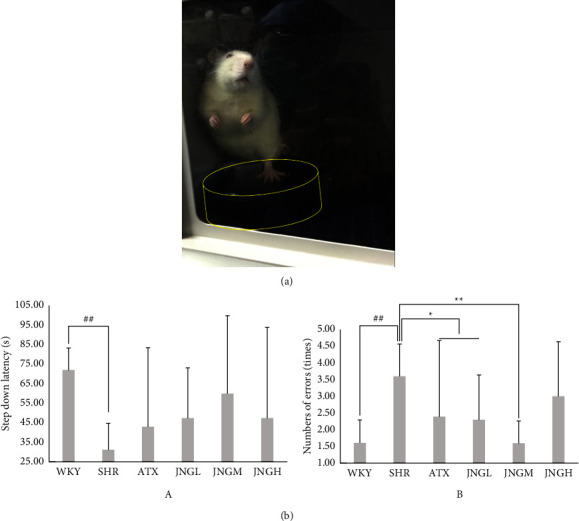
Six rat groups were used in the experiment: Wistar-Kyoto rats (WKY, control group) and five SHR groups, including a model group; atomoxetine (ATX, positive control) group; and low, medium, and high-dose JNG groups. The corresponding treatments were daily administered to each group for 6 weeks. A behavioral test, including a step-down test and open field test (OFT), was carried out at the end of treatment. After the behavioral test, all animals were sacrificed, and the brain tissue was collected and analyzed ex vivo; histopathological analysis was performed to assess the pathological changes of the hippocampus; expression of D1-like and D2-like receptors, sensor protein calmodulin (CaM), protein kinase A (PKA), and calcium/calmodulin-dependent serine/threonine protein kinase (CaMKII) in the striatum and hippocampus was measured by western blot and real-time quantitative PCR (RT-PCR); cyclic adenosine monophosphate (cAMP) levels in the striatum were analyzed using an enzyme-linked immunosorbent assay (ELISA), while the level of Ca in the striatum was analyzed by a calcium kit.
Our results showed that ATX or JNG could ameliorate the hyperactive/impulsive behavior and cognitive function of ADHD by promoting neuroprotection. Mechanistically, ATX or JNG could prompt the expressions of Dl-like and D2-like receptors and improve the mRNA and protein levels of cAMP/PKA and Ca/CAM/CAMKII signaling pathways.
These results indicate that JNG can produce therapeutic effects by regulating the balance of D2/D1-like receptor-mediated cAMP/PKA and Ca/CaM/CaMKII signaling pathways.
注意力缺陷多动障碍(ADHD)是一种以注意力缺陷、多动和冲动为特征的神经发育障碍。静宁颗粒(JNG)是一种能缓解ADHD的中药。尽管JNG通常用于有效治疗ADHD并已获得国家发明专利,但其确切作用机制仍不清楚。
在本研究中,我们研究了JNG对自发性高血压大鼠(SHR)的作用及其机制。我们假设JNG会影响多巴胺能D2/D1样受体及相关通路。
实验使用了六个大鼠组:Wistar-Kyoto大鼠(WKY,对照组)和五个SHR组,包括一个模型组;托莫西汀(ATX,阳性对照组);以及低、中、高剂量JNG组。每组每天给予相应治疗,持续6周。治疗结束时进行行为测试,包括跳台试验和旷场试验(OFT)。行为测试后,处死所有动物,收集脑组织并进行离体分析;进行组织病理学分析以评估海马体的病理变化;通过蛋白质印迹法和实时定量PCR(RT-PCR)测量纹状体和海马体中D1样和D2样受体、传感蛋白钙调蛋白(CaM)、蛋白激酶A(PKA)以及钙/钙调蛋白依赖性丝氨酸/苏氨酸蛋白激酶(CaMKII)的表达;使用酶联免疫吸附测定(ELISA)分析纹状体中环磷酸腺苷(cAMP)水平,同时用钙试剂盒分析纹状体中的钙水平。
我们的结果表明,ATX或JNG可通过促进神经保护改善ADHD的多动/冲动行为和认知功能。从机制上讲,ATX或JNG可促使D1样和D2样受体的表达,并提高cAMP/PKA和Ca/CAM/CAMKII信号通路的mRNA和蛋白质水平。
这些结果表明,JNG可通过调节D2/D1样受体介导的cAMP/PKA和Ca/CaM/CaMKII信号通路的平衡产生治疗作用。