Instituto de Ciências Ambientais, Químicas e Farmacêuticas (ICAQF), Universidade Federal de São Paulo (UNIFESP), Sao Paulo, Brazil.
Laboratório de Endocrinologia Molecular e Translacional (LEMT), Universidade Federal de São Paulo, Sao Paulo, Brazil.
Front Endocrinol (Lausanne). 2022 Oct 21;13:995503. doi: 10.3389/fendo.2022.995503. eCollection 2022.
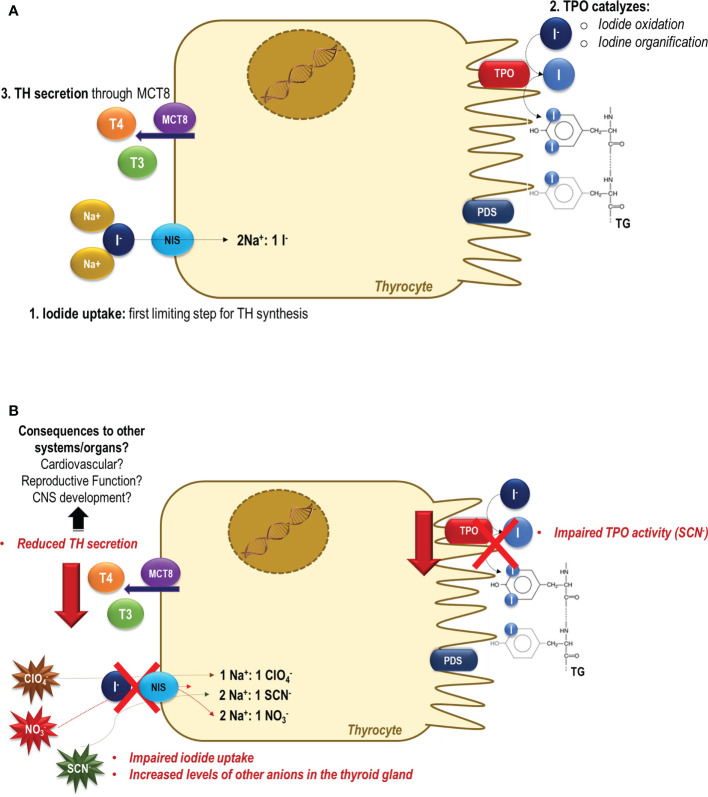
Thyroid disruptors are found in food, atmosphere, soil, and water. These contaminants interfere with the thyroid function through the impairment of thyroid hormone synthesis, plasma transport, peripheral metabolism, transport into the target cells, and thyroid hormone action. It is well known that iodide uptake mediated by the sodium-iodide symporter (NIS) is the first limiting step involved in thyroid hormones production. Therefore, it has been described that several thyroid disruptors interfere with the thyroid function through the regulation of NIS expression and/or activity. Perchlorate, nitrate, and thiocyanate competitively inhibit the NIS-mediated iodide uptake. These contaminants are mainly found in food, water and in the smoke of cigarettes. Although the impact of the human exposure to these anions is highly controversial, some studies indicated their deleterious effects in the thyroid function, especially in individuals living in iodine deficient areas. Considering the critical role of thyroid function and the production of thyroid hormones for growth, metabolism, and development, this review summarizes the impact of the exposure to these NIS-inhibitors on thyroid function and their consequences for human health.
甲状腺干扰物存在于食物、大气、土壤和水中。这些污染物通过损害甲状腺激素合成、血浆转运、外周代谢、向靶细胞转运以及甲状腺激素作用来干扰甲状腺功能。众所周知,钠-碘转运体(NIS)介导的碘摄取是甲状腺激素生成中涉及的第一个限速步骤。因此,已经描述了几种甲状腺干扰物通过调节 NIS 表达和/或活性来干扰甲状腺功能。高氯酸盐、硝酸盐和硫氰酸盐竞争性抑制 NIS 介导的碘摄取。这些污染物主要存在于食物、水和香烟烟雾中。尽管人类暴露于这些阴离子的影响存在很大争议,但一些研究表明它们对甲状腺功能具有有害影响,特别是在生活在缺碘地区的个体中。考虑到甲状腺功能和甲状腺激素的产生对生长、代谢和发育的关键作用,本综述总结了暴露于这些 NIS 抑制剂对甲状腺功能的影响及其对人类健康的后果。