Khazanov Gabriela Kattan, Keddem Shimrit, Hoskins Katelin, Myhre Karoline, Sullivan Sarah, Mitchell Emily, Holliman Brooke Dorsey, Landes Sara J, Simonetti Joseph
Mental Illness Research, Education and Clinical Center, Corporal Michael J. Crescenz VA Medical Center, Philadelphia, PA, United States.
Perelman School of Medicine, University of Pennsylvania, Philadelphia, PA, United States.
Front Psychiatry. 2022 Oct 20;13:993415. doi: 10.3389/fpsyt.2022.993415. eCollection 2022.
Lethal means safety counseling (LMSC) is an evidence-based suicide prevention intervention during which providers encourage patients to limit their access to lethal means (e.g., firearms, medications). Despite agreement about the importance of LMSC, it is underutilized in clinical practice.
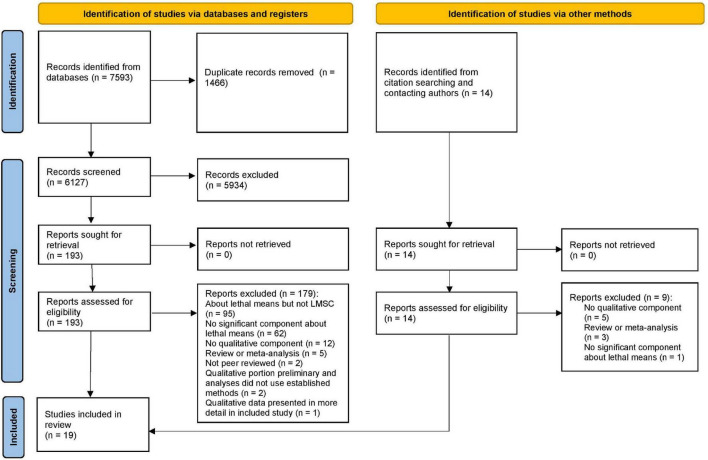
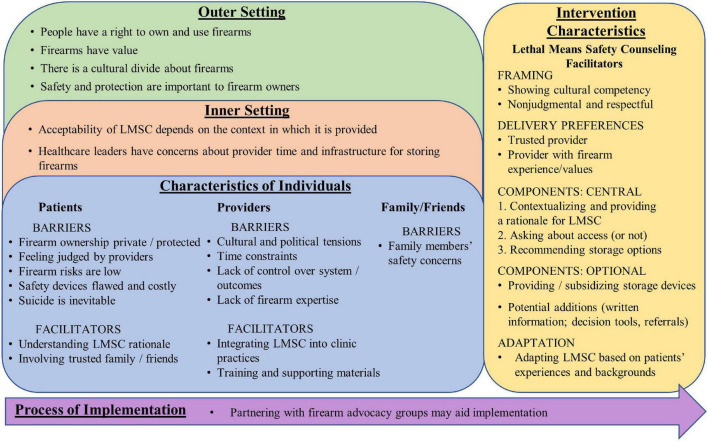
To better understand the individual and contextual factors that influence LMSC and its implementation, we conducted a systematic review of qualitative studies examining stakeholder perceptions of the intervention. PubMed and PsycInfo were searched up to February 2021 using terms related to: (1) LMSC, firearms, or medications; (2) suicide, safety, or injury; and (3) qualitative methodology. Two coders used thematic synthesis to analyze findings from eligible papers, including developing a codebook and coding using an inductive and iterative approach (reliability > 0.70). Confidence in review findings were evaluated using the Confidence in the Evidence from Reviews of Qualitative Research (CERQual) Approach. Subthemes were assigned to domains in the Consolidated Framework for Implementation Research.
Of the 19 papers identified, 18 discussed LMSC for firearms and 1 focused exclusively on LMSC for medications. The firearm-related studies explored perspectives of a variety of stakeholders (patients, providers, members of the firearms community, healthcare leaders, and family members) across multiple settings (emergency departments, pediatric and adult primary care, and outpatient mental health). Seven overarching themes emerged, including the: (1) importance of firearms to owners' identities and perceptions of ownership as a value and right, which can lead to perceived cultural tensions in clinical settings; (2) importance of patients understanding the context and rationale for LMSC; (3) value of providers showing cultural competency when discussing firearms; (4) influence of safety and risk beliefs on firearm behaviors; (5) need to navigate logistical concerns when implementing LMSC; (6) value of individualizing LMSC; (7) potential for trusted family members and friends to be involved in implementing LMSC.
This synthesis of the qualitative literature informs clinical, operational, and research endeavors aimed at increasing the reach and effectiveness of LMSC. Future research should address the perspectives of individuals underrepresented in the literature (e.g., those from racial/ethnic minority groups) and further examine stakeholders' perceptions of LMSC for medication. [-2pt].
[https://www.crd.york.ac.uk/prospero/display_record.php?ID=CRD42021237515], identifier [CRD42021237515].
致命手段安全咨询(LMSC)是一种基于证据的自杀预防干预措施,在此过程中,医疗服务提供者鼓励患者限制获取致命手段(如枪支、药物)。尽管人们一致认为LMSC很重要,但它在临床实践中的应用却未得到充分利用。
为了更好地理解影响LMSC及其实施的个体和背景因素,我们对定性研究进行了系统综述,以考察利益相关者对该干预措施的看法。截至2021年2月,我们在PubMed和PsycInfo数据库中使用了与以下方面相关的术语进行检索:(1)LMSC、枪支或药物;(2)自杀、安全或伤害;(3)定性方法。两名编码员采用主题综合法对符合条件的论文的研究结果进行分析,包括制定编码手册,并采用归纳和迭代的方法进行编码(信度>0.70)。使用定性研究综述证据的可信度(CERQual)方法评估对综述结果的信心。将子主题分配到实施研究综合框架中的各个领域。
在检索到的19篇论文中,18篇讨论了针对枪支的LMSC,1篇专门关注针对药物的LMSC。与枪支相关的研究探讨了多个环境(急诊科、儿科和成人初级保健以及门诊心理健康科)中各种利益相关者(患者、医疗服务提供者、枪支社区成员、医疗保健领导者和家庭成员)的观点。出现了七个总体主题,包括:(1)枪支对所有者身份的重要性以及将所有权视为一种价值和权利的观念,这可能导致在临床环境中感受到文化紧张关系;(2)患者理解LMSC的背景和基本原理的重要性;(3)医疗服务提供者在讨论枪支时表现出文化能力的价值;(4)安全和风险信念对枪支行为的影响;(5)实施LMSC时应对后勤问题的必要性;(6)个性化LMSC的价值;(7)可信赖的家庭成员和朋友参与实施LMSC的可能性。
对定性文献的这一综合分析为旨在扩大LMSC的覆盖范围和提高其有效性的临床、操作和研究工作提供了信息。未来的研究应关注文献中代表性不足的个体的观点(如来自种族/族裔少数群体的个体),并进一步考察利益相关者对针对药物的LMSC的看法。[-2pt]
[https://www.crd.york.ac.uk/prospero/display_record.php?ID=CRD42021237515],标识符[CRD42021237515]