Poon Kean, Ho Mimi S H, Chou Kee-Lee
School of Education, University of New South Wales, Sydney, Australia.
Department of Special Education and Counselling, The Education University of Hong Kong, Hong Kong.
Heliyon. 2022 Oct 19;8(10):e11121. doi: 10.1016/j.heliyon.2022.e11121. eCollection 2022 Oct.
It is well-documented that socioeconomic status (SES) and academic performance in school-aged children are closely related. However, little is known about how the three core executive functions (EFs), inhibition, working memory, and cognitive flexibility, mediate the association between the two. Moreover, most previous studies examined SES disparities in Western countries, how such disparities in EF and academic performance manifest in the Chinese context, where a distinctive EF profile and learning experience are observed, remains uncertain. The current study explored: (1) the mediating effects of the three core EFs in the association between SES and academic performance; and (2) the differences in EF and academic performance in three core subjects between Chinese children who are below and above the poverty line.
Of the 385 students sampled, 205 are in the low-SES group and 180 are in the middle-high SES group.
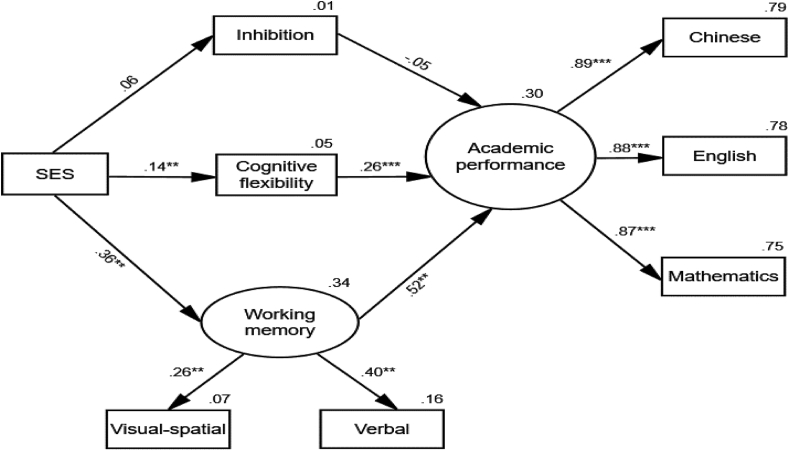
A structural equation model showed that the SES-academic performance relationship was fully mediated by cognitive flexibility and working memory but not inhibition. Working memory was a much stronger mediator than cognitive flexibility, suggesting that working memory may correlate with childhood SES and academic performance in Chinese children. An analysis of covariance suggested that compared to the middle-high SES group, the low-SES group demonstrated poorer working memory and academic performance in all three subjects after controlling for age and IQ. Interestingly, children with low-SES were found to have better cognitive flexibility than children with middle-high SES.
These findings suggest that interventions targeting working memory may be an important area to improve children's academic performance.
有充分文献记载,社会经济地位(SES)与学龄儿童的学业成绩密切相关。然而,对于三种核心执行功能(EFs),即抑制、工作记忆和认知灵活性,如何介导两者之间的关联,我们知之甚少。此外,以往大多数研究考察的是西方国家的SES差异,而在具有独特EF特征和学习经历的中国背景下,这种EF和学业成绩差异如何表现仍不确定。本研究探讨了:(1)三种核心EFs在SES与学业成绩关联中的中介作用;(2)贫困线以下和以上的中国儿童在三门核心学科的EF和学业成绩差异。
在抽取的385名学生中,205名属于低SES组,180名属于中高SES组。
结构方程模型显示,SES与学业成绩的关系完全由认知灵活性和工作记忆介导,而非抑制。工作记忆的中介作用比认知灵活性强得多,这表明工作记忆可能与中国儿童的童年SES和学业成绩相关。协方差分析表明,与中高SES组相比,低SES组在控制年龄和智商后,三门学科的工作记忆和学业成绩均较差。有趣的是,发现低SES儿童的认知灵活性比中高SES儿童更好。
这些发现表明,针对工作记忆的干预可能是提高儿童学业成绩的一个重要领域。