Venkatesh Prasad Karthik, Bonso Aldo, Woods Christopher E, Goya Masahiko, Matsuo Seiichiro, Padanilam Benzy J, Kreis Ingo, Yang Felix, Williams Christopher G, Tranter John H, Verbick Laura Zitella, Sarver Anne E, Almendral Jesus
North Mississippi Medical Center, Tupelo, Mississippi.
Ospedale Santa Maria del Prato, Feltre, Italy.
Heart Rhythm O2. 2022 Jun 16;3(5):526-535. doi: 10.1016/j.hroo.2022.06.004. eCollection 2022 Oct.
Pulmonary vein isolation (PVI) ablation is a standard therapy for paroxysmal atrial fibrillation (PAF). Lesion Index (LSI) is a metric to guide radiofrequency (RF) ablation using the TactiCath Ablation Catheter, Sensor Enabled with the EnSite Cardiac Mapping System (Abbott).
This study (NCT-03906461) was designed to capture best practices using LSI-guided catheter ablation to treat PAF subjects in a real-world setting.
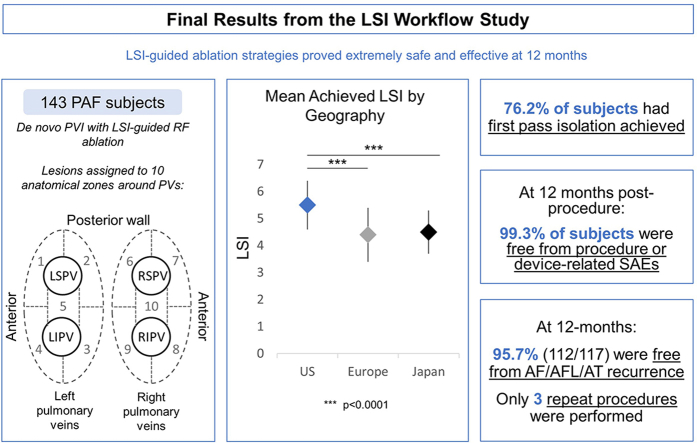
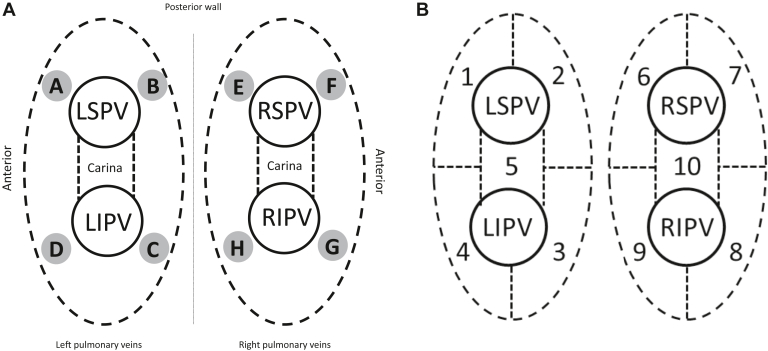
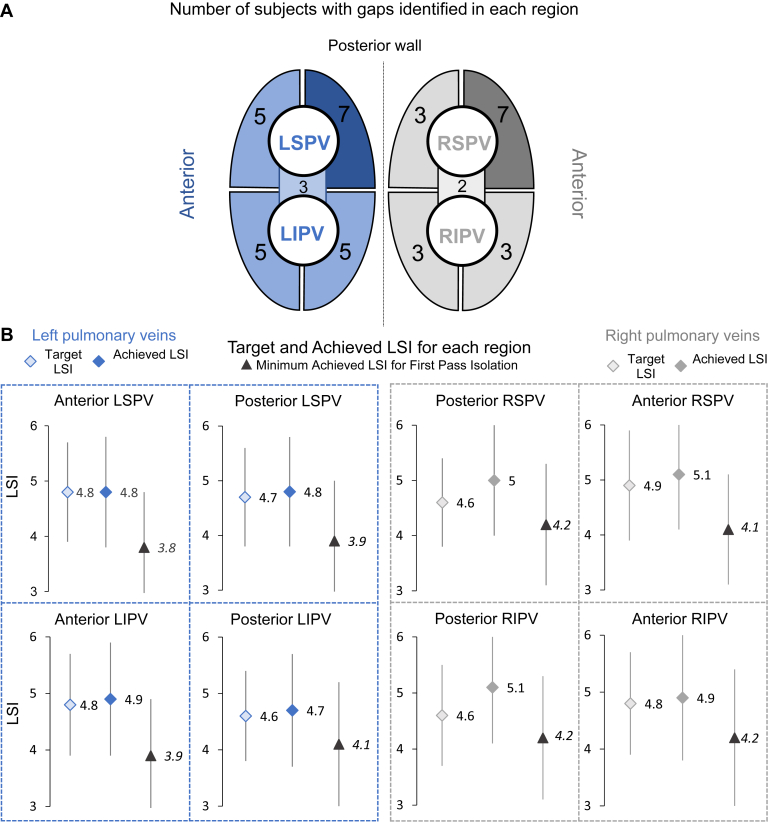
This prospective single-arm observational study enrolled 143 PAF subjects in the United States, Europe, and Japan undergoing de novo PVI with RF ablation. PVI lesions were assigned to 10 anatomically defined segments. Mean LSIs achieved for all lesions were analyzed. Follow-up was conducted between 3-6 months and 12 months after the procedure.
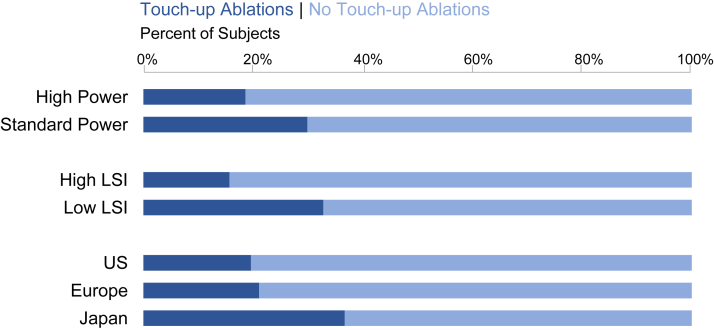
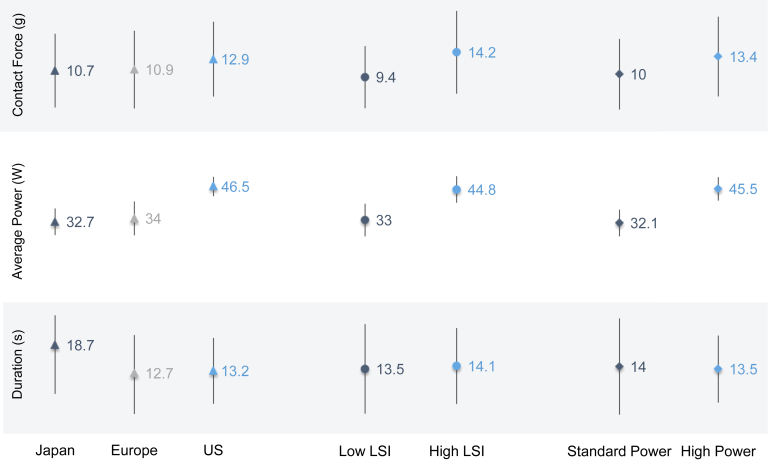
Pulmonary veins were isolated in all subjects. The mean achieved LSI was 4.9, with lower values in Europe (4.4) and Japan (4.5) than the United States (5.5). First-pass success, defined as no gaps requiring touch-up ablation after 20 minutes post isolation, was achieved in 76.2% of subjects. Use of high LSI (≥5) resulted in shorter procedure, RF, and fluoroscopy times and fewer touch-up ablations compared to low LSI (<5). At 12 months, 99.3% of subjects were free from procedure- or device-related serious adverse events and 95.7% (112/117) (35.0% on antiarrhythmic drugs) were free from recurrence and/or a repeat ablation procedure for atrial fibrillation / atrial flutter / atrial tachycardia.
LSI-guided ablation strategies proved safe and effective despite differences in LSI workflows. Use of high LSI values resulted in shorter procedure, RF, and fluoroscopy times and fewer touch-up ablations compared to low LSI.
肺静脉隔离(PVI)消融是阵发性心房颤动(PAF)的标准治疗方法。病变指数(LSI)是一种使用配备了EnSite心脏标测系统(雅培公司)的TactiCath消融导管来指导射频(RF)消融的指标。
本研究(NCT-03906461)旨在记录在现实环境中使用LSI指导的导管消融治疗PAF患者的最佳实践。
这项前瞻性单臂观察性研究纳入了美国、欧洲和日本的143例接受初次PVI射频消融的PAF患者。PVI病变被分配到10个解剖学定义的节段。分析了所有病变的平均LSI。在术后3至6个月和12个月进行随访。
所有患者的肺静脉均被隔离。平均达到的LSI为4.9,欧洲(4.4)和日本(4.5)的值低于美国(5.5)。首次消融成功定义为隔离后20分钟内无需要补点消融的间隙,76.2%的患者实现了首次消融成功。与低LSI(<5)相比,使用高LSI(≥5)可缩短手术时间、射频时间和透视时间,且补点消融次数更少。在12个月时,99.3%的患者无手术或器械相关严重不良事件,95.7%(112/117)(35.0%服用抗心律失常药物)无房颤/房扑/房性心动过速复发和/或再次消融手术。
尽管LSI工作流程存在差异,但LSI指导的消融策略被证明是安全有效的。与低LSI相比,使用高LSI值可缩短手术时间、射频时间和透视时间,且补点消融次数更少。