Nuhu Kaamel, Humagain Kamal, Alorbi Genevieve, Thomas Sabena, Blavos Alexis, Placide Vierne
Health Department, State University of New York at Cortland, Cortland, USA.
Geology Department, State University of New York at Potsdam, Potsdam, USA.
Discov Soc Sci Health. 2022;2(1):20. doi: 10.1007/s44155-022-00022-0. Epub 2022 Nov 1.
COVID-19 has exerted distress on virtually every aspect of human life with disproportionate mortality burdens on older individuals and those with underlying medical conditions. Variations in COVID-19 incidence and case fatality rates (CFRs) across countries have incited a growing research interest regarding the effect of social factors on COVID-19 case-loads and fatality rates. We investigated the effect of population median age, inequalities in human development, healthcare capacity, and pandemic mitigation indicators on country-specific COVID-19 CFRs across countries and regions.
Using population secondary data from multiple sources, we conducted a cross-sectional study and used regional analysis to compare regional differences in COVID-19 CFRs as influenced by the selected indicators.
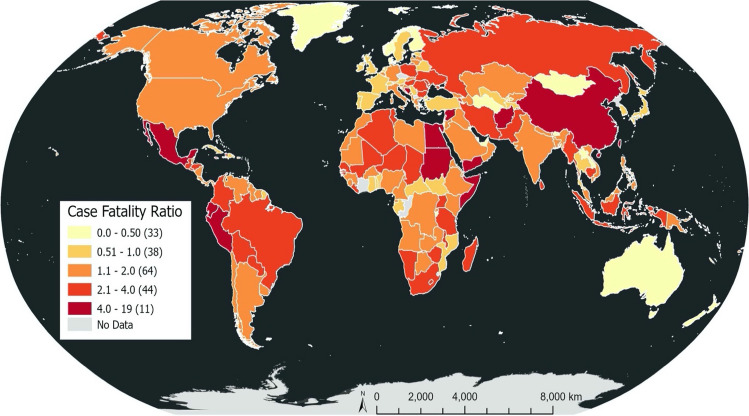
The analysis revealed wide variations in COVID-19 CFRs and the selected indicators across countries and regions. Mean CFR was highest for South America at 1.973% (± 0.742) and lowest for Oceania at 0.264% (± 0.107), while the Africa sub-region recorded the lowest scores for pandemic preparedness, vaccination rate, and other indicators. Population Median Age [0.073 (0.033 0.113)], Vaccination Rate [-3.3389 (-5.570.033 -1.208)], and Inequality-Adjusted Human Development Index (IHDI) [-0.014 (-0.023 -0.004)] emerged as statistically significant predictors of COVID-19 CFR, with directions indicating increasing Population Median Age, higher inequalities in human development and low vaccination rate are predictive of higher fatalities from COVID-19.
Regional differences in COVID-19 CFR may be influenced by underlying differences in sociodemographic and pandemic mitigation indicators. Populations with wide social inequalities, increased population Median Age and low vaccination rates are more likely to suffer higher fatalities from COVID-19.
新冠疫情对人类生活的几乎各个方面都造成了困扰,给老年人和有基础疾病的人带来了不成比例的死亡负担。各国新冠疫情发病率和病死率的差异引发了人们对社会因素对新冠病例数和病死率影响的日益浓厚的研究兴趣。我们调查了人口中位数年龄、人类发展不平等、医疗保健能力和疫情缓解指标对不同国家和地区特定国家新冠病死率的影响。
利用来自多个来源的人口二级数据,我们进行了一项横断面研究,并使用区域分析来比较所选指标影响下新冠病死率的区域差异。
分析显示,不同国家和地区的新冠病死率及所选指标存在很大差异。南美洲的平均病死率最高,为1.973%(±0.742),大洋洲最低,为0.264%(±0.107),而非洲次区域在疫情防范、疫苗接种率和其他指标方面得分最低。人口中位数年龄[0.073(0.033 0.113)]、疫苗接种率[-3.3389(-5.570.033 -1.208)]和不平等调整后的人类发展指数(IHDI)[-0.014(-0.023 -(此处原文有误,推测应为-0.004)]成为新冠病死率的统计学显著预测因素,其趋势表明人口中位数年龄增加、人类发展不平等加剧和疫苗接种率低预示着新冠死亡人数增加。
新冠病死率的区域差异可能受到社会人口统计学和疫情缓解指标的潜在差异影响。社会不平等程度高、人口中位数年龄增加和疫苗接种率低的人群更有可能因新冠疫情而死亡人数增加。