Animal and Plant Health Agency, Weybridge, United Kingdom.
Avian Influenza Group, The Pirbright Institute, Woking, United Kingdom.
J Virol. 2022 Nov 23;96(22):e0129022. doi: 10.1128/jvi.01290-22. Epub 2022 Nov 7.
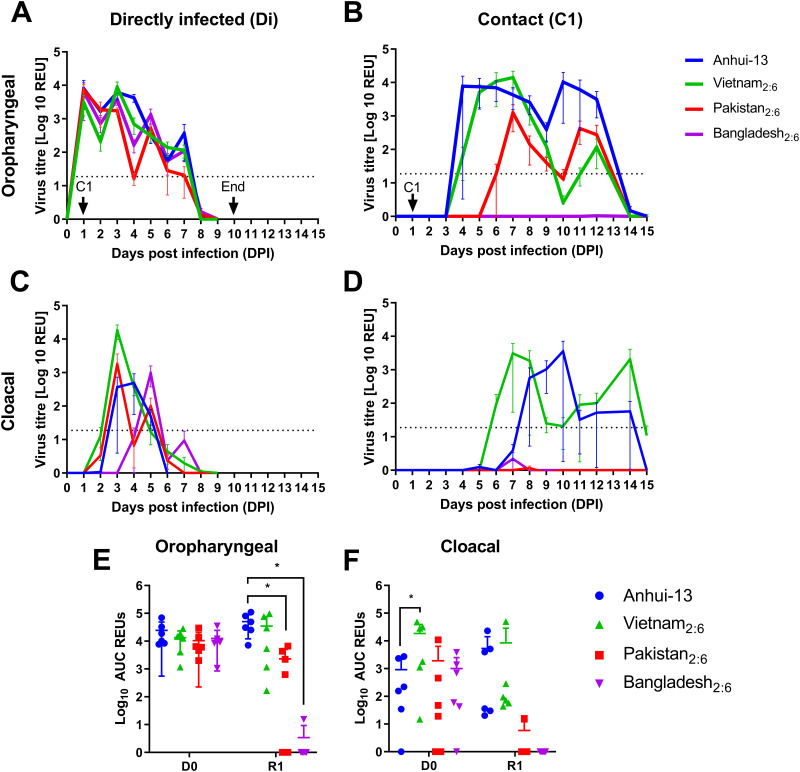
H9N2 avian influenza viruses (AIVs) have donated internal gene segments during the emergence of zoonotic AIVs, including H7N9. We used reverse genetics to generate A/Anhui/1/13 (H7N9) and three reassortant viruses (2:6 H7N9) which contained the hemagglutinin and neuraminidase from Anhui/13 (H7N9) and the six internal gene segments from H9N2 AIVs belonging to (i) G1 subgroup 2, (ii) G1 subgroup 3, or (iii) BJ94 lineages, enzootic in different regions throughout Asia. Infection of chickens with the 2:6 H7N9 containing G1-like H9N2 internal genes conferred attenuation , with reduced shedding and transmission to contact chickens. However, possession of BJ94-like H9N2 internal genes resulted in more rapid transmission and significantly elevated cloacal shedding compared to the parental Anhui/13 H7N9. analysis showed that the 2:6 H7N9 with BJ94-like internal genes had significantly increased replication compared to the Anhui/13 H7N9 in chicken cells. coinfection experiments followed, where chickens were coinfected with pairs of Anhui/13 H7N9 and a 2:6 H7N9 reassortant. During ensuing transmission events, the Anhui/13 H7N9 virus outcompeted 2:6 H7N9 AIVs with internal gene segments of BJ94-like or G1-like H9N2 viruses. Coinfection did lead to the emergence of novel reassortant genotypes that were transmitted to contact chickens. Some of the reassortant viruses had a greater replication in chicken and human cells compared to the progenitors. We demonstrated that the internal gene cassette determines the transmission fitness of H7N9 viruses in chickens, and the reassortment events can generate novel H7N9 genotypes with increased virulence in chickens and enhanced zoonotic potential. H9N2 avian influenza viruses (AIVs) are enzootic in poultry in different geographical regions. The internal genes of these viruses can be exchanged with other zoonotic AIVs, most notably the A/Anhui/1/2013-lineage H7N9, which can give rise to new virus genotypes with increased veterinary, economic and public health threats to both poultry and humans. We investigated the propensity of the internal genes of H9N2 viruses (G1 or BJ94) in the generation of novel reassortant H7N9 AIVs. We observed that the internal genes of H7N9 which were derivative of BJ94-like H9N2 virus have a fitness advantage compared to those from the G1-like H9N2 viruses for efficient transmission among chickens. We also observed the generation of novel reassortant viruses during chicken transmission which infected and replicated efficiently in human cells. Therefore, such emergent reassortant genotypes may pose an elevated zoonotic threat.
H9N2 禽流感病毒 (AIV) 在人畜共患病 AIV 的出现过程中提供了内部基因片段,包括 H7N9。我们使用反向遗传学技术生成了 A/Anhui/1/13 (H7N9) 和三种重组病毒 (2:6 H7N9),它们含有来自 Anhui/13 (H7N9) 的血凝素和神经氨酸酶以及来自属于不同地区的 H9N2 AIV 的六个内部基因片段 (i) G1 亚群 2、(ii) G1 亚群 3 或 (iii) BJ94 谱系。用含有 G1 样 H9N2 内部基因的 2:6 H7N9 感染鸡会导致衰减,病毒脱落和传播给接触鸡的能力降低。然而,携带 BJ94 样 H9N2 内部基因会导致更快的传播,并显著增加泄殖腔脱落量,与亲本 Anhui/13 H7N9 相比。分析表明,含有 BJ94 样内部基因的 2:6 H7N9 在鸡细胞中的复制能力明显高于 Anhui/13 H7N9。随后进行了共感染实验,其中鸡同时感染 Anhui/13 H7N9 和 2:6 H7N9 重组病毒。在随后的传播事件中,含有 Anhui/13 H7N9 的病毒与内部基因片段为 BJ94 样或 G1 样 H9N2 病毒的 2:6 H7N9 AIV 相比具有竞争优势。共感染确实导致了具有传播能力的新型重组基因型的出现,并传播给接触鸡。一些重组病毒在鸡和人细胞中的复制能力比亲本病毒更强。我们证明了内部基因盒决定了 H7N9 病毒在鸡中的传播适应性,重组事件可以产生新的 H7N9 基因型,在鸡中具有更高的毒力,并增强了人畜共患病的潜力。 H9N2 禽流感病毒 (AIV) 在不同地理区域的家禽中流行。这些病毒的内部基因可以与其他人畜共患病 AIV 交换,最显著的是 A/Anhui/1/2013 谱系 H7N9,它可以产生具有更高兽医、经济和公共卫生威胁的新型病毒基因型,对家禽和人类都有影响。我们研究了 H9N2 病毒 (G1 或 BJ94) 的内部基因在产生新型重组 H7N9 AIV 中的倾向性。我们观察到,与来自 G1 样 H9N2 病毒的内部基因相比,来自 BJ94 样 H9N2 病毒的 H7N9 内部基因在鸡之间的有效传播方面具有优势。我们还观察到在鸡传播过程中产生了新型重组病毒,这些病毒能够有效地感染和复制人细胞。因此,这种新出现的重组基因型可能构成更高的人畜共患病威胁。