Toraskar Kedar, Zore Ravindra R, Gupta Gaurav A, Gondse Bhooshan, Pundpal Gurudas, Kadam Shirishkumar, Pawaskar Sachin, Setia Maninder Singh
Critical Care Department, Wockhardt Hospital, Mumbai Central, Mumbai 400011, India.
MGM Institute of Health Sciences, Kamothe, Navi Mumbai 410209, India.
Eur J Radiol Open. 2022;9:100451. doi: 10.1016/j.ejro.2022.100451. Epub 2022 Nov 3.
We conducted this study to assess the diagnostic test properties of point of care ultrasonography (POCUS) of lung and cardiovascular system in prediction of mortality in COVID-19 patients.
This is a cross-sectional study of 178 Covid-19 patients; POCUS was performed within one hour of admission to the ICU. We estimated sensitivity, specificity, positive predictive value, negative predictive value for prediction of mortality.
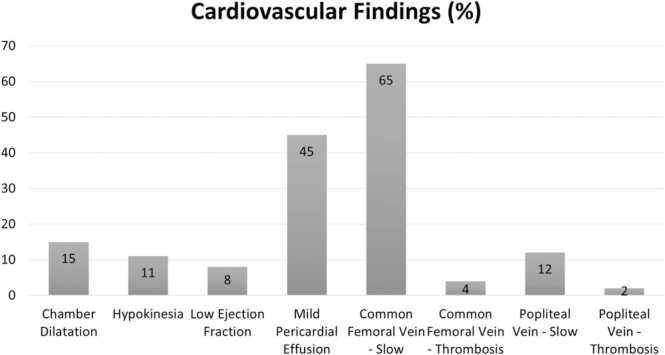
The mean (SD) age of these patients was 57.3 (12.8) years. The findings were on cardiac ultrasonography were: mild pericardial effusion (45%), chamber dilatation (15%), hypokinesia (11%), and low ejection fraction (8%). In our study, 30 patients (17%) had died. A cut-off score of > to 13 (for lung ultrasound score [LUS]) had high sensitivity for mortality (93.3%, 95% CI: 77.9-99.2%). However, low ejection fraction (92.3%, 95% CI: 86,6-96.1%), and thrombosis in either vein (96.5%, 95% CI: 92.0-98.9%) were specific for mortality. A combination of LUS > =13 or low ejection fraction or thrombosis or spontaneous echo contrast (slow flow) improved sensitivity for mortality to 96.7% (95% CI: 82.8-99.9%). The agreement between LUS of > =13 and CT score of moderate/severe was 85.7% (95% CI: 62.8-100%). The interrater agreement between these two parameters was 0.82 (95% CI: 0.68, 0.97).
Multi-organ POCUS is effective in diagnosis, prognosis, and management of COVID-19 patients. Rather than just lung ultrasound, clinicians should use multiorgan POCUS for early identification of severe lung involvement and thrombotic changes; it may help reduce mortality in these patients.
我们开展这项研究以评估床旁超声检查(POCUS)对肺部和心血管系统的诊断测试特性,用于预测新型冠状病毒肺炎(COVID-19)患者的死亡率。
这是一项对178例COVID-19患者的横断面研究;POCUS在患者入住重症监护病房(ICU)后1小时内进行。我们估计了预测死亡率的敏感性、特异性、阳性预测值和阴性预测值。
这些患者的平均(标准差)年龄为57.3(12.8)岁。心脏超声检查结果为:轻度心包积液(45%)、心腔扩大(15%)、运动减弱(11%)和射血分数降低(8%)。在我们的研究中,30例患者(17%)死亡。肺超声评分(LUS)>13分时对死亡率具有高敏感性(93.3%,95%置信区间:77.9 - 99.2%)。然而,射血分数降低(92.3%,95%置信区间:86.6 - 96.1%)以及任一静脉血栓形成(96.5%,95%置信区间:92.0 - 98.9%)对死亡率具有特异性。LUS≥13或射血分数降低或血栓形成或自发回声增强(血流缓慢)的联合应用将死亡率预测的敏感性提高至96.7%(95%置信区间:82.8 - 99.9%)。LUS≥13与中度/重度CT评分之间的一致性为85.7%(95%置信区间:62.8 - 100%)。这两个参数之间的评分者间一致性为0.82(95%置信区间:0.68,0.97)。
多器官POCUS在COVID-19患者的诊断、预后评估及管理中有效。临床医生不应仅使用肺部超声,而应采用多器官POCUS以早期识别严重肺部受累及血栓形成变化;这可能有助于降低这些患者的死亡率。