Department of Neurology, West China Hospital of Sichuan University, Chengdu, China.
Department of Neurology, Ruijin Hospital, Shanghai Jiao Tong University School of Medicine, Shanghai, China.
CNS Drugs. 2022 Nov;36(11):1217-1227. doi: 10.1007/s40263-022-00958-6. Epub 2022 Nov 8.
Levodopa remains the gold standard for the treatment of Parkinson's disease, but its long-term use is associated with motor complications whose management is still a significant challenge. Safinamide is a multimodal drug with proven efficacy as an adjunct to levodopa.
The objective of this study was to investigate the efficacy and safety of safinamide as an add-on to levodopa in Chinese patients with Parkinson's disease with motor fluctuations.
The XINDI study was a phase III, randomized, double-blind, placebo-controlled, multicenter study, with a 2-week screening period and a 16-week treatment period. The starting dose of safinamide (or placebo) was 50 mg once daily, increased to 100 mg once daily at day 15. Patients aged ≥ 18 years, with idiopathic Parkinson's disease of >3 years duration, Hoehn and Yahr stage 1-4, and daily OFF time ≥ 1.5 h, were eligible. Patients should follow a stable oral levodopa regimen and may receive concomitant treatment with stable doses of other anti-Parkinson drugs, except monoamine oxidase-B inhibitors. Patients with severe disabling peak-dose or biphasic dyskinesia, unpredictable or widely swinging fluctuations, other forms of parkinsonism, a history of dementia or severe cognitive dysfunction, major psychiatric illnesses, and/or clinically significant medical illnesses were excluded. The primary efficacy endpoint was the change from baseline to week 16 in the mean daily OFF time. Secondary efficacy endpoints included the Unified Parkinson's Disease Rating Scale, the Numerical Rating Scale, the Clinical Global Impression scale, and the 39-Item Parkinson's Disease Questionnaire scale. The statistical analysis of the efficacy parameters was conducted using an analysis of co-variance, except for the Clinical Global Impression scale scores that were assessed using the Wilcoxon-Mann-Whitney test. Safety was evaluated through the frequency of adverse events and serious adverse events, physical examination, vital signs, 12-lead electrocardiograms, and laboratory exams. All safety endpoints were summarized using descriptive statistics.
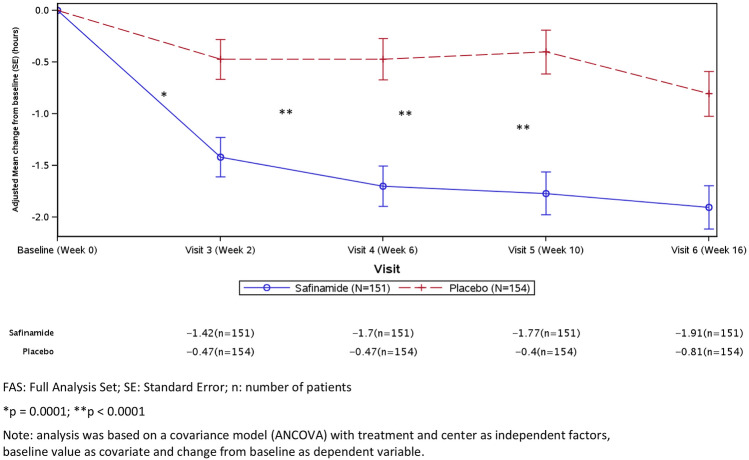
The trial enrolled 307 patients. At week 16, the difference in the change of the mean total daily OFF time between safinamide and placebo groups was 1.10 h (p < 0.0001). This change was significantly greater in the safinamide group starting from week 2, suggesting a rapid onset of drug efficacy. ON time, Unified Parkinson's Disease Rating Scale, Clinical Global Impression scale, and the 39-Item Parkinson's Disease Questionnaire showed statistically significant improvements. There were no significant between-group differences for adverse events or serious adverse events.
Safinamide, as add-on therapy to levodopa, significantly reduced motor fluctuations and improved motor symptoms and quality of life of Chinese patients with idiopathic Parkinson's disease. The improvements observed in the Unified Parkinson's Disease Rating Scale total and motor scores were also clinically significant. No safety concerns were identified, confirming the good tolerability profile of the drug.
NCT03881371, registered on 19 March, 2019, https://clinicaltrials.gov/NCT03881371 .
左旋多巴仍然是治疗帕金森病的金标准,但长期使用会导致运动并发症,其管理仍然是一个重大挑战。沙芬酰胺是一种具有多种作用机制的药物,已被证明可作为左旋多巴的辅助药物。
本研究旨在探讨沙芬酰胺作为左旋多巴的附加药物在中国帕金森病伴运动波动患者中的疗效和安全性。
XINDI 研究是一项为期 16 周的、随机、双盲、安慰剂对照、多中心的 III 期研究,有 2 周的筛选期和 16 周的治疗期。沙芬酰胺(或安慰剂)的起始剂量为 50mg 每日 1 次,第 15 天增加至 100mg 每日 1 次。符合条件的患者年龄≥18 岁,患有特发性帕金森病≥3 年,Hoehn 和 Yahr 分期 1-4 级,每日 OFF 时间≥1.5 小时。患者应遵循稳定的口服左旋多巴治疗方案,并可同时接受其他抗帕金森病药物(除单胺氧化酶-B 抑制剂外)的稳定剂量治疗。排除严重致残性峰剂量或双相运动障碍、不可预测或广泛波动、其他形式的帕金森病、痴呆或严重认知功能障碍史、重大精神疾病和/或有临床意义的医学疾病的患者。主要疗效终点是从基线到第 16 周时平均每日 OFF 时间的变化。次要疗效终点包括统一帕金森病评定量表、数字评定量表、临床总体印象量表和 39 项帕金森病问卷量表。除临床总体印象量表评分采用 Wilcoxon-Mann-Whitney 检验进行评估外,其他疗效参数的统计分析均采用协方差分析。安全性通过不良事件和严重不良事件的频率、体格检查、生命体征、12 导联心电图和实验室检查进行评估。所有安全性终点均采用描述性统计进行总结。
该试验共纳入 307 例患者。第 16 周时,沙芬酰胺组和安慰剂组的平均总每日 OFF 时间变化差异为 1.10 小时(p < 0.0001)。沙芬酰胺组从第 2 周开始,这种变化明显更大,提示药物疗效迅速起效。ON 时间、统一帕金森病评定量表、临床总体印象量表和 39 项帕金森病问卷显示出统计学上的显著改善。不良事件或严重不良事件在两组间无显著差异。
沙芬酰胺作为左旋多巴的附加治疗药物,可显著减少运动波动,改善中国特发性帕金森病患者的运动症状和生活质量。观察到的统一帕金森病评定量表总分和运动评分的改善也具有临床意义。未发现安全性问题,证实了药物良好的耐受性。
NCT03881371,于 2019 年 3 月 19 日注册,https://clinicaltrials.gov/NCT03881371。