Sadidi Mohammad, Zare Ahad, Nasrollahzadehsabet Mehrdad, Dastan Farzaneh, Mosadegh Khah Ali, Jafari Asheyani Milad
Department of Internal Medicine, AJA University of Medical Sciences, Tehran, Iran.
Department of Immunology, Faculty of Medicine, Tehran Medical Sciences, Islamic Azad University, Tehran, Iran.
J Res Med Sci. 2022 Aug 27;27:62. doi: 10.4103/jrms.jrms_71_22. eCollection 2022.
COVID-19 is responsible for the latest pandemic. Dipeptidyl peptidase-4 (DPP-4) is one of the cellular receptors of interest for coronavirus. The aim of this study was to assess the roles of DPP-4 inhibitors in prognosis of COVID-19 infection in patients with type 2 diabetes mellitus.
retrospective cohort study was performed in 2020 in military medical centers affiliated to AJA University of Medical Sciences in Tehran on 220 patients with type 2 diabetes mellitus who were admitted in medical centers with COVID-19 infection. We collected demographic data of patients including age, gender, drug history, usage of DPP-4 inhibitors, clinical presentations at the time of the first visit, and the disease outcome including hospitalization duration and need for respiratory assist.
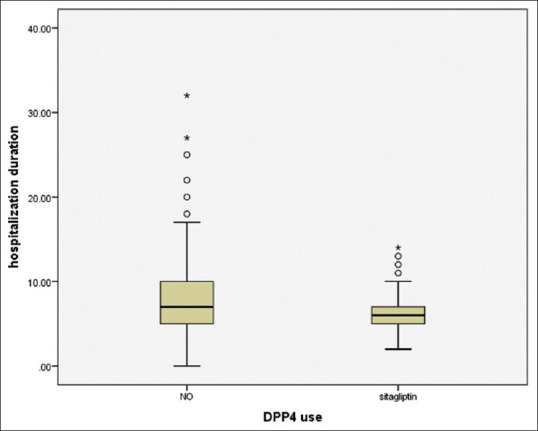
The study population consisted of 133 males (60.5%) and 87 females (39.5%), with a mean age of 66.13 ± 12.3 years. Forty-four patients (20%) consumed DPP-4 inhibitors (sitagliptin and linagliptin). Patients who were treated with DPP-4 inhibitors required less oxygen (O) therapies compared to other cases (76.7% vs. 88.6%, = 0.04). Patients who were treated with DPP-4 inhibitors had significantly lower hospitalization duration compared to other cases (6.57 ± 2.3 days vs. 8.03 ± 4.4 days, respectively, = 0.01). There were no significant differences between the two groups of patients regarding survival rates ( = 0.55). Age was a predictive factor for survival (odds ratio, 1.13; 95% confidence interval, 1.04-1.23; = 0.004).
DPP-4 inhibitors could significantly decrease hospitalization days in patients with type 2 diabetes mellitus who were hospitalized for COVID-19. However, DPP-4 inhibitor usage showed no statistically significant impact on survival. Age was the important prognostic factor.
新型冠状病毒肺炎(COVID-19)引发了最近的大流行。二肽基肽酶4(DPP-4)是冠状病毒感兴趣的细胞受体之一。本研究的目的是评估DPP-4抑制剂在2型糖尿病患者COVID-19感染预后中的作用。
2020年在德黑兰阿亚图拉大学医学科学分校附属的军事医疗中心对220例因COVID-19感染入住医疗中心的2型糖尿病患者进行了回顾性队列研究。我们收集了患者的人口统计学数据,包括年龄、性别、用药史、DPP-4抑制剂的使用情况、首次就诊时的临床表现以及疾病结局,包括住院时间和呼吸辅助需求。
研究人群包括133名男性(60.5%)和87名女性(39.5%),平均年龄为66.13±12.3岁。44例患者(20%)使用了DPP-4抑制剂(西他列汀和利格列汀)。与其他病例相比,接受DPP-4抑制剂治疗的患者需要的氧疗较少(76.7%对88.6%,P = 0.04)。与其他病例相比,接受DPP-4抑制剂治疗的患者住院时间显著缩短(分别为6.57±2.3天和8.03±4.4天,P = 0.01)。两组患者的生存率无显著差异(P = 0.55)。年龄是生存的预测因素(优势比,1.13;95%置信区间,1.04 - 1.23;P = 0.004)。
DPP-4抑制剂可显著缩短因COVID-19住院的2型糖尿病患者的住院天数。然而,DPP-4抑制剂的使用对生存率没有统计学上的显著影响。年龄是重要的预后因素。