Department of Cardiology, Inselspital, Bern University Hospital, University of Bern, Bern, Switzerland.
ARTORG Center for Biomedical Engineering Research, University of Bern, Bern, Switzerland.
Europace. 2023 Feb 16;25(2):767-774. doi: 10.1093/europace/euac202.
Subcutaneous implantable cardioverter defibrillators (S-ICDs) are well established. However, inappropriate shocks (IAS) remain a source of concern since S-ICDs offer very limited troubleshooting options. In our multicentre case series, we describe several patients who experienced IAS due to a previously unknown S-ICD system issue.
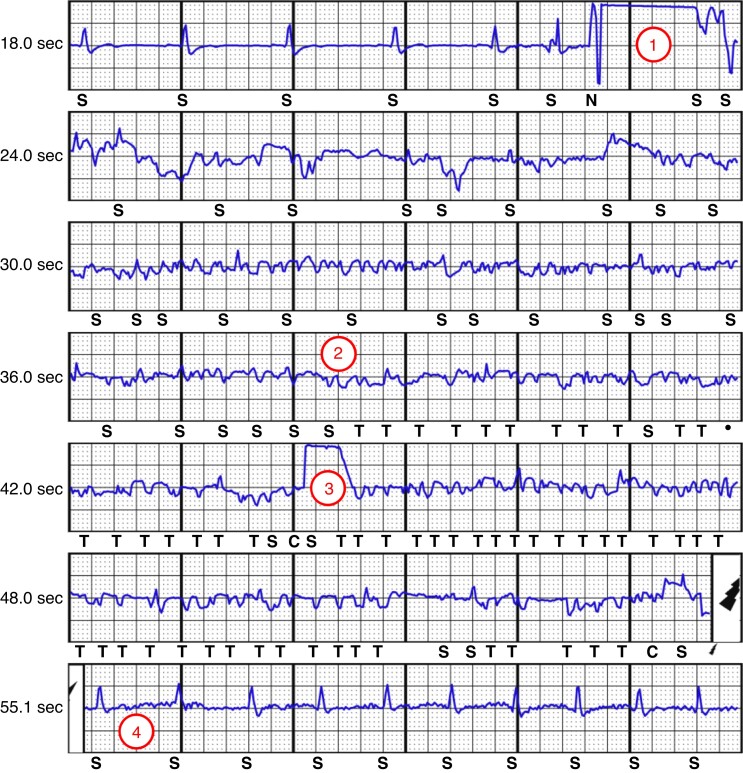
We observed six patients suffering from this novel IAS entity. The IAS occurred exclusively in primary or alternate S-ICD sensing vector configuration (therefore called 'Sense-B-noise'). IAS were caused by non-physiologic oversensing episodes characterized by intermittent signal saturation, diminished QRS amplitudes, and disappearance of the artefacts after the IAS. Noise/oversensing could not be provoked by manipulation, X-ray did not show evidence for lead/header issues and impedance measurements were within normal limits. The pooled experience of our centres implies that up to ∼5% of S-ICDs may be affected. The underlying root cause was discussed extensively with the manufacturer but remains unknown and is under further investigation.
Sense-B-noise is a novel cause for IAS due to non-physiologic signal oversensing, arising from a previously unknown S-ICD system issue. Sense-B-noise may be suspected if episodes of signal saturation in primary or alternate vector configuration are present, oversensing cannot be provoked, and X-ray and electrical measurements appear normal. The issue can be resolved by reprogramming the device to secondary sensing vector.
皮下植入式心律转复除颤器(S-ICD)已经得到广泛应用。然而,不适当的电击(IAS)仍然是一个令人担忧的问题,因为 S-ICD 提供的故障排除选项非常有限。在我们的多中心病例系列中,我们描述了几位因先前未知的 S-ICD 系统问题而经历 IAS 的患者。
我们观察到六名患有这种新型 IAS 实体的患者。IAS 仅发生在原发性或备用 S-ICD 感测向量配置中(因此称为“感测-B-噪声”)。IAS 是由非生理过度感测事件引起的,其特征为间歇性信号饱和、QRS 幅度降低以及 IAS 后伪影消失。通过操作无法引发噪声/过度感测,X 射线未显示出导联/头端问题的证据,阻抗测量值在正常范围内。我们中心的经验表明,高达约 5%的 S-ICD 可能受到影响。与制造商广泛讨论了根本原因,但仍不清楚,正在进一步调查中。
感测-B-噪声是一种由于非生理信号过度感测引起的新型 IAS 原因,源自先前未知的 S-ICD 系统问题。如果在原发性或备用向量配置中存在信号饱和的事件,过度感测无法引发,并且 X 射线和电测量看起来正常,则可以怀疑存在感测-B-噪声。可以通过将设备重新编程到次要感测向量来解决此问题。