Department of Cell Biology, Microbiology, and Molecular Biology, University of South Florida, Tampa, FL 33620, USA.
Biomolecules. 2022 Oct 25;12(11):1558. doi: 10.3390/biom12111558.
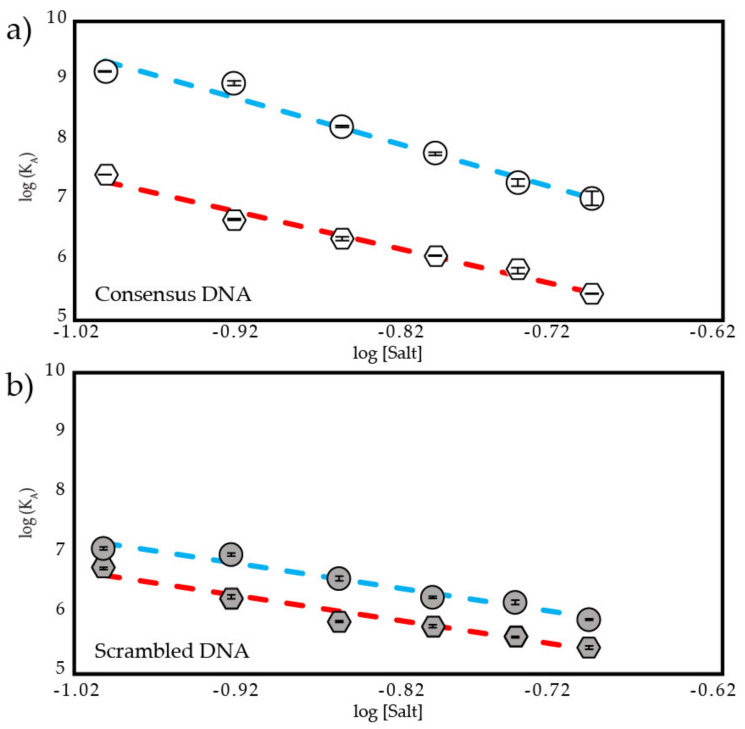
An intramolecular interaction between the p53 transactivation and DNA binding domains inhibits DNA binding. To study this autoinhibition, we used a fragment of p53, referred to as ND WT, containing the N-terminal transactivation domains (TAD1 and TAD2), a proline rich region (PRR), and the DNA binding domain (DBD). We mutated acidic, nonpolar, and aromatic amino acids in TAD2 to disrupt the interaction with DBD and measured the effects on DNA binding affinity at different ionic strengths using fluorescence anisotropy. We observed a large increase in DNA binding affinity for the mutants consistent with reduced autoinhibition. The ΔΔG between DBD and ND WT for binding a consensus DNA sequence is -3.0 kcal/mol at physiological ionic strength. ΔΔG increased to -1.03 kcal/mol when acidic residues in TAD2 were changed to alanine (ND DE) and to -1.13 kcal/mol when all the nonpolar residues, including W53/F54, were changed to alanine (ND NP). These results indicate there is some cooperation between acidic, nonpolar, and aromatic residues from TAD2 to inhibit DNA binding. The dependence of DNA binding affinity on ionic strength was used to predict excess counterion release for binding both consensus and scrambled DNA sequences, which was smaller for ND WT and ND NP with consensus DNA and smaller for scrambled DNA overall. Using size exclusion chromatography, we show that the ND mutants have similar Stokes radii to ND WT suggesting the mutants disrupt autoinhibition without changing the global structure.
p53 转录激活和 DNA 结合结构域之间的分子内相互作用抑制 DNA 结合。为了研究这种自动抑制作用,我们使用了 p53 的一个片段,称为 ND WT,它包含 N 端转录激活结构域(TAD1 和 TAD2)、富含脯氨酸的区域(PRR)和 DNA 结合结构域(DBD)。我们突变了 TAD2 中的酸性、非极性和芳香族氨基酸,以破坏与 DBD 的相互作用,并使用荧光各向异性测量了在不同离子强度下对 DNA 结合亲和力的影响。我们观察到突变体的 DNA 结合亲和力有很大的增加,这与自动抑制作用的降低一致。在生理离子强度下,DBD 与 ND WT 结合共识 DNA 序列的 ΔΔG 为-3.0 kcal/mol。当 TAD2 中的酸性残基突变为丙氨酸(ND DE)时,ΔΔG 增加到-1.03 kcal/mol,当包括 W53/F54 在内的所有非极性残基突变为丙氨酸(ND NP)时,ΔΔG 增加到-1.13 kcal/mol。这些结果表明,TAD2 中的酸性、非极性和芳香族残基之间存在一些协同作用,以抑制 DNA 结合。DNA 结合亲和力对离子强度的依赖性用于预测结合共识和乱序 DNA 序列的过量抗衡离子释放,对于共识 DNA,ND WT 和 ND NP 的结合亲和力较小,而总体上乱序 DNA 的结合亲和力较小。使用尺寸排阻色谱法,我们表明 ND 突变体的 Stokes 半径与 ND WT 相似,这表明突变体在不改变整体结构的情况下破坏了自动抑制作用。