Department of Geriatrics, Tianjin Medical University General Hospital, Tianjin 300052, China.
Tianjin Geriatrics Institute, Tianjin 300052, China.
Genes (Basel). 2022 Nov 2;13(11):2010. doi: 10.3390/genes13112010.
Observational research has found a bidirectional relationship between major depressive disorder and gastroesophageal reflux disease; however, the causal association of this relationship is undetermined.
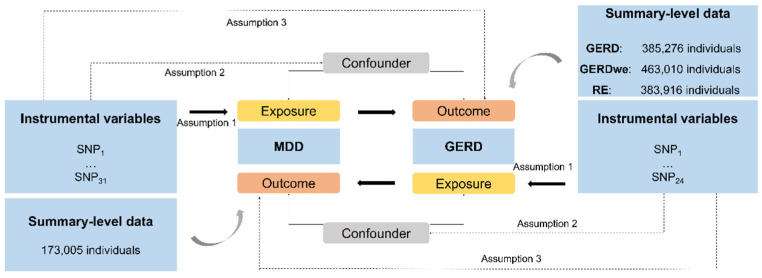
A bidirectional Mendelian randomization study was performed to explore the causal relationships between major depressive disorder and gastroesophageal reflux disease.
For the instrumental variables of major depressive disorder and gastroesophageal reflux disease, 31 and 24 single-nucleotide polymorphisms without linkage disequilibrium ( ≤ 0.001) were selected from relevant genome-wide association studies, respectively, at the genome-wide significance level ( ≤ 5 × 10). We sorted summary-level genetic data for major depressive disorder, gastroesophageal reflux disease, gastroesophageal reflux disease without esophagitis, and reflux esophagitis from meta-analysis study of genome-wide association studies involving 173,005 individuals (59,851 cases and 113,154 non-cases), 385,276 individuals (80,265 cases and 305,011 non-cases), 463,010 individuals (4360 cases and 458,650 non-cases), and 383,916 individuals (12,567 cases and 371,349 non-cases), respectively.
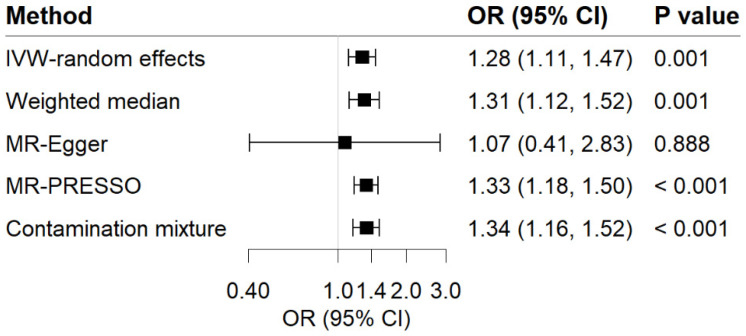
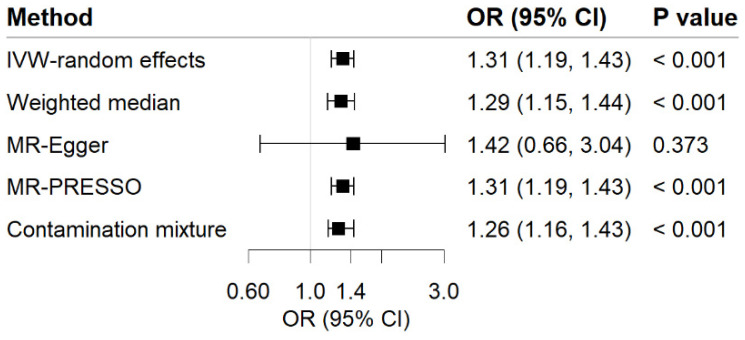
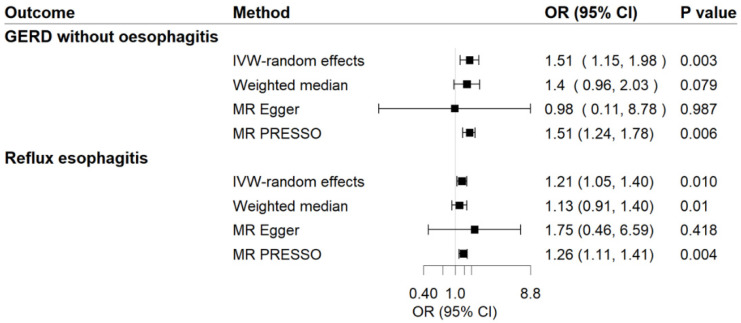
Genetic liability to major depressive disorder was positively associated with gastroesophageal reflux disease and its subtypes. Per one-unit increase in log-transformed odds ratio of major depressive disorder, the odds ratio was 1.31 (95% confidence interval [CI], 1.19-1.43; = 1.64 × 10) for gastroesophageal reflux disease, 1.51 (95% CI, 1.15-1.98; = 0.003) for gastroesophageal reflux disease without esophagitis, and 1.21 (95% CI, 1.05-1.40; = 0.010) for reflux esophagitis. Reverse-direction analysis suggested that genetic liability to gastroesophageal reflux disease was causally related to increasing risk of major depressive disorder. Per one-unit increase in log-transformed odds ratio of gastroesophageal reflux disease, the odds ratio of major depressive disorder was 1.28 (95% confidence interval, 1.11-1.47; = 1.0 × 10).
This Mendelian randomization study suggests a bidirectional causal relationship between major depressive disorder and gastroesophageal reflux disease.
观察性研究发现,重度抑郁症与胃食管反流病之间存在双向关系;然而,这种关系的因果关联尚未确定。
进行双向孟德尔随机化研究,以探讨重度抑郁症与胃食管反流病之间的因果关系。
对于重度抑郁症和胃食管反流病的工具变量,分别从相关全基因组关联研究中选择了 31 个和 24 个无连锁不平衡(≤0.001)的单核苷酸多态性,达到全基因组显著性水平(≤5×10)。我们从涉及 173005 人的全基因组关联研究的荟萃分析中对重度抑郁症、胃食管反流病、无食管炎的胃食管反流病和反流性食管炎的汇总水平遗传数据进行了排序,这些数据包括 59851 例病例和 113154 例非病例,80265 例病例和 305011 例非病例,4360 例病例和 458650 例非病例,以及 12567 例病例和 371349 例非病例。
重度抑郁症的遗传易感性与胃食管反流病及其亚型呈正相关。每增加一个对数转换优势比的单位,重度抑郁症的优势比为 1.31(95%置信区间[CI],1.19-1.43;=1.64×10),胃食管反流病为 1.51(95%CI,1.15-1.98;=0.003),无食管炎的胃食管反流病为 1.21(95%CI,1.05-1.40;=0.010),反流性食管炎为 1.21(95%CI,1.05-1.40;=0.010)。反向分析表明,胃食管反流病的遗传易感性与重度抑郁症风险增加有关。每增加一个对数转换优势比的单位,胃食管反流病的优势比为 1.28(95%置信区间,1.11-1.47;=1.0×10)。
这项孟德尔随机化研究表明,重度抑郁症与胃食管反流病之间存在双向因果关系。