Department of Physiotherapy, Epworth Hospital, Melbourne 3122, Australia.
Department of Epidemiology and Preventive Medicine, Monash University, Melbourne 3004, Australia.
Int J Environ Res Public Health. 2022 Oct 28;19(21):14063. doi: 10.3390/ijerph192114063.
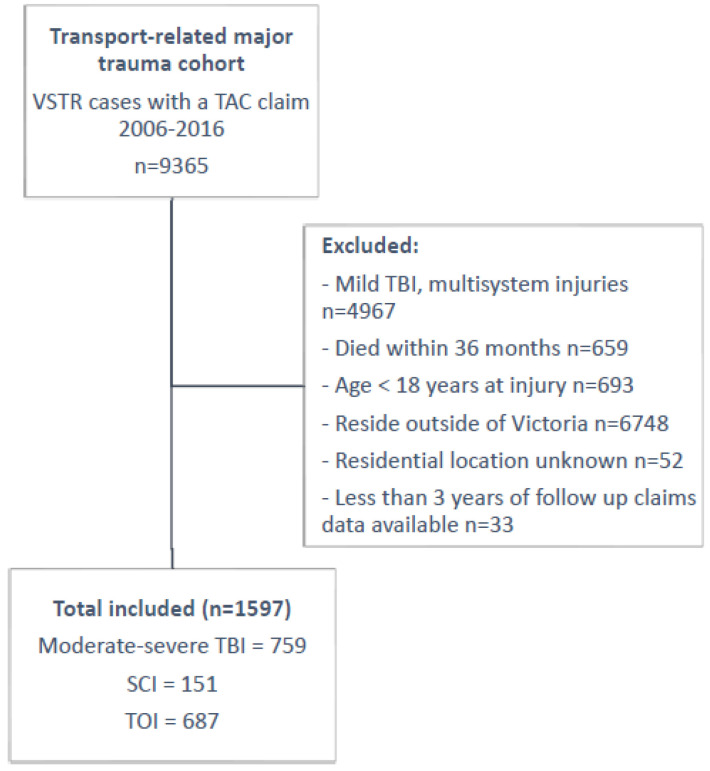
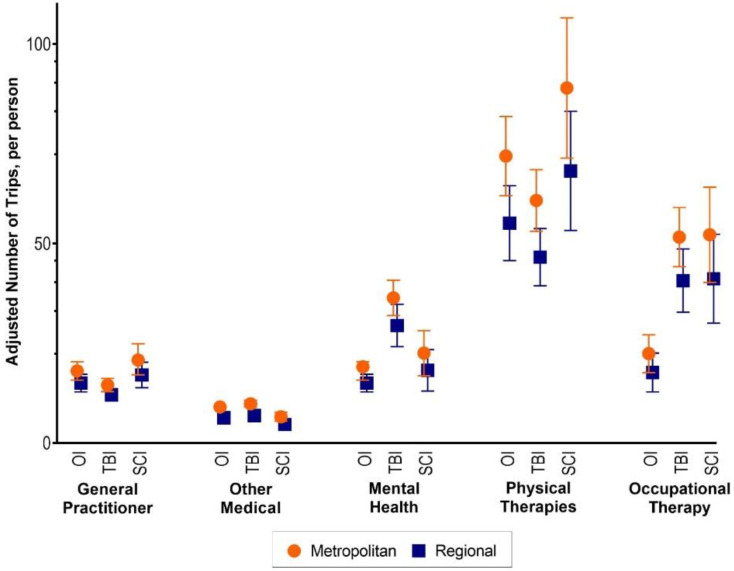
This study aimed to describe regional variations in service use and distance travelled to post-discharge health services in the first three years following hospital discharge for people with transport-related orthopaedic, brain, and spinal cord injuries. Using linked data from the Victorian State Trauma Registry (VSTR) and Transport Accident Commission (TAC), we identified 1597 people who had sustained transport-related orthopaedic, brain, or spinal cord injuries between 2006 and 2016 that met the study inclusion criteria. The adjusted odds of GP service use for regional participants were 76% higher than for metropolitan participants in the orthopaedic and traumatic brain injury (TBI) groups. People with spinal cord injury (SCI) living in regional areas had 72% lower adjusted odds of accessing mental health, 76% lower adjusted odds of accessing OT services, and 82% lower adjusted odds of accessing physical therapies compared with people living in major cities. People with a TBI living in regional areas on average travelled significantly further to access all post-discharge health services compared with people with TBI in major cities. For visits to medical services, the median trip distance for regional participants was 76.61 km (95%CI: 16.01-132.21) for orthopaedic injuries, 104.05 km (95% CI: 51.55-182.78) for TBI, and 68.70 km (95%CI: 8.34-139.84) for SCI. Disparities in service use and distance travelled to health services exist between metropolitan Melbourne and regional Victoria following serious injury.
本研究旨在描述在因交通相关的骨科、脑部和脊柱损伤而住院后的头三年中,出院后健康服务的使用和所涉及的行程距离的区域差异。我们利用维多利亚州创伤登记处(VSTR)和运输事故委员会(TAC)的关联数据,确定了 1597 名在 2006 年至 2016 年间发生交通相关的骨科、脑部或脊柱损伤且符合研究纳入标准的患者。与大都市地区参与者相比,骨科和创伤性脑损伤(TBI)组中区域参与者使用全科医生服务的调整后优势比(OR)高出 76%。居住在区域的脊柱损伤(SCI)患者在接受心理健康、职业治疗服务和物理治疗的调整后 OR 分别低 72%、76%和 82%。与居住在主要城市的患者相比,居住在区域的 TBI 患者平均需要行驶更远的距离才能获得所有的出院后健康服务。在医疗服务就诊方面,骨科损伤区域参与者的中位数出行距离为 76.61 公里(95%CI:16.01-132.21),TBI 为 104.05 公里(95%CI:51.55-182.78),SCI 为 68.70 公里(95%CI:8.34-139.84)。在严重受伤后,大都市墨尔本和维多利亚州区域之间在服务使用和前往健康服务的行程距离方面存在差异。