Department of Ocean Systems Engineering, Sejong University, Seoul 05006, Korea.
Sensors (Basel). 2022 Nov 4;22(21):8511. doi: 10.3390/s22218511.
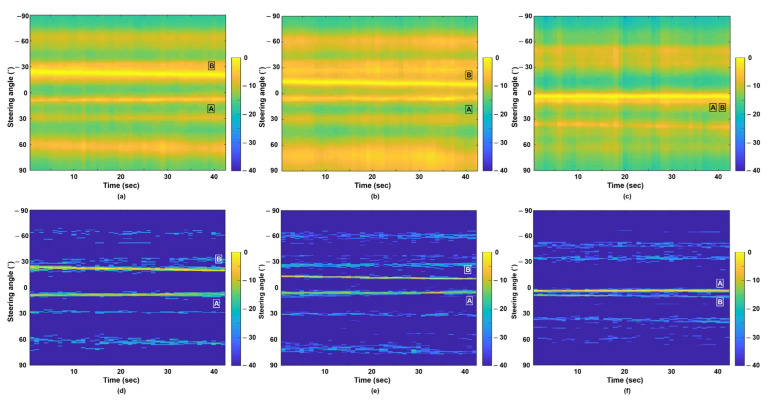
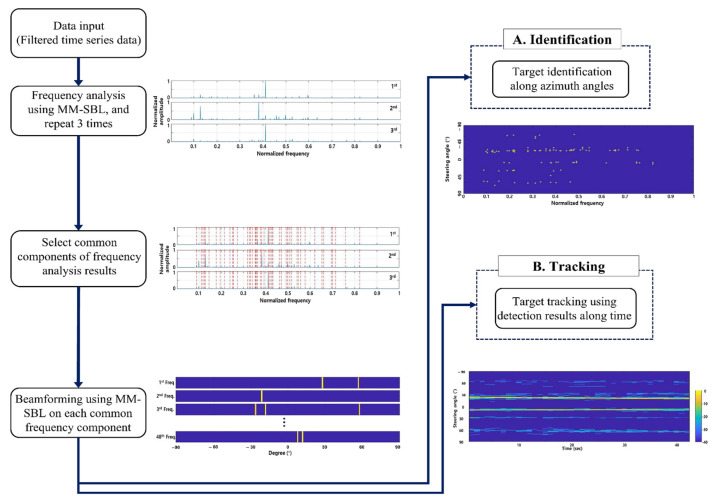
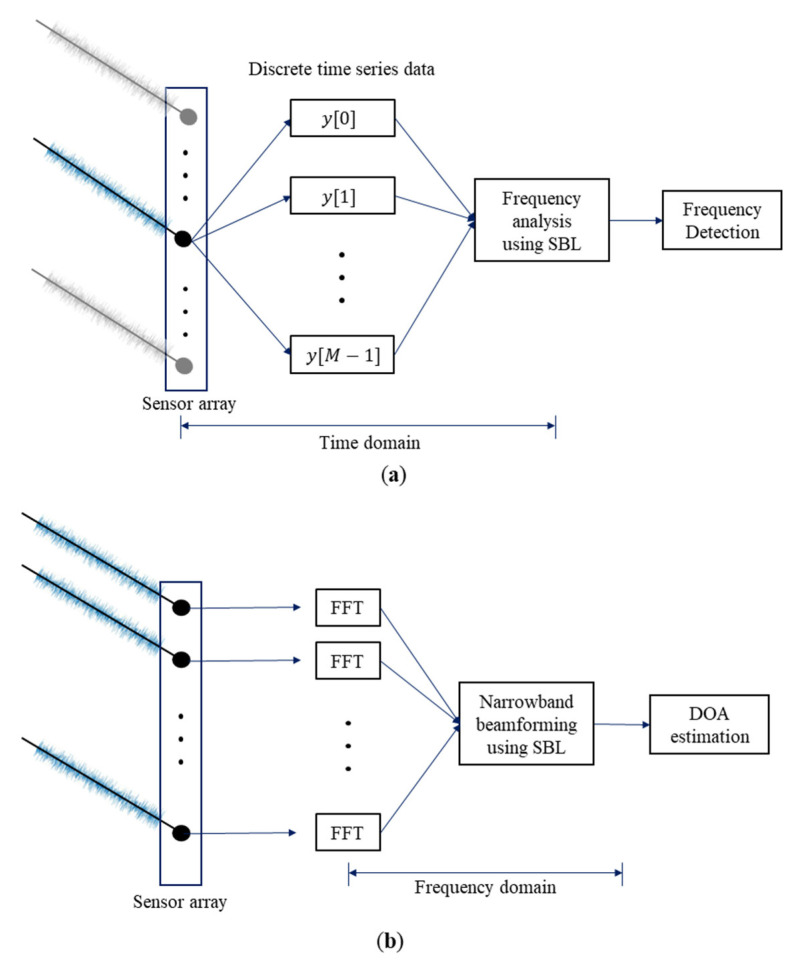
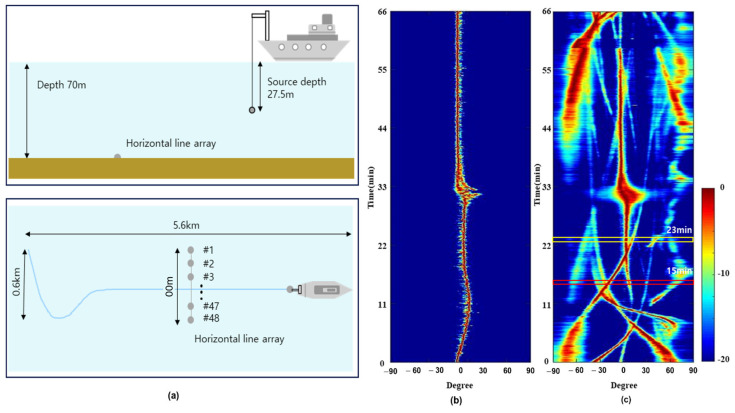
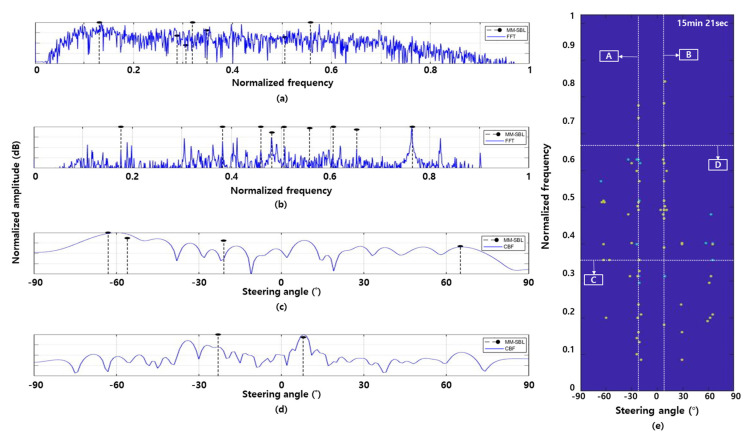
Accurate estimation of the frequency component is an important issue to identify and track marine objects (e.g., surface ship, submarine, etc.). In general, a passive sonar system consists of a sensor array, and each sensor receives data that have common information of the target signal. In this paper, we consider multiple-measurement sparse Bayesian learning (MM-SBL), which reconstructs sparse solutions in a linear system using Bayesian frameworks, to detect the common frequency components received by each sensor. In addition, the direction of arrival estimation was performed on each detected common frequency component using the MM-SBL based on beamforming. The azimuth for each common frequency component was confirmed in the frequency-azimuth plot, through which we identified the target. In addition, we perform target tracking using the target detection results along time, which are derived from the sum of the signal spectrum at the azimuth angle. The performance of the MM-SBL and the conventional target detection method based on energy detection were compared using in-situ data measured near the Korean peninsula, where MM-SBL displays superior detection performance and high-resolution results.
准确估计频率分量是识别和跟踪海洋目标(例如水面舰艇、潜艇等)的一个重要问题。一般来说,被动声纳系统由传感器阵列组成,每个传感器接收的数据都具有目标信号的公共信息。在本文中,我们考虑了多测量稀疏贝叶斯学习(MM-SBL),它使用贝叶斯框架在线性系统中重建稀疏解,以检测每个传感器接收到的公共频率分量。此外,还使用基于波束形成的 MM-SBL 对每个检测到的公共频率分量进行到达角估计。在频率-方位图中确定每个公共频率分量的方位,从而识别目标。此外,我们还通过对来自方位角处信号频谱的总和进行时间上的目标跟踪,利用目标检测结果进行目标跟踪。使用在朝鲜半岛附近测量的现场数据比较了 MM-SBL 和基于能量检测的传统目标检测方法的性能,结果表明 MM-SBL 具有优越的检测性能和高分辨率。