Santiago-Hernández Héctor, Beltrán-González Anuar Benjamín, Mora-Nuñez Azael, Bravo-Medina Beethoven, Pottiez Olivier
Departamento de Ingeniería Electro-Fotónica, Universidad de Guadalajara (UDG), Blvd. Gral. Marcelino García Barragán 1421, Guadalajara 44430, Jalisco, Mexico.
Centro de Investigaciones en Óptica (CIO), Loma del Bosque 115, Col. Lomas del Campestre, León 37150, Guanajuato, Mexico.
Sensors (Basel). 2022 Nov 7;22(21):8557. doi: 10.3390/s22218557.
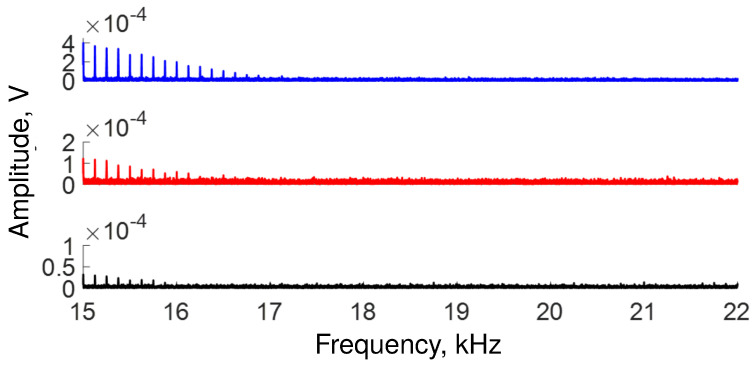
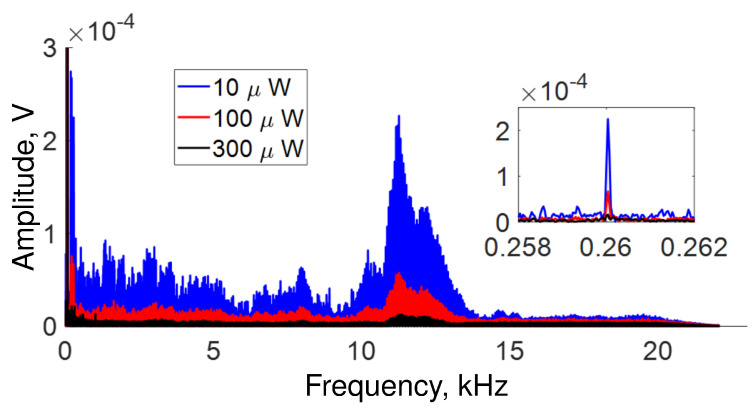
In this work, we study a double-sense twisted low-birefringence Sagnac loop structure as a sound/vibration sensing device. We study the relation between the adjustments of a wave retarder inside the loop (which allows controlling the transmission characteristic to deliver 10, 100, and 300 μW average power at the output of the system) and the response of the Sagnac sensor to vibration frequencies ranging from 0 to 22 kHz. For a 300 m loop Sagnac, two sets of experiments were carried out, playing at the same time all the sound frequencies mixed for ∼1 s, and playing a sweep of frequencies for 30 s. In both cases, the time- and frequency-domain transmission amplitudes are larger for an average power of 10 μW, and smaller for an average power of 300 μW. For mixed frequencies, the Fourier analysis shows that the Sagnac response is larger for low frequencies (from 0 to ∼5 kHz) than for high frequencies (from ∼5 kHz to ∼22 kHz). For a sweep of frequencies, the results reveal that the interferometer perceives all frequencies. However, beyond ∼2.5 kHz, harmonics are present each ∼50 Hz, revealing that some resonances are present. The results about the influence of the power transmission through the polarizer and power emission of laser diode (LD) on the Sagnac interferometer response at high frequencies reveal that our system is robust, and the results are highly reproducible, and harmonics do not depend on the state of polarization at the input of the Sagnac interferometer. Furthermore, increasing the LD output power from 5 mW to 67.5 mW allows us to eliminate noisy signals at the system output. in our setup, the minimum sound level detected was 56 dB. On the other hand, the experimental results of a 10 m loop OFSI reveal that the response at low frequencies (1.5 kHz to 5 kHz) is minor compared with the 300 m loop OFSI. However, the response at high frequencies is low but still enables the detection of these frequencies, yielding the possibility of tuning the response of the vibration sensor by varying the length of the Sagnac loop.
在这项工作中,我们研究了一种双传感扭曲低双折射萨尼亚克环结构作为声音/振动传感装置。我们研究了环内波片的调整(这允许控制传输特性,以便在系统输出端提供10、100和300 μW的平均功率)与萨尼亚克传感器对0至22 kHz振动频率的响应之间的关系。对于一个300 m的环萨尼亚克,进行了两组实验,一组同时播放所有混合的声音频率约1 s,另一组播放频率扫描30 s。在这两种情况下,对于10 μW的平均功率,时域和频域传输幅度较大,而对于300 μW的平均功率则较小。对于混合频率,傅里叶分析表明,萨尼亚克响应在低频(从0至约5 kHz)比高频(从约5 kHz至约22 kHz)更大。对于频率扫描,结果表明干涉仪能感知所有频率。然而,超过约2.5 kHz,每隔约50 Hz就会出现谐波,这表明存在一些共振。关于通过偏振器的功率传输和激光二极管(LD)的功率发射对萨尼亚克干涉仪在高频响应的影响的结果表明,我们的系统很稳健,结果具有高度可重复性,并且谐波不依赖于萨尼亚克干涉仪输入端的偏振状态。此外,将LD输出功率从5 mW增加到67.5 mW使我们能够消除系统输出端的噪声信号。在我们的设置中,检测到的最小声级为56 dB。另一方面,一个10 m环光纤萨尼亚克干涉仪(OFSI)的实验结果表明,与300 m环OFSI相比,其在低频(1.5 kHz至5 kHz)的响应较小。然而,其在高频的响应较低,但仍能检测到这些频率,这使得通过改变萨尼亚克环的长度来调整振动传感器的响应成为可能。