Medical Oncology, Department of Precision Medicine, Università Degli Studi Della Campania Luigi Vanvitelli, Naples, Italy.
Oncologia Medica, University of Pisa, Pisa, Italy.
ESMO Open. 2022 Dec;7(6):100603. doi: 10.1016/j.esmoop.2022.100603. Epub 2022 Nov 8.
BRAF mutations occur in 8%-12% of metastatic colorectal cancer (mCRC) cases and are associated with poor survival. European guidelines recommend combination (doublet or triplet) chemotherapy plus bevacizumab in first line. However, an unmet need remains for more effective treatments for these patients.
CAPSTAN CRC is a European, retrospective, multicenter, observational study evaluating real-world treatment practices for patients with BRAF-mutant mCRC treated between 1 January 2016 and 31 January 2020. The primary objective was to describe first-line treatment patterns. Secondary objectives included describing baseline demographics, mutational testing procedures, treatment effectiveness, and safety.
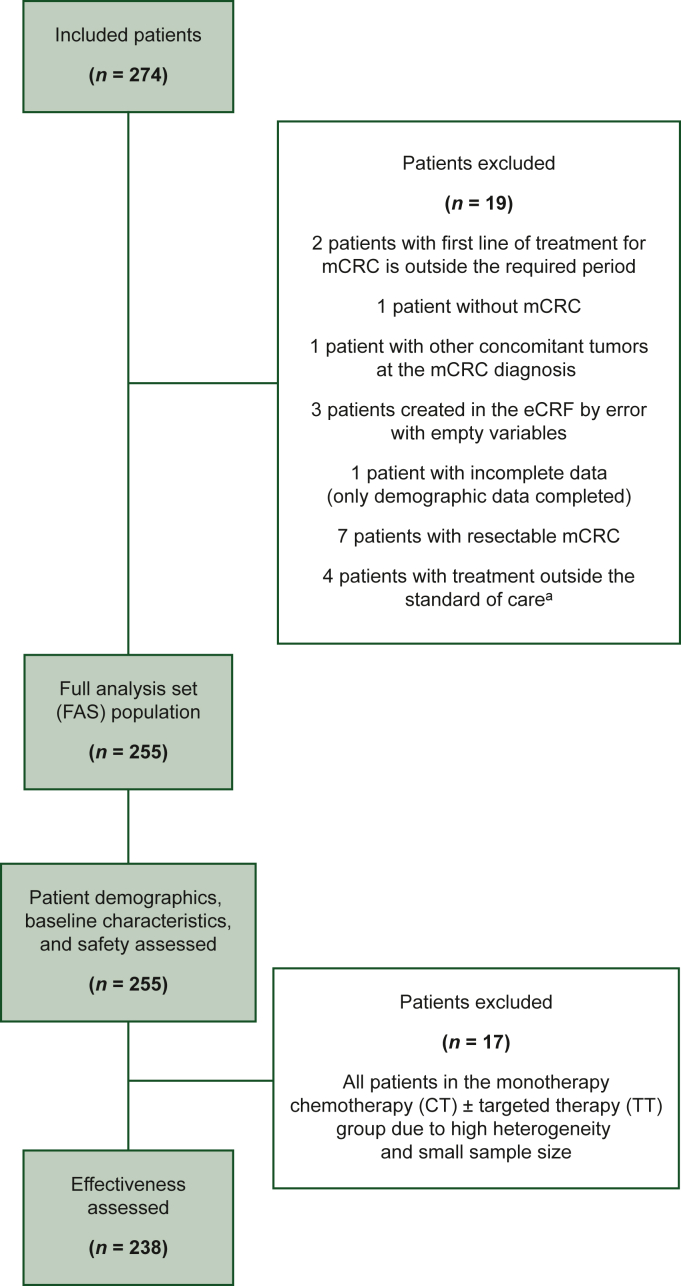
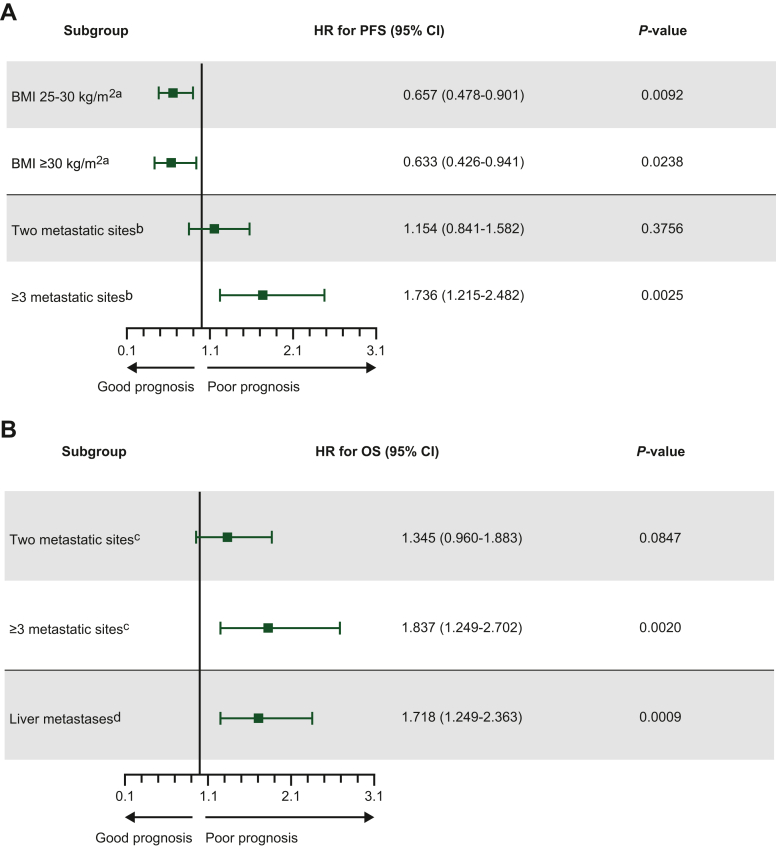
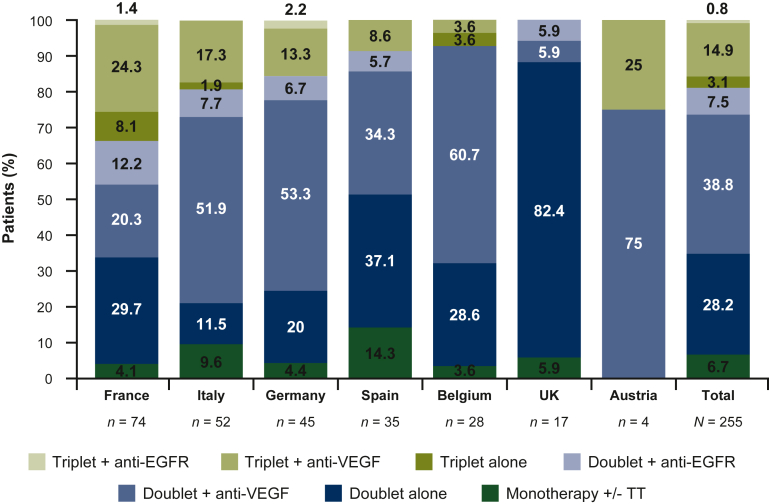
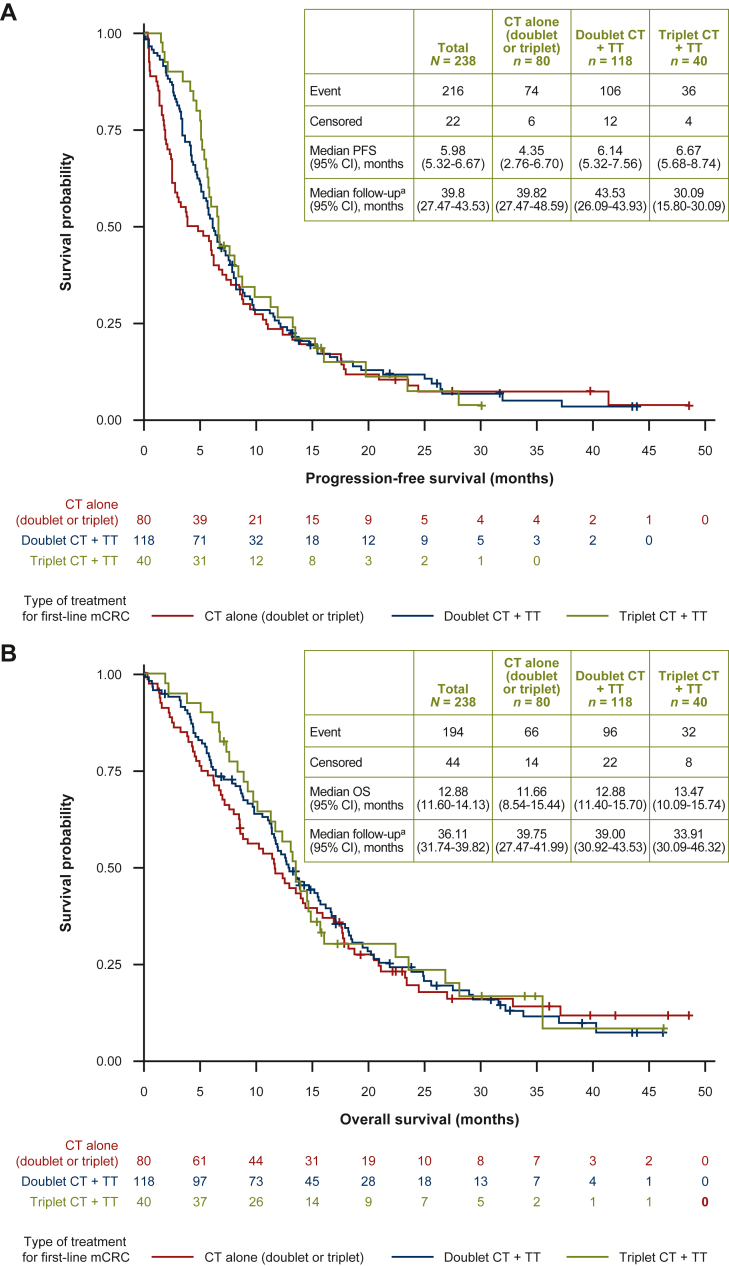
In total, 255 patients (median age 66.0 years; 58.4% female) with BRAF-mutant unresectable mCRC from seven countries were included. Most had right-sided tumors (52.5%) and presented with synchronous disease at diagnosis (66.4%). Chemotherapy plus targeted therapy (68.7%) was preferred at first line over chemotherapy alone (31.3%). The main first-line treatments were FOLFOX plus bevacizumab (27.1%) and FOLFOXIRI (folinic acid, 5-fluorouracil, oxaliplatin, irinotecan) with/without bevacizumab (27.1%/19.2%). Median duration of first-line treatment was 4.9 months. Overall, 52.5% received second-line treatment. Across all first-line regimens, progression-free survival (PFS) and overall survival were 6.0 [95% confidence interval (CI) 5.3-6.7] months and 12.9 (95% CI 11.6-14.1) months, respectively. Triplet plus targeted therapy was associated with more adverse events (75.0%) compared with triplet chemotherapy alone (50.0%) and doublet chemotherapy alone (36.1%). Multivariate analysis identified low body mass index and presence of three or more metastatic sites as significant prognostic factors for PFS.
This study is, to date, the largest real-world analysis of patients with BRAF-mutant mCRC, providing valuable insights into routine first-line treatment practices for these patients. The data highlight the intrinsic aggressiveness of this disease subgroup, confirming results from previous real-world studies and clinical trials, and stressing the urgent need for more effective treatment options in this setting.
BRAF 突变发生在 8%-12%的转移性结直肠癌(mCRC)病例中,与不良预后相关。欧洲指南建议在一线治疗中使用联合(双联或三联)化疗加贝伐珠单抗。然而,对于这些患者,仍需要更有效的治疗方法。
CAPSTAN CRC 是一项欧洲、回顾性、多中心、观察性研究,评估了 2016 年 1 月 1 日至 2020 年 1 月 31 日期间接受 BRAF 突变型 mCRC 治疗的患者的真实世界治疗实践。主要目的是描述一线治疗模式。次要目标包括描述基线人口统计学、突变检测程序、治疗效果和安全性。
共纳入来自 7 个国家的 255 例 BRAF 突变型不可切除 mCRC 患者(中位年龄 66.0 岁;58.4%为女性)。大多数患者的肿瘤位于右侧(52.5%),且诊断时为同步疾病(66.4%)。与单独化疗(31.3%)相比,化疗联合靶向治疗(68.7%)是首选的一线治疗方法。主要的一线治疗方案是 FOLFOX 联合贝伐珠单抗(27.1%)和 FOLFOXIRI(亚叶酸、5-氟尿嘧啶、奥沙利铂、伊立替康)联合/不联合贝伐珠单抗(27.1%/19.2%)。一线治疗的中位持续时间为 4.9 个月。总体而言,52.5%的患者接受了二线治疗。在所有一线治疗方案中,无进展生存期(PFS)和总生存期分别为 6.0 个月(95%置信区间[CI]5.3-6.7)和 12.9 个月(95%CI 11.6-14.1)。三联加靶向治疗与三联化疗(50.0%)和双药化疗(36.1%)相比,不良反应更多(75.0%)。多变量分析发现,低体重指数和存在三个或更多转移部位是 PFS 的显著预后因素。
这项研究是迄今为止 BRAF 突变型 mCRC 患者最大的真实世界分析,为这些患者的一线治疗提供了有价值的见解。数据突出了该疾病亚组的固有侵袭性,证实了之前真实世界研究和临床试验的结果,并强调了在这种情况下迫切需要更有效的治疗选择。