Department of Internal Medicine, Gyeongsang National University School of Medicine and Gyeongsang National University Changwon Hospital, 11, Samjungja-ro, Sungsan-gu, 51472, Changwon, Republic of Korea.
BMC Pulm Med. 2022 Nov 16;22(1):419. doi: 10.1186/s12890-022-02222-5.
Chronic cough is an extremely common clinical symptom of various diseases. However, the relationship between obstructive sleep apnea (OSA) and chronic cough in the general population has not been sufficiently studied.
Using the 2019 Korean National Health and Nutrition Examination Survey data, we identified a group at high-risk of OSA via the STOP-Bang questionnaire and determined the association between OSA and chronic cough by a regression model.
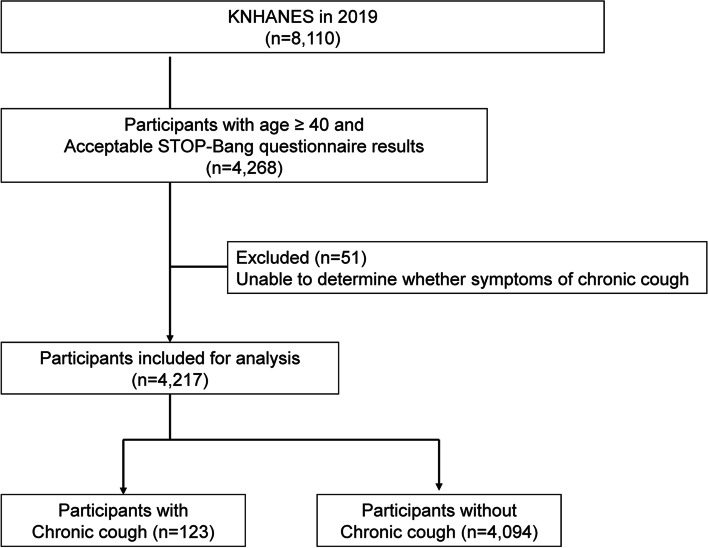
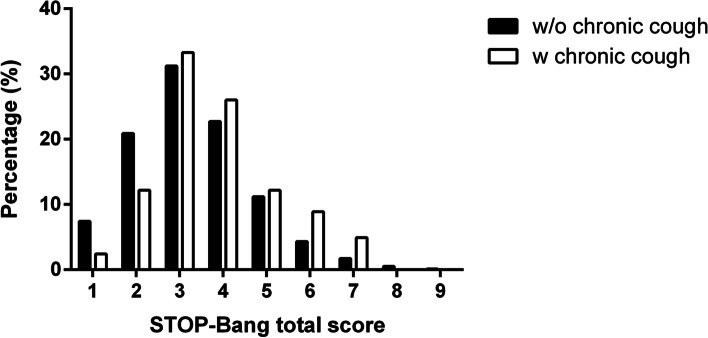
Of the eligible 4,217 participants, 97.1% and 2.9% were classified into the non-chronic cough and chronic cough groups, respectively. The chronic cough group had higher STOP-Bang scores than those of the group without chronic cough (2.32 ± 1.38 vs. 2.80 ± 1.39; P < 0.001). In the group at high-risk of OSA, 40.4% and 52.0% of participants scored ≥ 3 in STOP-Bang, depending on the absence or presence of chronic cough (P = 0.012), respectively. Chronic cough independently correlated with impaired lung function (forced expiratory volume in one second ≥ 50-<80% predicted value, P = 0.001; <50, P < 0.001), low household income (P = 0.015), and a group at high-risk of OSA (STOP-Bang score 3-4, P = 0.004; 5-8, P < 0.001). Obesity I had a protective role against the occurrence of chronic cough (P = 0.023).
A high-risk for OSA is a significant risk factor for chronic cough. OSA should be considered when evaluating chronic cough patients.
慢性咳嗽是各种疾病的一种极其常见的临床症状。然而,阻塞性睡眠呼吸暂停(OSA)与普通人群中慢性咳嗽之间的关系尚未得到充分研究。
使用 2019 年韩国国家健康和营养检查调查数据,我们通过 STOP-Bang 问卷确定了一组 OSA 高危人群,并通过回归模型确定 OSA 与慢性咳嗽之间的关系。
在符合条件的 4217 名参与者中,97.1%和 2.9%分别归入非慢性咳嗽组和慢性咳嗽组。慢性咳嗽组的 STOP-Bang 评分高于无慢性咳嗽组(2.32±1.38 与 2.80±1.39;P<0.001)。在 OSA 高危人群中,无论是否存在慢性咳嗽,分别有 40.4%和 52.0%的参与者的 STOP-Bang 评分≥3(P=0.012)。慢性咳嗽与肺功能受损(一秒用力呼气容积≥50-<80%预计值,P=0.001;<50,P<0.001)、低收入家庭(P=0.015)和 OSA 高危人群(STOP-Bang 评分 3-4,P=0.004;5-8,P<0.001)独立相关。肥胖 I 对慢性咳嗽的发生具有保护作用(P=0.023)。
OSA 高危是慢性咳嗽的一个重要危险因素。在评估慢性咳嗽患者时应考虑 OSA。