Song Yanjuan, Li Tong, Ma Chunlian, Liu Hui, Liang Fengxia, Yang Yi
Graduate School, Wuhan Sports University, Wuhan, China.
College of Acupuncture and Orthopedics, Hubei University of Chinese Medicine, Wuhan, China.
Front Neurol. 2022 Oct 26;13:1010410. doi: 10.3389/fneur.2022.1010410. eCollection 2022.
Migraine is a worldwide disabling chronic brain disorder, some studies suggest acupuncture-related therapy plays an important role in raising efficiency rates and reducing migraine attacks. However, clinical trials comparing the efficacy of different interventions for migraine are limited and controversial. This network meta-analysis (NMA) was performed to review all randomized controlled trials (RCTs) comparing the effects of acupuncture-related therapy for migraine.
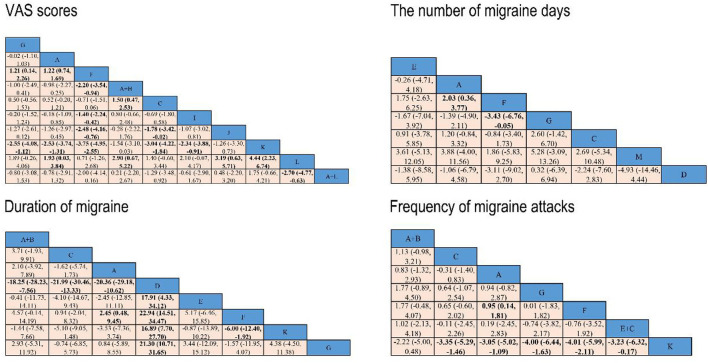
Randomized controlled trials (RCTs) of acupuncture-related therapy for migraine were searched in the following databases from the date of database inception to March 31, 2022, including PubMed, Embase, Cochrane Library, Web of Science, China National Knowledge Infrastructure (CNKI), VIP Database, Wanfang Database, and Chinese Biomedical Database (CBM). The primary endpoint was visual analog scale (VAS) scores. The secondary endpoints were the number of migraine days, duration of migraine, and frequency of migraine attacks. We used Cochrane risk of bias to assess the quality of evidence for outcomes.
Thirty-nine studies involving 4379 patients with 13 different acupuncture-related methods were evaluated. According to surface under the cumulative ranking curve value, acupoint injection was ranked the highest (98.0%) in VAS scores, followed by acupoint implantation (79.0%); electroacupuncture was the optimal intervention method (82.4%) in the number of migraine days, followed by embedding needle therapy (73.1%); embedding needle therapy ranked first (99.9%) in the duration of migraine, followed by acupoint injection (77.4%); acupoint injection was the best intervention (99.3%) in the frequency of migraine attacks, followed by conventional acupuncture plus massage (73.8%).
These results provide preliminary evidence that acupuncture-related therapy could be recommended as one of the effective treatments for migraine. Conventional acupuncture has significant effects on improving VAS scores, the number of migraine days, duration of migraine, and frequency of migraine attacks. However, more high-quality studies should be carried out to verify this finding.
https://inplasy.com/, identifier: INPLASY202110035.
偏头痛是一种全球性的致残性慢性脑部疾病,一些研究表明,针灸相关疗法在提高有效率和减少偏头痛发作方面发挥着重要作用。然而,比较不同偏头痛干预措施疗效的临床试验有限且存在争议。本网络荟萃分析(NMA)旨在回顾所有比较针灸相关疗法治疗偏头痛效果的随机对照试验(RCT)。
从数据库建立之日至2022年3月31日,在以下数据库中检索针灸相关疗法治疗偏头痛的随机对照试验,包括PubMed、Embase、Cochrane图书馆、科学网、中国知网(CNKI)、维普数据库、万方数据库和中国生物医学数据库(CBM)。主要终点是视觉模拟量表(VAS)评分。次要终点是偏头痛天数、偏头痛持续时间和偏头痛发作频率。我们使用Cochrane偏倚风险评估结局的证据质量。
评估了39项研究,涉及4379例患者,采用13种不同的针灸相关方法。根据累积排名曲线下面积值,穴位注射在VAS评分中排名最高(98.0%),其次是穴位植入(79.0%);电针在偏头痛天数方面是最佳干预方法(82.4%),其次是埋针疗法(73.1%);埋针疗法在偏头痛持续时间方面排名第一(99.9%),其次是穴位注射(77.4%);穴位注射在偏头痛发作频率方面是最佳干预措施(99.3%),其次是传统针灸加按摩(73.8%)。
这些结果提供了初步证据,表明针灸相关疗法可被推荐为偏头痛的有效治疗方法之一。传统针灸对改善VAS评分、偏头痛天数、偏头痛持续时间和偏头痛发作频率有显著效果。然而,需要开展更多高质量研究来验证这一发现。