Sun Ye, Liu Yi, Cai Yun, Han Pingping, Hu Shan, Cao Lijun
Department of Traditional Chinese Medicine, The First Affiliated Hospital of Xi'an Jiaotong University, Xi'an, China.
J Gastrointest Oncol. 2022 Oct;13(5):2382-2392. doi: 10.21037/jgo-22-910.
Colorectal cancer (CRC) is a type of ordinary malignancy of the gastrointestinal tract. Atractylenolide I (AT-I) has been shown to inhibit the process of CRC. However, the specific mechanism by which AT-I inhibits CRC is not yet well understood.
Cell Counting Kit-8 and colony formation assays were conducted to examine cell proliferation. The cell apoptosis was detected by terminal deoxynucleotidyl-transferase-mediated dUTP nick end labeling (TUNEL). Cell invasion and migration were evaluated by wound-healing and Transwell assay. The angiogenesis capabilities of the cells were examined by tube formation experiments. Western blot was conducted to examine the apoptosis and angiogenesis-associated proteins, pyruvate dehydrogenase kinase 1 (PDK1), and Forkhead box protein O1 (FoxO1) expression.
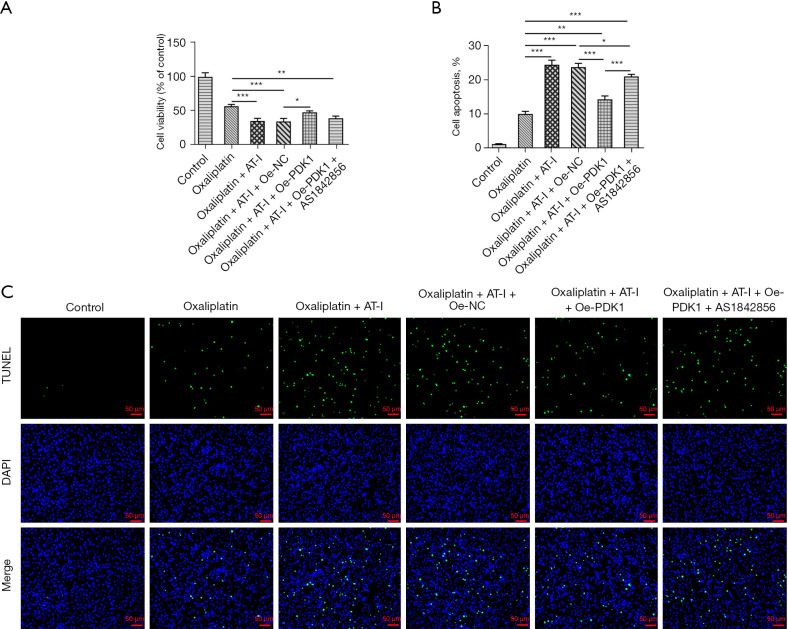
We found that AT-I inhibited the proliferative, migratory and invasive abilities of Human colorectal cancer cell line HCT116 cells but stimulated cell death by promoting cell apoptosis via the PDK1/FoxO1 axis. In addition, the upregulation of PDK1 decreased the inhibitory effect of AT-I on HCT116 angiogenesis, and AT-I increased oxaliplatin sensitivity via the PDK1/FoxO1 axis.
Collectively, AT-I inhibited the malignant development of CRC cells and increased oxaliplatin sensitivity by decreasing PDK1 and inhibiting FoxO1 phosphorylation. Thus, AT-I has protective potential and could be a promising agent for CRC treatment.
结直肠癌(CRC)是一种常见的胃肠道恶性肿瘤。白术内酯I(AT-I)已被证明可抑制CRC的进程。然而,AT-I抑制CRC的具体机制尚不完全清楚。
采用细胞计数试剂盒-8和集落形成试验检测细胞增殖。通过末端脱氧核苷酸转移酶介导的dUTP缺口末端标记法(TUNEL)检测细胞凋亡。通过伤口愈合试验和Transwell试验评估细胞侵袭和迁移能力。通过管腔形成实验检测细胞的血管生成能力。进行蛋白质免疫印迹法检测凋亡和血管生成相关蛋白、丙酮酸脱氢酶激酶1(PDK1)和叉头框蛋白O1(FoxO1)的表达。
我们发现AT-I抑制人结肠癌细胞系HCT116细胞的增殖、迁移和侵袭能力,但通过PDK1/FoxO1轴促进细胞凋亡来刺激细胞死亡。此外,PDK1的上调降低了AT-I对HCT116血管生成的抑制作用,并且AT-I通过PDK1/FoxO1轴增加了奥沙利铂的敏感性。
总体而言,AT-I通过降低PDK1和抑制FoxO1磷酸化来抑制CRC细胞的恶性发展并增加奥沙利铂敏感性。因此,AT-I具有保护潜力,可能是一种有前景的CRC治疗药物。