Christian Doppler Laboratory for Innovative Poultry Vaccines (IPOV), University of Veterinary Medicine, Vienna, Austria.
Clinic for Poultry and Fish Medicine, Department for Farm Animals and Veterinary Public Health, University of Veterinary Medicine, Vienna, Austria.
Front Immunol. 2022 Oct 28;13:1026233. doi: 10.3389/fimmu.2022.1026233. eCollection 2022.
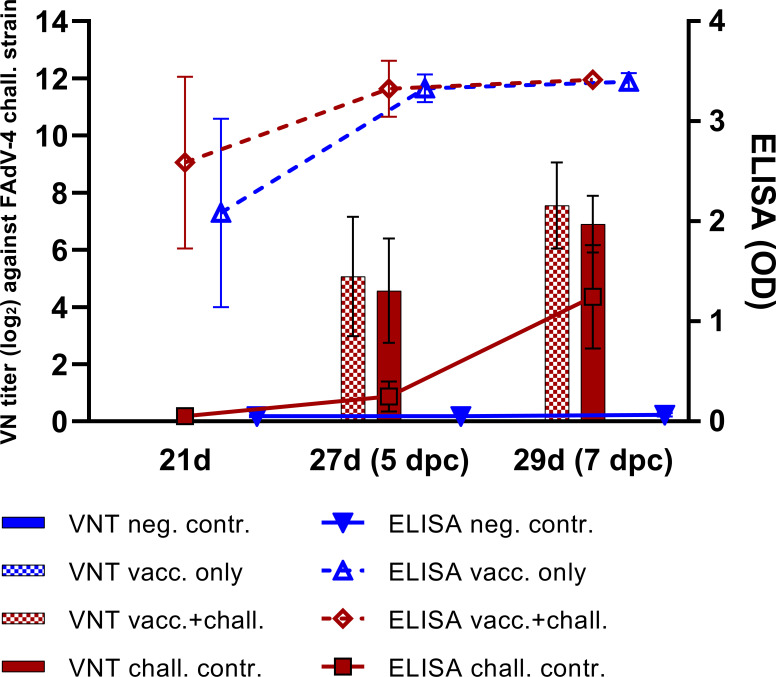
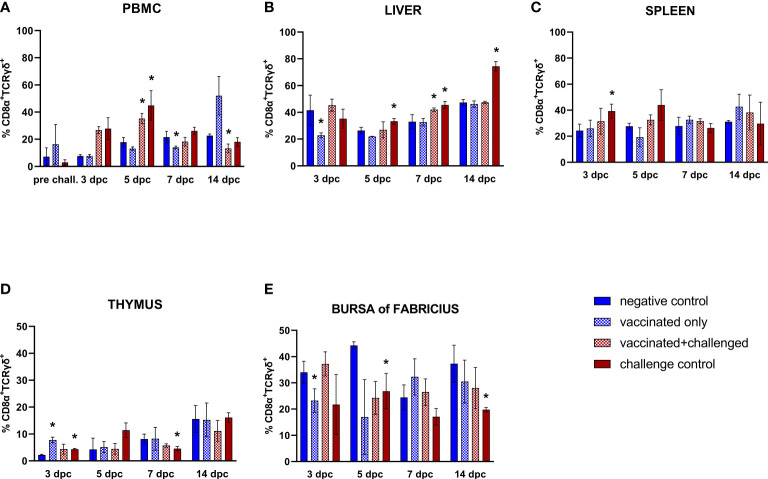
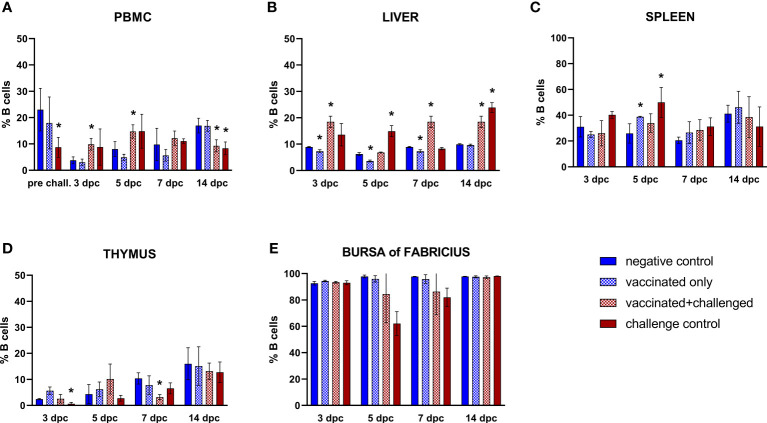
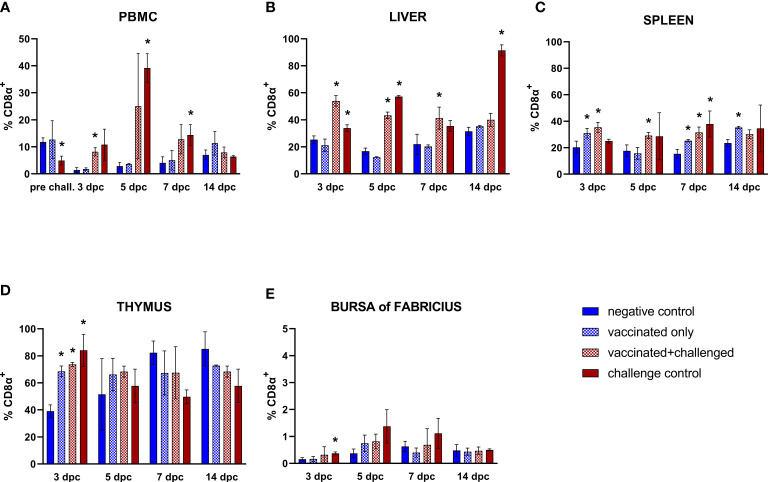
Fowl adenovirus (FAdV)-induced diseases hepatitis-hydropericardium syndrome (HHS) and inclusion body hepatitis (IBH) have been affecting the poultry industry with increasing severity in the last two decades. Recently, a subunit vaccine based on a chimeric fiber protein with epitopes from different fowl adenovirus serotypes (named crecFib-4/11) has been shown to confer simultaneous protection against both HHS and IBH. However, the underlying immune mechanisms in chickens are still enigmatic, especially because of frequently absent neutralizing response despite high levels of protection. In this study, we investigated the kinetics of the humoral and cellular immune responses in specific pathogen-free chickens after vaccination with crecFib-4/11 and/or challenge with a HHS-causing strain, on a systemic level, as well as locally in target and lymphoid organs. The humoral response was assessed via enzyme-linked immunosorbent assay (ELISA) and virus neutralization test in serum, while the cellular immune response was determined by phenotyping using flow cytometry. Although vaccination induced serum antibodies, as confirmed by ELISA, such antibodies exhibited no pre-challenge neutralizing activity against FAdV-4. Nevertheless, immunized birds experienced a significant B cell increase in the liver upon challenge, remaining high throughout the experiment. Furthermore, vaccination stimulated the proliferation of cytotoxic T lymphocytes, with earlier circulation in the blood compared to the challenge control and subsequent increase in liver and spleen. Overall, these findings imply that protection of chickens from HHS after crecFib-4/11 vaccination relies on a prominent local immune response in the target organs, instead of circulating neutralizing antibodies.
禽腺病毒(FAdV)引起的疾病——肝炎-心包积水综合征(HHS)和包涵体肝炎(IBH)在过去二十年中对家禽业的影响越来越严重。最近,一种基于嵌合纤维蛋白的亚单位疫苗,该蛋白具有来自不同禽腺病毒血清型的表位(命名为 crecFib-4/11),已被证明能同时预防 HHS 和 IBH。然而,鸡的潜在免疫机制仍然是个谜,特别是因为尽管有高水平的保护,但经常没有中和反应。在这项研究中,我们在无特定病原体鸡中研究了接种 crecFib-4/11 和/或用引起 HHS 的毒株攻毒后,在全身水平以及在靶器官和淋巴器官中的体液和细胞免疫反应的动力学。通过酶联免疫吸附试验(ELISA)和血清中的病毒中和试验评估体液反应,而通过流式细胞术表型分析确定细胞免疫反应。尽管接种疫苗会诱导血清抗体,如 ELISA 所证实的,但这些抗体在攻毒前对 FAdV-4 没有中和活性。尽管如此,免疫鸡在攻毒后肝脏中的 B 细胞显著增加,整个实验过程中一直保持高水平。此外,接种疫苗刺激了细胞毒性 T 淋巴细胞的增殖,其在血液中的循环早于攻毒对照组,随后在肝脏和脾脏中增加。总的来说,这些发现表明,crecFib-4/11 接种后鸡对 HHS 的保护依赖于靶器官中的显著局部免疫反应,而不是循环中和抗体。