Department of Internal Medicine, Amiens University Medical Center, Rue du Professeur Christian Cabrol, 80000, Amiens, France.
RECIF, Amiens-Picardie University Medical Center, 80054, Amiens, France.
BioDrugs. 2023 Jan;37(1):73-87. doi: 10.1007/s40259-022-00564-4. Epub 2022 Nov 19.
Published data on the safety of biologics other than tumor necrosis factor (TNF) inhibitors during pregnancy are limited.
The aim was to detect pharmacovigilance signals for fetal and neonatal adverse drug reactions (ADRs) to biologics taken by pregnant women with autoimmune diseases.
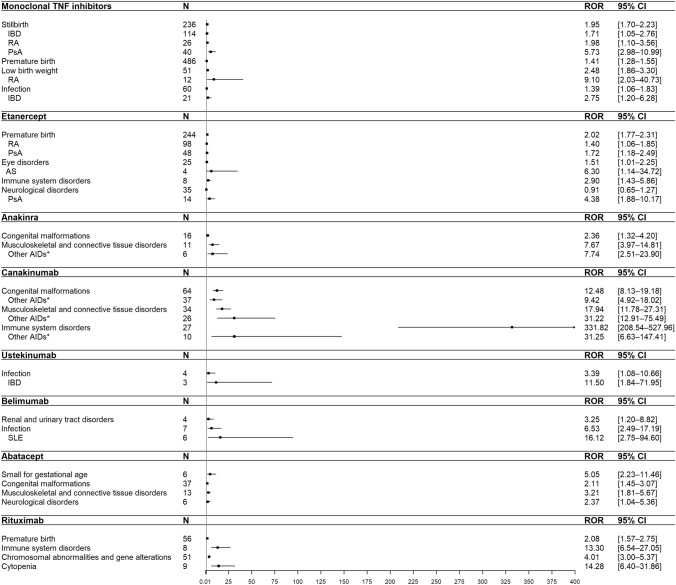
We performed a disproportionality analysis of the World Health Organization's VigiBase pharmacovigilance database from 1968 to June 1, 2021. Data were collected in June 2021. By using terms for different hierarchical levels of the Medical Dictionary for Regulatory Activities, we selected the following fetal or neonatal ADRs: stillbirth, premature birth, low birth weight, small for gestational age, and congenital malformations. The frequency of all identified ADRs for biologics of interest (adalimumab, infliximab, golimumab, certolizumab, etanercept, anakinra, canakinumab, tocilizumab, sarilumab, ustekinumab, guselkumab, secukinumab, ixekizumab, belimumab, abatacept, and rituximab) was compared with that of all other reports for all other drugs and quoted as the reporting odds ratio (ROR) [95% confidence interval]. Reports with known concomitant use of teratogenic drugs were excluded from the main analysis. Other analyses included ROR stratifications by therapeutic indication in the periods 1968-2021 and 2001-2021, and an analysis after excluding reports with steroids.
In the main analysis, the RORs were particularly high for musculoskeletal malformations with anakinra (7.18 [3.50-14.73]), canakinumab (19.54 [12.82-29.79]), and abatacept (5.09 [2.77-9.33]), and for immune system disorders with canakinumab (347.88 [217.9-555.50]) and rituximab (9.27 [2.95-29.15]). After the exclusion of reports with steroids, the ROR was significant for neonatal infections with belimumab (28.49 [5.75-141.25]).
We identified possible associations with some adverse fetal and neonatal outcomes, suggesting that vigilance is required when prescribing certain biologics during pregnancy.
目前关于肿瘤坏死因子(TNF)抑制剂以外的生物制剂在妊娠期间安全性的数据有限。
本研究旨在检测接受生物制剂治疗的自身免疫性疾病孕妇所发生胎儿和新生儿不良药物反应(ADR)的药物警戒信号。
我们对 1968 年至 2021 年 6 月 1 日期间世界卫生组织的 VigiBase 药物警戒数据库进行了比例失衡分析。数据于 2021 年 6 月收集。我们使用监管活动医学词典的不同层次术语,选择了以下胎儿或新生儿 ADR:死胎、早产、低出生体重、小于胎龄儿和先天性畸形。与所有其他药物的所有其他报告相比,我们比较了感兴趣的生物制剂(阿达木单抗、英夫利昔单抗、戈利木单抗、西妥昔单抗、依那西普、阿那白滞素、卡那单抗、托珠单抗、沙利鲁单抗、乌司奴单抗、古塞库单抗、司库奇尤单抗、依维莫司、贝利木单抗、阿巴西普和利妥昔单抗)的所有鉴定 ADR 的频率,并将其表示为报告比值比(ROR)[95%置信区间]。从主要分析中排除了已知同时使用致畸药物的报告。其他分析包括 1968 年至 2021 年和 2001 年至 2021 年期间按治疗指征分层的 ROR 分析,以及排除使用类固醇报告后的分析。
在主要分析中,阿那白滞素(7.18 [3.50-14.73])、卡那单抗(19.54 [12.82-29.79])和阿巴西普(5.09 [2.77-9.33])的肌肉骨骼畸形,以及卡那单抗(347.88 [217.9-555.50])和利妥昔单抗(9.27 [2.95-29.15])的免疫系统疾病的 ROR 特别高。排除使用类固醇的报告后,贝伐单抗(28.49 [5.75-141.25])与新生儿感染的 ROR 有统计学意义。
我们发现与某些胎儿和新生儿不良结局存在可能的关联,这表明在妊娠期间开具某些生物制剂时需要保持警惕。