Department of Earth Sciences, Royal Holloway University of London, Egham, TW20 0EX, Surrey, UK.
OMV Exploration and Production GmbH, Trabrennstrasse 6-8, 1020, Vienna, Austria.
Sci Rep. 2022 Nov 19;12(1):19931. doi: 10.1038/s41598-022-24573-z.
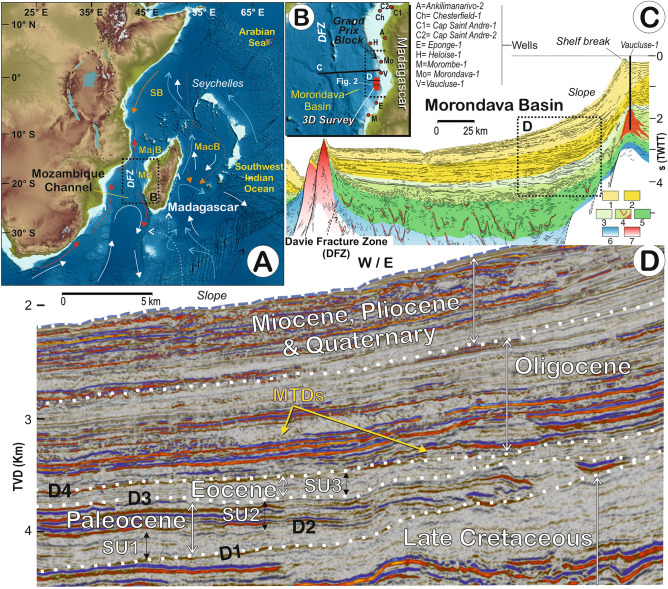
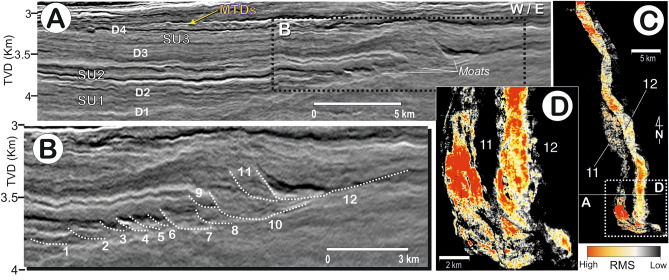
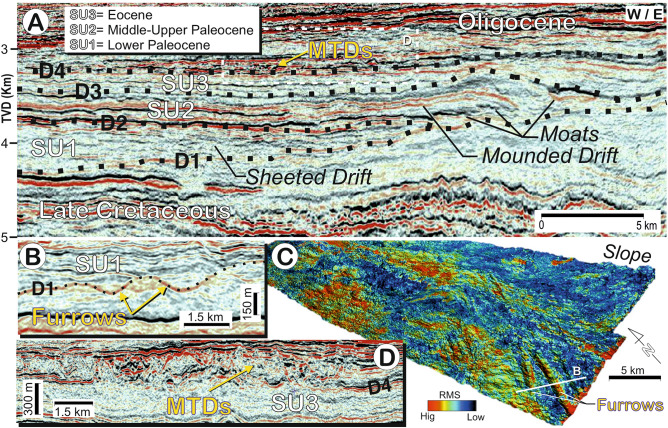
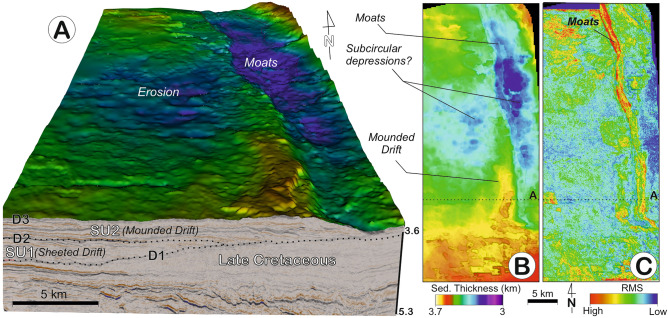
Numerous bottom current-controlled depositional and erosional features, which together form Contourite Depositional Systems (CDS), have been recognized in deep-water settings over the past decade. Most of these systems are described based on two-dimensional (2D) seismic data, whereas only a few CDS have been characterised from high-resolution 3D data. Here we document a newly identified CDS that formed during the Paleocene within the Morondava Basin, offshore west Madagascar, through analysis of a depth-migrated 3D seismic survey, enhanced by the implementation of seismic attributes. Three seismic units (SU) mark the main evolutionary stages of the CDS: (a) the onset (SU1), (b) drift growth (SU2), and (c) burial (SU3) stages. The growth stage documents lateral upslope migration of a mounded drift and its associated moat. The increasing, long-term influence of bottom currents along the foot of the slope occurred simultaneously with plate tectonic, climatic and oceanographic changes. Evidence amassed from the CDS highly erosive bounding discontinuities, internal discontinuities, and moat architecture all indicate the intermittent behaviour of the currents over shorter time frames during its formation. Drift deposits form under the influence of weaker currents, while discontinuities appear to record the most vigorous currents, producing the large-scale morphology of the system.
在过去的十年中,人们在深水区中识别出了许多底流控制的沉积和侵蚀特征,这些特征共同构成了等深流沉积体系(CDS)。这些体系中的大多数都是基于二维(2D)地震数据来描述的,而只有少数 CDS 是通过高分辨率的 3D 数据来描述的。在这里,我们通过对经过深度偏移的 3D 地震数据的分析,记录了一个新识别出的 CDS,该 CDS 是在马达加斯加西部近海莫龙达瓦盆地的古近纪形成的,这项研究还结合了地震属性的应用。三个地震单元(SU)标志着 CDS 的主要演化阶段:(a)起始阶段(SU1),(b)漂移生长阶段(SU2)和(c)埋藏阶段(SU3)。生长阶段记录了堆积漂移及其相关的壕沟的侧向向上坡迁移。随着板块构造、气候和海洋变化的发生,底流在斜坡脚的长期影响逐渐增强。从 CDS 中收集到的大量侵蚀性边界不连续面、内部不连续面和壕沟结构的证据都表明,在其形成过程中,底流的间歇性较为明显。漂移沉积物是在较弱的底流影响下形成的,而不连续面似乎记录了最强烈的底流,从而产生了系统的大规模形态。