Department of Nephrology, Hiroshima University Hospital, 1-2-3 Kasumi, Minami-ku, Hiroshima, 734-8551, Japan.
Department of Analytic Human Pathology, Nippon Medical School, 1-1-5 Sendagi, Bunkyo-ku, Tokyo, Japan.
BMC Nephrol. 2022 Nov 19;23(1):373. doi: 10.1186/s12882-022-03007-y.
Anti-glomerular basement membrane (anti-GBM) disease is characterized by crescentic necrotizing glomerulonephritis, with linear deposits of immunoglobulin G (IgG) in the GBM. Classic anti-GBM disease is clinically associated with rapidly progressive glomerulonephritis with or without pulmonary hemorrhage. Some patients have a better renal prognosis and milder symptoms than those with classic anti-GBM disease, which is termed atypical anti-GBM disease.
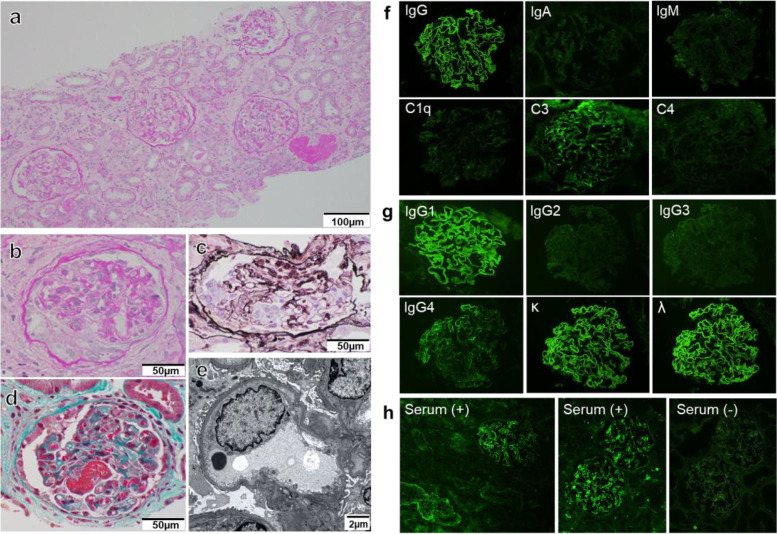
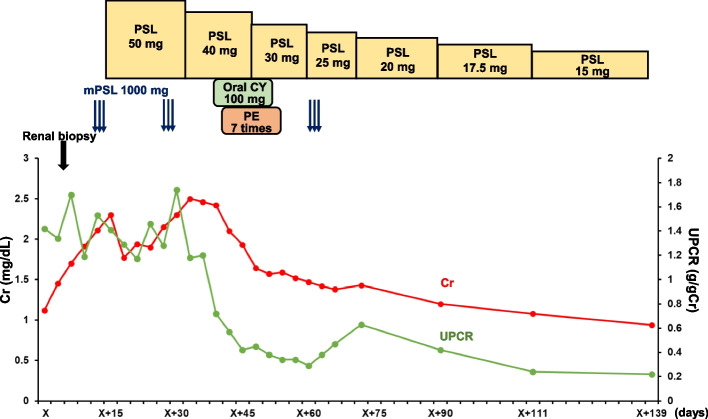
A 43-year-old Japanese woman was admitted to our hospital complaining of hematuria that had persisted for more than one month. Serological examination revealed negativity for anti-nuclear, anti-neutrophilic cytoplasmic, and anti-GBM antibodies. However, renal biopsy showed cellular crescents. Immunofluorescence revealed strong diffuse linear capillary loop staining for IgG. An indirect immunofluorescence antibody method was performed by applying the patient serum to normal kidney tissue to confirm the presence of autoantibodies binding to the GBM. Using this method, anti-GBM antibodies were detected. The patient was treated with high-dose steroids, cyclophosphamide, and plasma exchange. Aggressive treatment resolved proteinuria and hematuria and improved renal function.
Renal biopsy is crucial in the diagnosis of anti-GBM disease, especially when serological tests are negative. Accurately identifying the presence of anti-GBM disease is important to initiate optimal treatment.
抗肾小球基底膜(anti-GBM)病的特征是新月体性坏死性肾小球肾炎,伴 IgG 在 GBM 中的线性沉积。经典的抗 GBM 病在临床上与快速进行性肾小球肾炎有关,伴有或不伴有肺出血。一些患者的肾脏预后较好,症状比经典抗 GBM 病更轻,称为非典型抗 GBM 病。
一名 43 岁的日本女性因持续一个月以上的血尿就诊于我院。血清学检查抗核、抗中性粒细胞胞浆和抗 GBM 抗体均为阴性。然而,肾活检显示细胞性新月体。免疫荧光显示 IgG 强烈弥漫线性毛细血管袢染色。通过将患者的血清应用于正常肾组织,采用间接免疫荧光抗体方法证实存在与 GBM 结合的自身抗体。使用该方法检测到抗 GBM 抗体。患者接受了大剂量类固醇、环磷酰胺和血浆置换治疗。积极的治疗缓解了蛋白尿和血尿,改善了肾功能。
肾活检对诊断抗 GBM 病至关重要,特别是在血清学检查为阴性时。准确识别抗 GBM 病的存在对于启动最佳治疗非常重要。