Department of Geriatrics, University Medical Center Goettingen, Waldweg 33, D-37073, Goettingen, Germany.
Department of Anatomy and Cell Biology, University Medical Center Goettingen, Kreuzbergring 36, 37075, Goettingen, Germany.
BMC Cancer. 2022 Nov 19;22(1):1193. doi: 10.1186/s12885-022-10247-6.
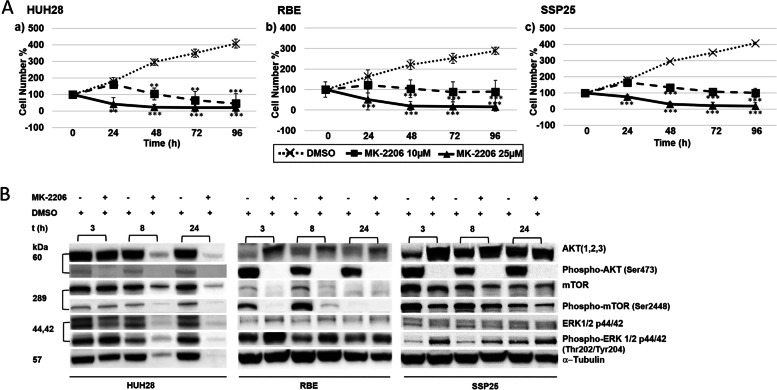
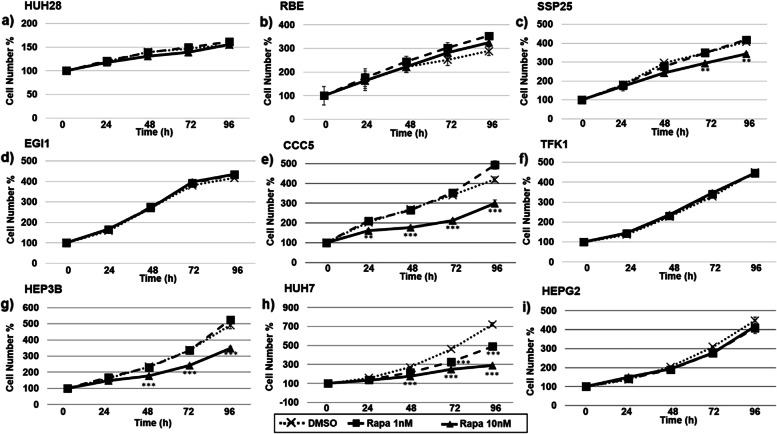
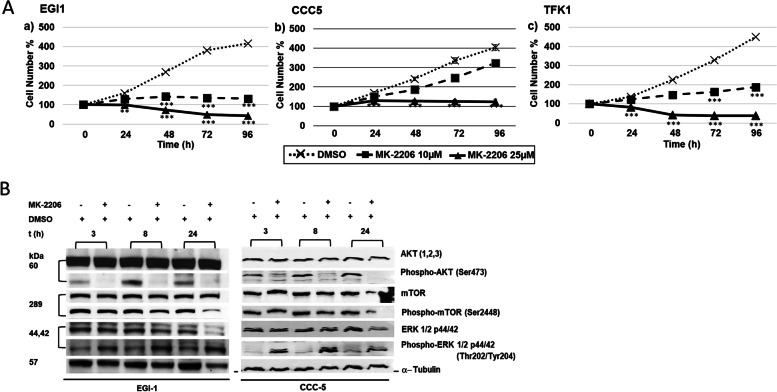
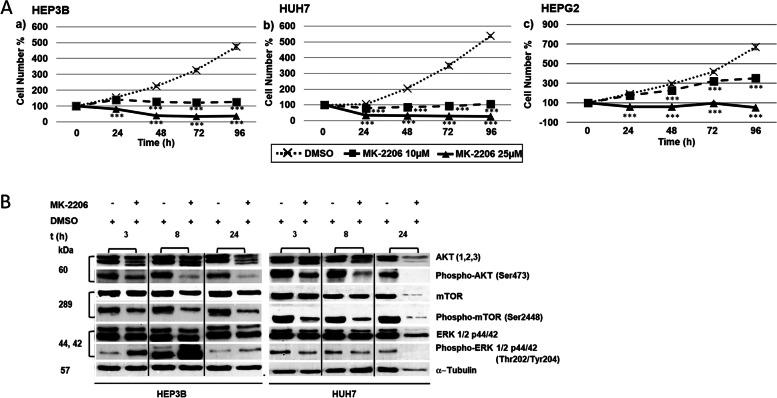
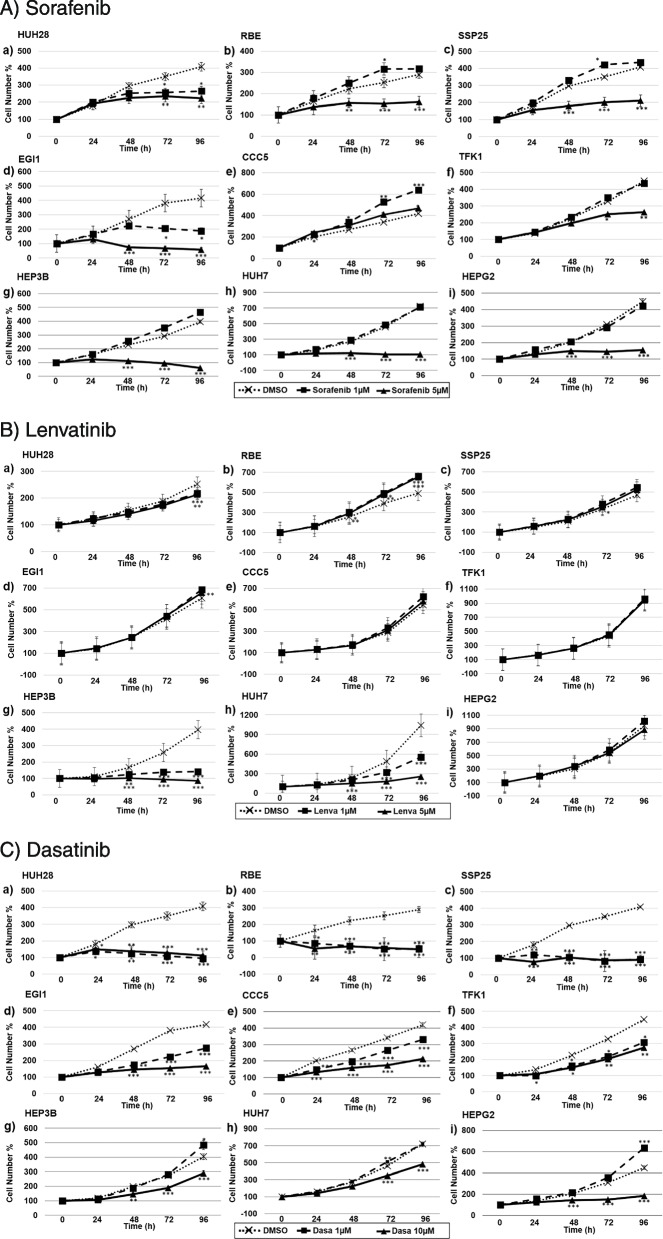
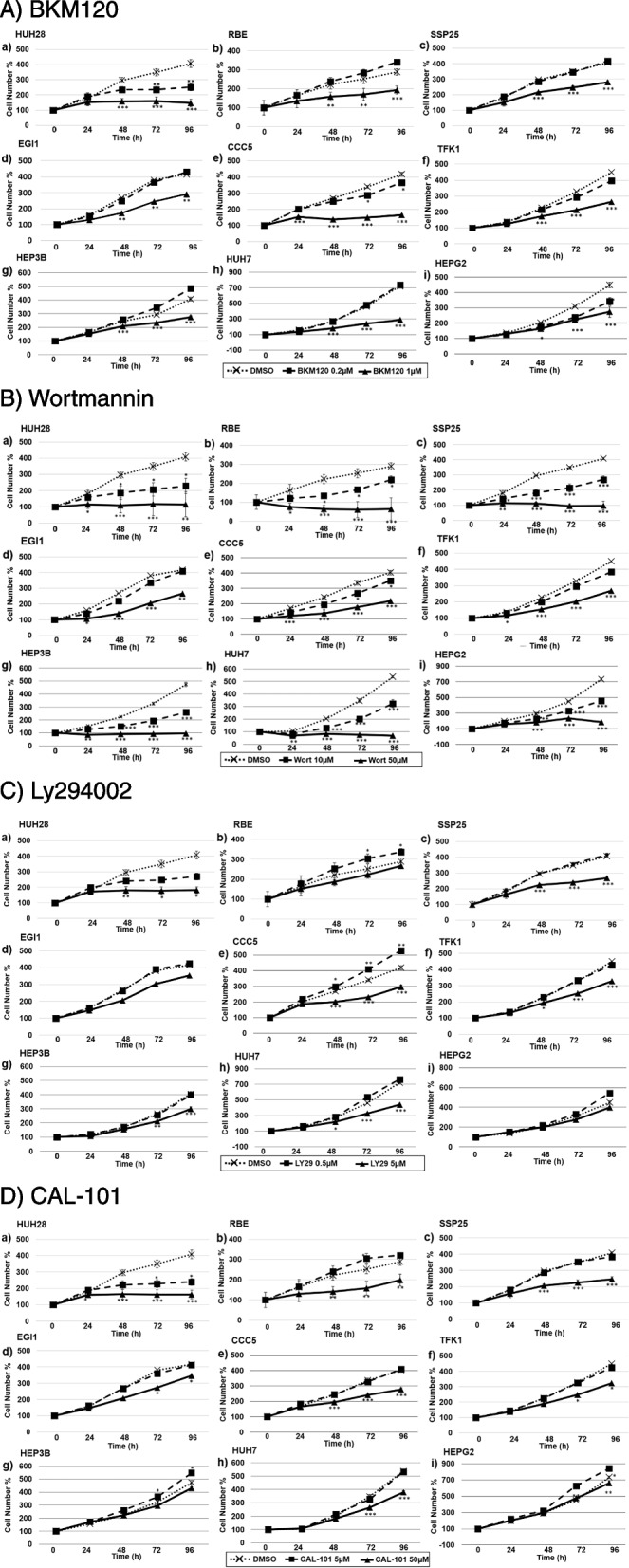
The incidence of primary liver tumors, hepatocellular carcinoma (HCC), intrahepatic cholangiocellular carcinoma (ICC), and combined HCC/ICC (cHCC/CC) is increasing. For ICC, targeted therapy exists only for a small subpopulation of patients, while for HCC, Sorafenib and Lenvatinib are in use. Diagnosis of cHCC/CC is a great challenge and its incidence is underestimated, bearing the risk of unintended non-treatment of ICC. Here, we investigated effects of targeted inhibitors on human ICC cell lines (HUH28, RBE, SSP25), in comparison to extrahepatic (E)CC lines (EGI1, CCC5, TFK1), and HCC/hepatoblastoma cell lines (HEP3B, HUH7, HEPG2). Cells were challenged with: AKT inhibitor MK-2206; multikinase inhibitors Sorafenib, Lenvatinib and Dasatinib; PI3-kinase inhibitors BKM-120, Wortmannin, LY294002, and CAL-101; and mTOR inhibitor Rapamycin. Dosage of the substances was based on the large number of published data of recent years. Proliferation was analyzed daily for four days. All cell lines were highly responsive to MK-2206. Thereby, MK-2206 reduced expression of phospho(p)-AKT in all ICC, ECC, and HCC lines, which mostly corresponded to reduction of p-mTOR, whereas p-ERK1/2 was upregulated in many cases. Lenvatinib showed inhibitory effects on the two HCC cell lines, but not on HEPG2, ICCs and ECCs. Sorafenib inhibited proliferation of all cells, except the ECC line CCC5. However, at reduced dosage, we observed increased cell numbers in some ICC experiments. Dasatinib was highly effective especially in ICC cell lines. Inhibitory effects were observed with all four PI3-kinase inhibitors. However, cell type-specific differences were also evident here. Rapamycin was most effective in the two HCC cell lines. Our studies show that the nine inhibitors differentially target ICC, ECC, and HCC/hepatoblastoma lines. Caution should be taken with Lenvatinib and Sorafenib administration in patients with cHCC/CC as the drugs may have no effects on, or might even stimulate, ICC.
原发性肝肿瘤、肝细胞癌 (HCC)、肝内胆管细胞癌 (ICC) 和 HCC/ICC 混合型 (cHCC/CC) 的发病率正在上升。对于 ICC,只有一小部分患者可以接受靶向治疗,而对于 HCC,索拉非尼和仑伐替尼正在使用中。cHCC/CC 的诊断是一个巨大的挑战,其发病率被低估,存在 ICC 治疗不及时的风险。在这里,我们研究了靶向抑制剂对人 ICC 细胞系 (HUH28、RBE、SSP25) 的影响,并与肝外 (E)CC 细胞系 (EGI1、CCC5、TFK1) 和 HCC/肝母细胞瘤细胞系 (HEP3B、HUH7、HEPG2) 进行了比较。细胞受到以下物质的挑战:AKT 抑制剂 MK-2206;多激酶抑制剂索拉非尼、仑伐替尼和 Dasatinib;PI3-激酶抑制剂 BKM-120、Wortmannin、LY294002 和 CAL-101;和 mTOR 抑制剂 Rapamycin。物质的剂量基于近年来大量发表的数据。在四天内每天分析细胞增殖情况。所有细胞系对 MK-2206 高度敏感。因此,MK-2206 降低了所有 ICC、ECC 和 HCC 细胞系中磷酸化 (p)-AKT 的表达,这主要对应于 p-mTOR 的减少,而在许多情况下,p-ERK1/2 被上调。仑伐替尼对两种 HCC 细胞系有抑制作用,但对 HEPG2、ICC 和 ECC 没有作用。索拉非尼抑制了所有细胞的增殖,除了 ECC 细胞系 CCC5。然而,在较低剂量下,我们在一些 ICC 实验中观察到细胞数量增加。Dasatinib 对 ICC 细胞系特别有效。四种 PI3-激酶抑制剂都有抑制作用。然而,这里也存在细胞类型特异性差异。Rapamycin 对两种 HCC 细胞系最有效。我们的研究表明,这九种抑制剂对 ICC、ECC 和 HCC/肝母细胞瘤细胞系有不同的作用。在 cHCC/CC 患者中使用仑伐替尼和索拉非尼时应谨慎,因为这些药物可能对 ICC 没有作用,甚至可能刺激 ICC。